Environmental protection equipment supplier

Industrial Wet Scrubber Tower
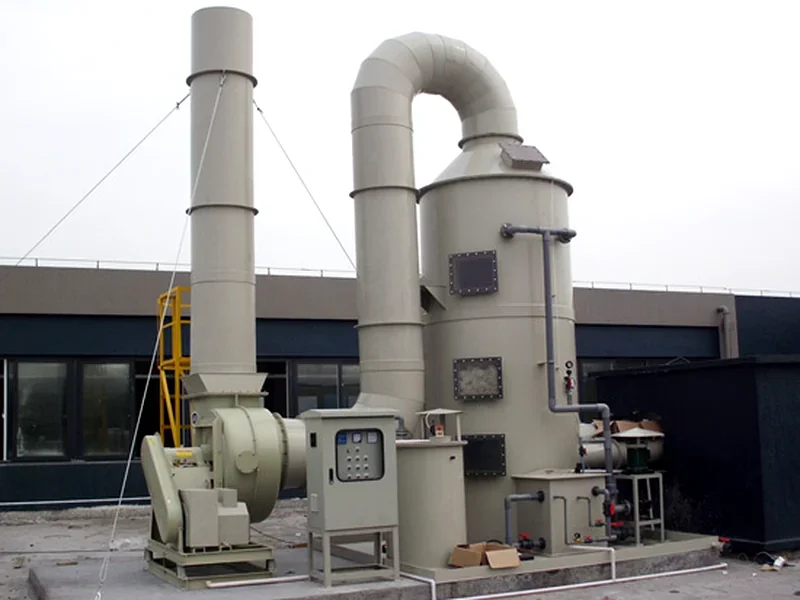
Packed bed, spray, and venturi scrubber designs for acid gas treatment, alkaline fume removal, and particulate dust collection. Counter-current gas-liquid contact achieves 90-99% removal efficiency across a wide range of industrial emissions.
99%
Max Efficiency
80,000
m3/h Air Volume
3
Spray Stages
800 Pa
Max Pressure Drop
0.5-3.5
Tower Diameter (m)
80°C
Max Gas Temp
10+
Tower Models
3
Scrubber Types
1-3
Spray Stages
24h
Quote Response
Overview
Wet Scrubbing Technology for Industrial Emission Control
Wet scrubbers use a liquid — typically water or a chemical solution — to absorb, neutralize, and capture pollutants from industrial exhaust gas.
The wet scrubber tower is a vertical cylindrical vessel where polluted gas and scrubbing liquid make intimate contact through counter-current flow. Gas enters from the bottom and flows upward through packing media, while scrubbing liquid sprays downward from nozzles at the top. This opposite-direction flow maximizes the contact surface area and mass transfer efficiency.
As the gas rises through the packing bed, pollutants transfer from the gas phase to the liquid phase. Acid gases are neutralized by alkaline solutions (NaOH), alkaline fumes by acid solutions (H2SO4), and dust particles are captured by water droplets. The cleaned gas passes through a demister to remove entrained liquid droplets before exiting to atmosphere.
Wet scrubbers are the workhorse of industrial air pollution control — versatile enough to handle acidic gases, alkaline vapors, particulate matter, and even some VOCs in a single treatment stage. They are widely deployed in electroplating, chemical synthesis, semiconductor fabrication, battery production, and metallurgical processes.
HCl (Hydrochloric acid gas)
HF (Hydrofluoric acid gas)
H2SO4 (Sulfuric acid mist)
HNO3 (Nitric acid fume)
NaOH (Caustic mist)
NH3 (Ammonia gas)
SO2 (Sulfur dioxide)
Dust & particulate matter
How It Works
Counter-Current Gas-Liquid Contact
The counter-current design is the key to high removal efficiency in packed bed scrubbers.
Clean Gas Outlet
Treated gas exits to atmosphere
↓
Demister Layer
Removes liquid droplets
↓
Spray Nozzles (Layer 2)
Upper spray distribution
↓
Packing Bed (Upper)
PP Pall rings / saddles
↓
Spray Nozzles (Layer 1)
Lower spray distribution
↓
Packing Bed (Lower)
Mass transfer zone
↑
Gas Inlet
Polluted gas enters tangentially
Why Counter-Current Flow?
In a counter-current scrubber, gas and liquid flow in opposite directions. This creates a concentration gradient that drives mass transfer — the cleanest liquid contacts the cleanest gas at the top, while the most concentrated liquid contacts the dirtiest gas at the bottom.
This design is more efficient than co-current flow (same direction) because it maintains a driving force for mass transfer throughout the entire packing bed. The result: higher removal efficiency at lower liquid flow rates.
- Gas phase: Polluted gas enters at the bottom, flows upward through packing media
- Liquid phase: Scrubbing liquid sprays from the top, flows downward by gravity
- Packing media: PP Pall rings or saddles create large surface area for gas-liquid contact
- Demister: Mist eliminator at the top removes liquid droplets from clean gas
- Sump: Bottom section collects spent scrubbing liquid for recirculation or discharge
Liquid Selection
Scrubbing Liquid Selection Guide
The scrubbing liquid is selected based on the target pollutant. Different pollutants require different chemical solutions for effective absorption and neutralization.
| Target Pollutant | Scrubbing Liquid | Reaction Product | Typical Efficiency |
|---|---|---|---|
| HCl (Hydrochloric acid) | NaOH 5-10% solution | NaCl + H2O | 95-99% |
| HF (Hydrofluoric acid) | NaOH 5-10% solution | NaF + H2O | 95-99% |
| H2SO4 (Sulfuric acid mist) | NaOH 5-10% solution | Na2SO4 + H2O | 95-99% |
| HNO3 (Nitric acid fume) | NaOH 5-10% solution | NaNO3 + H2O | 90-95% |
| NH3 (Ammonia gas) | H2SO4 5-10% solution | (NH4)2SO4 | 95-99% |
| SO2 (Sulfur dioxide) | NaOH or Ca(OH)2 | Na2SO3 or CaSO3 | 90-95% |
| Dust & particulates | Water (plain) | Sludge | 85-95% |
| VOCs (water-soluble) | Water or specialized | Dilute solution | 70-90% |
Packing Media
Packing Materials for Scrubber Towers
Each packing type has specific advantages for different gas compositions and operating conditions.
PP Pall Rings
The most common and cost-effective packing. Open-ring structure provides excellent mass transfer with moderate pressure drop. Suitable for most acid and alkaline gas applications.
Low cost
Good mass transfer
PP material
PP Hollow Balls
Lightweight hollow spheres that resist clogging and are self-cleaning. Ideal for dust-laden gas streams where Pall rings might accumulate particulate matter.
Self-cleaning
Anti-clogging
For dusty gas
SS316 Spiral Packing
Stainless steel spiral packing for high-temperature or highly corrosive environments. Superior mechanical strength and durability for demanding industrial applications.
High temp resistant
SS316 material
Long lifespan
Comparison
Packed Bed vs Spray Tower vs Venturi
Three scrubber designs for different pollutant types, dust loading, and efficiency requirements.
| Parameter | Packed Bed Scrubber | Spray Tower | Venturi Scrubber |
|---|---|---|---|
| Best For | Acid / alkaline gas | High-dust gas | Fine dust & fumes |
| Removal Efficiency | 90-99% | 85-95% | 90-98% (dust) |
| Packing Media | PP Pall rings | None | Venturi throat |
| Pressure Drop | 400-800 Pa | 200-400 Pa | 800-2000 Pa |
| Clogging Risk | Medium | Low | Low |
| Particle Capture | >5 um | >10 um | 0.1-5 um |
| Maintenance | Medium | Low | Medium |
| Relative Cost | Medium | Low | Higher |
Gallery
Project Gallery
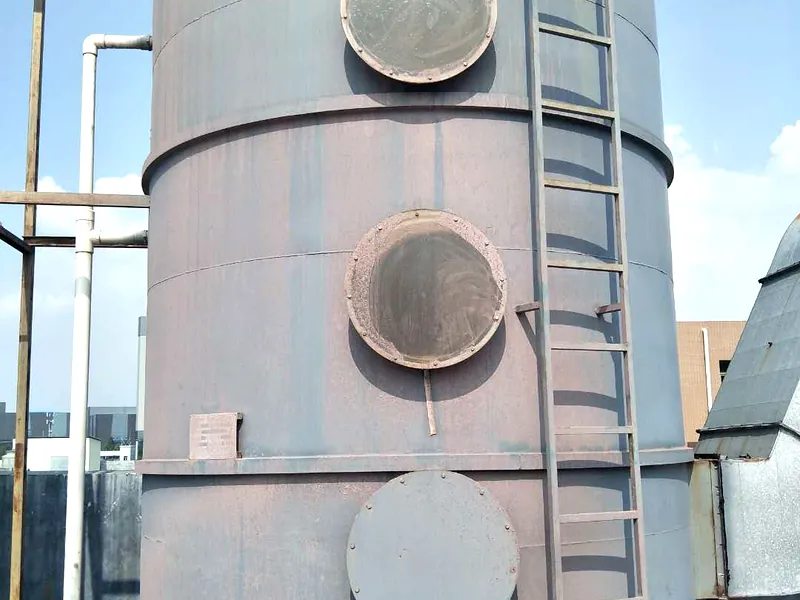
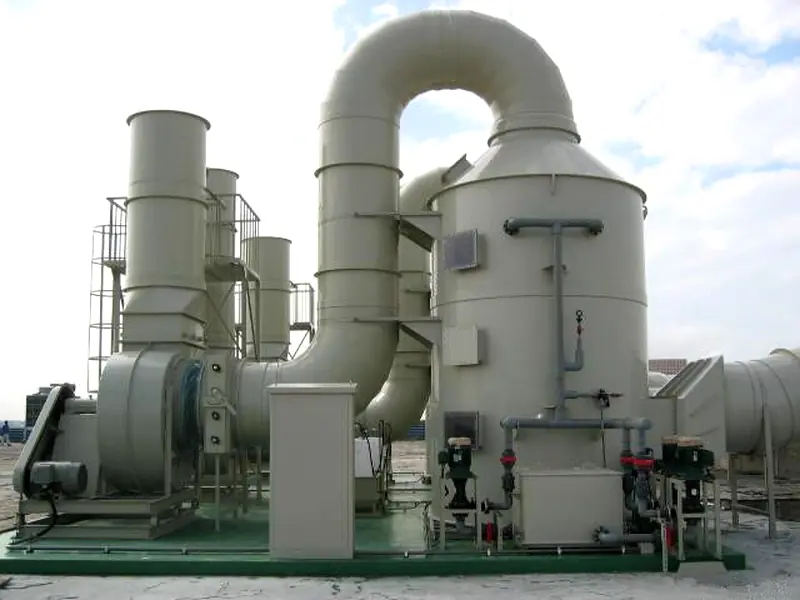
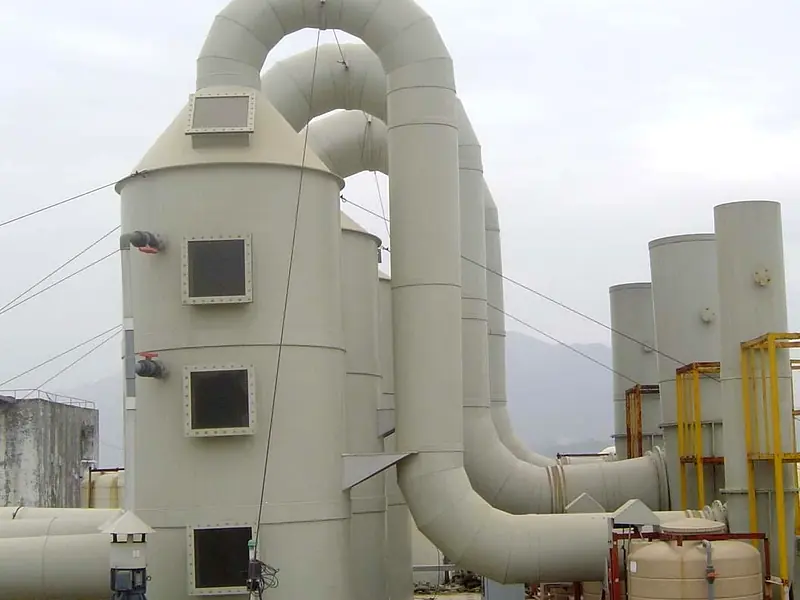
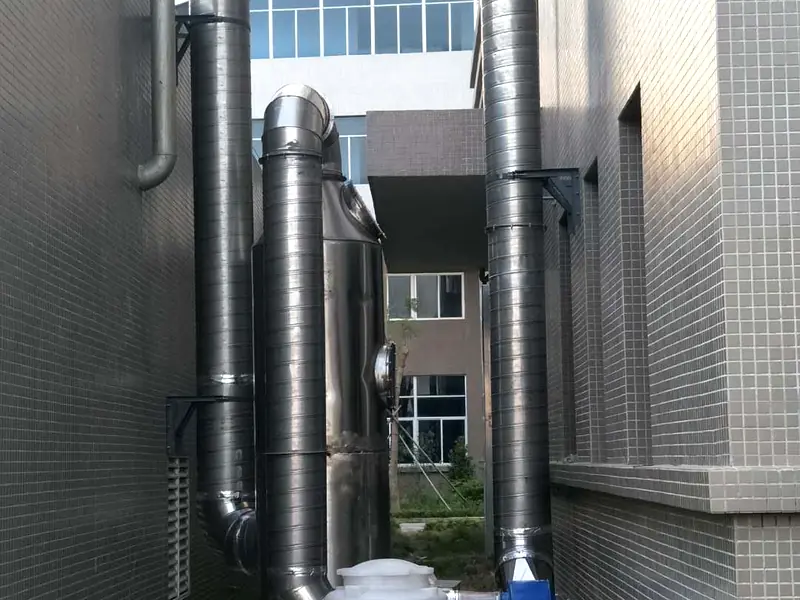
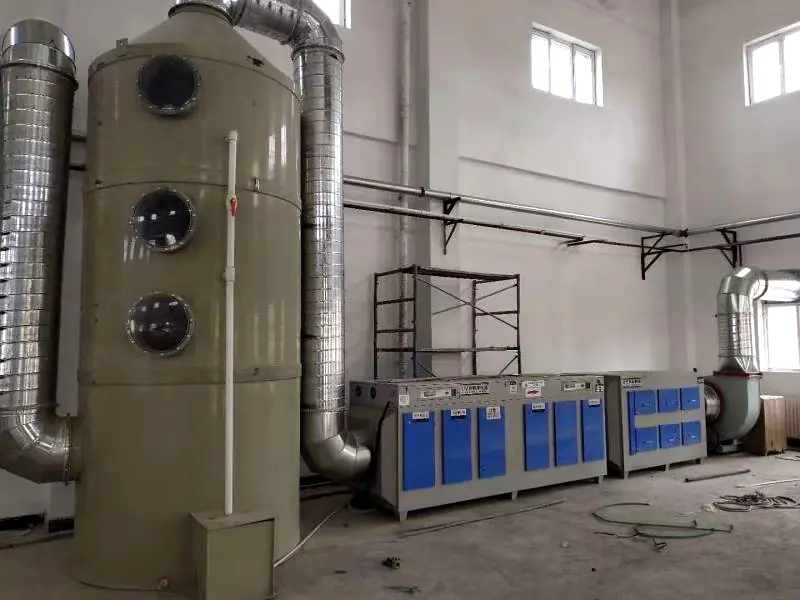
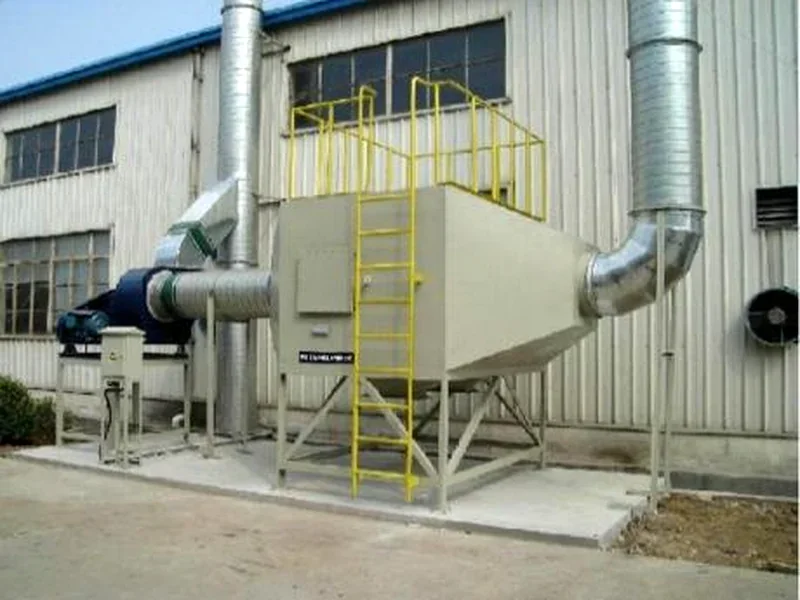
Real wet scrubber installation photos from our industrial projects.
What Is
What Is a Wet Scrubber Tower?
A wet scrubber tower is an industrial air pollution control device that removes pollutants from exhaust gas by bringing it into intimate contact with a scrubbing liquid. The tower is a vertical cylindrical vessel filled with packing media that creates a large surface area for gas-liquid contact.
Polluted gas enters from the bottom of the tower and flows upward through the packing bed. Simultaneously, scrubbing liquid — water, NaOH solution, or acid solution depending on the target pollutant — sprays from nozzles at the top and flows downward by gravity. This counter-current flow maximizes mass transfer efficiency.
Wet scrubbers are widely used in electroplating, chemical synthesis, semiconductor manufacturing, battery production, metallurgy, and waste incineration. They are especially valued for their ability to handle high-temperature gas, simultaneously remove multiple pollutant types, and operate safely with combustible dusts due to the inherent fire suppression of water.
Key Benefits
Why Choose a Wet Scrubber Tower
Four advantages that make wet scrubbers the first choice for acid gas and dust treatment.
01
High Removal Efficiency
Achieves 90-99% removal efficiency for acid gases (HCl, HF, H2SO4), alkaline fumes (NH3), and dust particles. Multi-stage designs with 2-3 spray layers can achieve even higher performance for stringent emission standards.
02
Handles High Temperatures
Suitable for hot gas streams up to 80°C (PP) or higher (SS316). The scrubbing liquid simultaneously cools the gas while removing pollutants. No pre-cooling system needed for most applications, reducing overall system complexity.
03
Multi-Pollutant Removal
Simultaneously removes acid gases, alkaline fumes, dust particles, and some water-soluble VOCs in a single treatment stage. One system handles multiple pollution problems — reducing equipment count and footprint.
04
Inherently Safe Operation
Because the system uses water as the primary scrubbing medium, there is virtually no fire or explosion risk. Safe for use with flammable or combustible dusts where dry collectors would require special explosion protection.
Types
Three Scrubber Tower Designs
Different tower designs for different pollutant types, dust loading, and efficiency requirements.
Packed Bed
Packed Tower Scrubber
Filled with PP Pall rings or saddles that create a large surface area for gas-liquid contact. The most common and efficient design for acid and alkaline gas treatment.
- High mass transfer efficiency
- 90-99% removal rate
- PP Pall rings / saddle packing
- For acid / alkaline gas
- Moderate dust tolerance
Spray Tower
Spray Tower Scrubber
Uses spray nozzles only, without packing media. Lower pressure drop and less prone to clogging — ideal for high-dust gas streams where packed beds would foul.
- No packing, no clogging
- 85-95% removal rate
- Low pressure drop
- For high-dust gas streams
- Easy maintenance
Venturi
Venturi Scrubber
Uses a venturi throat to accelerate gas, atomizing scrubbing liquid into fine droplets. Excellent for sub-micron dust and fume particles.
- High dust capture efficiency
- Captures 0.1-10 um particles
- Higher pressure drop
- For fine dust & fumes
- Compact design
Applications
Industries We Serve
Wet scrubber towers are deployed across a wide range of industrial sectors.
Electroplating
Acid mist & chrome vapor
Acid Pickling
HCl & H2SO4 fume control
Chemical Plant
Process emission treatment
Semiconductor
Cleanroom exhaust gas
Battery Mfg
Electrolyte & solvent vapor
Fertilizer Plant
NH3 & acid gas removal
Metallurgy
Furnace off-gas treatment
Waste Incineration
Acid gas & dust control
Specifications
Technical Specifications
Detailed technical parameters for our wet scrubber tower systems.
| Parameter | Packed Bed (WS-P) | Spray Tower (WS-S) | Venturi (WS-V) |
|---|---|---|---|
| Model | WS-P-1000 to WS-P-80000 | WS-S-1000 to WS-S-80000 | WS-V-1000 to WS-V-50000 |
| Air Volume | 1,000-80,000 m3/h | 1,000-80,000 m3/h | 1,000-50,000 m3/h |
| Tower Diameter | 0.5-3.5 m | 0.6-4.0 m | 0.4-2.0 m |
| Packing Height | 800-2000 mm | N/A | N/A |
| Spray Layers | 1-3 | 2-4 | 1-2 |
| Liquid-Gas Ratio | 1-3 L/m3 | 2-4 L/m3 | 0.5-1.5 L/m3 |
| Pressure Drop | 400-800 Pa | 200-400 Pa | 800-2000 Pa |
| Efficiency | 90-99% | 85-95% | 90-98% |
| Material | PP / FRP / SS304 / SS316 | PP / FRP / SS304 | SS304 / SS316 |
| Max Gas Temp | 80°C (PP) / 200°C (SS) | 80°C (PP) / 200°C (SS) | 200°C+ |
Custom Solutions
Custom Design & OEM Options
Every scrubber is custom-sized based on your gas flow rate, pollutant type, and concentration. We select the right tower material, packing media, and spray configuration for your specific application.
PP / FRP / SS304 / SS316 materials
1-3 spray stage configurations
pH-controlled chemical dosing
Demister & mist eliminator
Water recirculation systems
OEM branding & packaging
FAQ
Frequently Asked Questions
Common questions about wet scrubber tower systems for industrial gas treatment.
What materials are wet scrubber towers made of?
We offer several material options depending on your gas composition and temperature: PP (polypropylene) for most acid gas applications up to 80°C, FRP (fiberglass reinforced plastic) for higher strength and corrosion resistance, and SS304 or SS316 stainless steel for high-temperature or special applications. Our engineers will recommend the best material for your conditions.
How much water does a wet scrubber use?
Wet scrubbers typically use 1-3 liters of scrubbing liquid per cubic meter of gas (L/m3). Most systems recirculate the water, so makeup water is only needed to replace what evaporates or is discharged for sludge removal. The actual water consumption depends on your gas temperature and humidity.
How often do I need to clean or maintain the scrubber?
Routine maintenance includes checking pump operation weekly, inspecting spray nozzles monthly, and checking packing condition every 3-6 months. For dusty applications, the sump may need periodic sludge removal. We provide a detailed maintenance schedule with every system and can also supply replacement parts.
Can a wet scrubber handle both acid gas and dust?
Yes, wet scrubbers simultaneously remove both gaseous pollutants (acid/alkaline gases) and particulate matter (dust). However, very high dust loading can clog packing media. For dusty applications, we may recommend a spray tower design or a pre-filter before a packed tower to prevent clogging.
Get a Quote
WhatsApp
+86 18653221918
Request Your Wet Scrubber Tower Quote
Tell us your gas composition, flow rate, and temperature. We’ll design the right tower size, material, and configuration for your application.
Get Your Free Quote
Fill in the form and we’ll respond within 24 hours.
Need a Wet Scrubber Tower?
Send us your gas composition and volume. We’ll design the right tower diameter, packing, and spray configuration.