Environmental protection equipment supplier

Industrial waste gas treatment systems, sized to your gas stream
Soto Machinery is a Qingdao manufacturer of exhaust gas purification equipment. We engineer systems for VOCs, acid mist, dust, oil mist and odour, then ship them factory-direct to industrial plants and EPC contractors worldwide.
We build eight core technologies and combine them when one stage is not enough. You start with gas composition, airflow and the emission limit you must meet — not with a product catalogue.
You receive a written selection note and a preliminary layout drawing. No obligation, no sales call first.
8treatment technologies, built in one factory
5pollutant families handled
1enquiry-to-acceptance path, step by step
Selection logic
Start with your gas, not with our catalogue
Most enquiries stall at the first step. A buyer asks for “a scrubber” when the real problem is a mist-loaded, high-humidity stream, or asks for activated carbon when the VOC concentration would make bed replacement uneconomic. In practice, the gas decides the technology — you do not pick it from a price list.
Five inputs that matter most
Before we quote, we ask for five things: the pollutants and their rough concentration, the airflow in m³/h, the gas temperature and humidity, the space you have for ductwork and equipment, and the emission or odour limit your authority will measure against. With those five inputs, an engineer can usually narrow eight technologies down to one primary route plus, at most, one polishing stage. Without them, any price is a guess and any guarantee means nothing.
That is why we publish the decision logic below instead of a list of best sellers. It also lets your own design institute or EHS team challenge our reasoning before money changes hands.
Match the pollutant to the route
VOCs and solvent vapours
Activated carbon adsorption, or UV photolysis for low-concentration odour streams
Bed life and empty-bed contact time decide whether carbon stays affordable.
Acid mist and soluble inorganic gases
Packed-bed wet scrubber with neutralising liquor
Liquid chemistry does the work; material choice follows the acid and temperature.
Dust and particulate
Baghouse dust collector, sometimes after a cyclone or spray pre-conditioning
Filtration velocity and cleaning cycle matter more than a nominal efficiency figure.
Oil mist and cooking fume
Electrostatic oil fume purifier with wash-down
Droplet size and grease load set the plate spacing and cleaning frequency.
Specification
Engineering specifications you can audit
A supplier who quotes “up to 99% removal” without stating the conditions has handed you a marketing number, not a specification. The table below shows the indicative engineering envelope for each route, plus the single variable that usually decides it.
How to read this table
Treat it as a screening tool. Airflow ranges, materials and removal bands are typical for custom-built industrial systems, and we confirm them in the selection note for your project. Pressure drop is the most useful number for estimating fan power — and fan power is usually the largest part of operating cost over five years. Consumable intervals matter just as much: an adsorption unit that looks cheap at purchase can become expensive if you change the carbon bed every few weeks because the inlet concentration turned out lower than expected. We state these dependencies up front so you can compare competing quotations on the same basis.
The engineering envelope, route by route
| Technology | Typical airflow | Main materials | Deciding variable | Consumable / service interval |
|---|---|---|---|---|
| UV photolysis purifier | 2,000–60,000 m³/h | SS304 / galvanised steel | Residence time, humidity | Lamp replacement, checked annually |
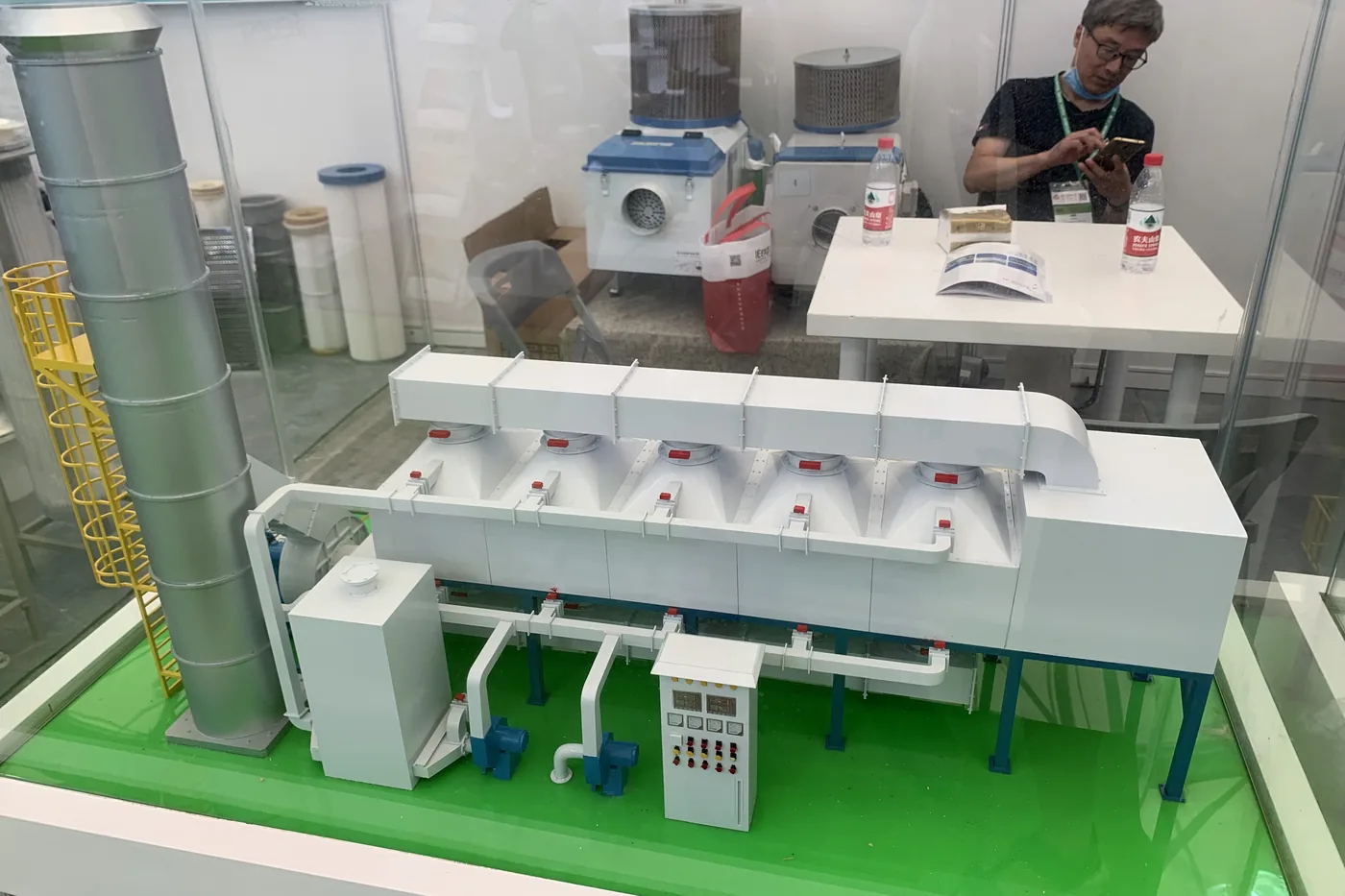
| Activated carbon adsorption | 1,000–50,000 m³/h | PP / FRP / SS304 | Inlet concentration, contact time | Carbon bed change, load dependent |
| Wet scrubber tower | 1,000–120,000 m³/h | PP / FRP / SS316L | Liquid-to-gas ratio, pH | Packing check, liquor make-up |
| Baghouse dust collector | 3,000–150,000 m³/h | Carbon steel / SS304 | Filtration velocity, dust load | Bag replacement, differential pressure |
| Spray deodorization | 1,000–80,000 m³/h | PP / FRP | Contact time, packing media | Media top-up, nozzle cleaning |
| Low-temperature plasma | 500–20,000 m³/h | SS304 / ceramic | Concentration, gas residence | Electrode service, checked annually |
| Oil fume purifier | 3,000–40,000 m³/h | SS304 | Droplet size, grease load | Plate wash-down, quarterly |
| Animal room exhaust | 1,000–60,000 m³/h | PP / SS304 | Ammonia load, air changes | Pre-filter, weekly inspection |
Ranges are indicative for planning only. The selection note confirms the values for your stream, materials and duty.
Equipment range
Waste gas treatment equipment range
Eight technologies, built and combined in one factory. Each entry below states what the equipment does well and, just as important, where it stops being the right answer.
Buyers often arrive with a technology already named in an internal specification. That specification may be right, but teams usually write it before anyone measures the gas. If your document says “activated carbon” while your stream carries acid mist at high humidity, the honest answer is to add a scrubber ahead of the carbon or change the route entirely. We would rather correct the specification at enquiry stage than deliver a system that passes factory testing and then fails the stack test.
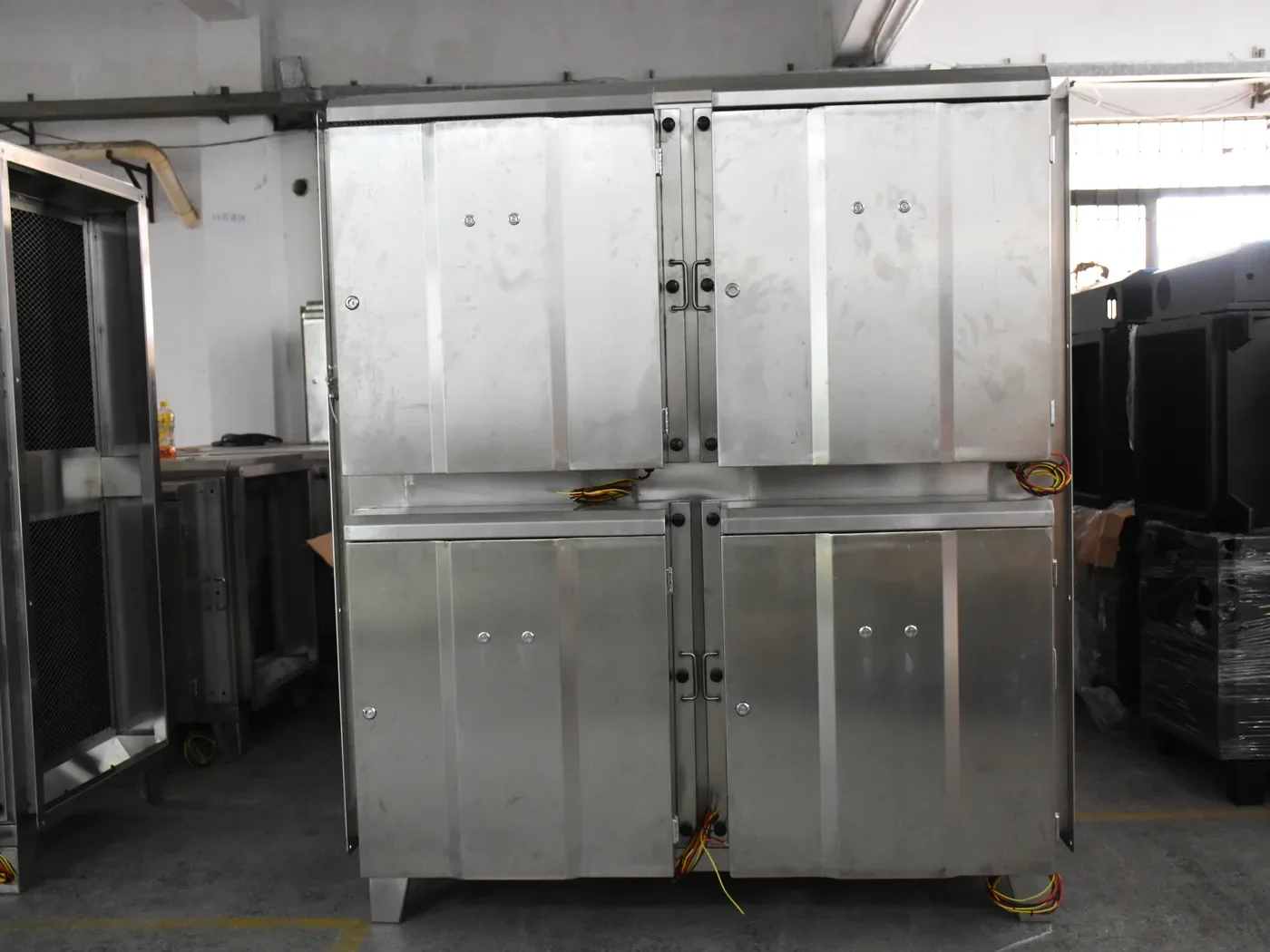
UV photolysis waste gas purifier
UV photolysis uses high-energy lamps to break down odorous and some organic molecules in a controlled reaction chamber. It suits low to moderate concentrations where the alternative would be a large carbon bed with frequent replacement, and we often install it as a polishing stage behind a scrubber. Its limits are physical rather than commercial: high humidity, heavy particulate loading and very short residence time all cut performance. That is why pre-filtration and correct duct sizing belong in the design rather than in the options list.
Lamp output falls with operating hours, so a maintenance schedule belongs in the handover documents. Where the stream contains chlorinated compounds, we check material compatibility first.
Read the purifier construction and sizing notes →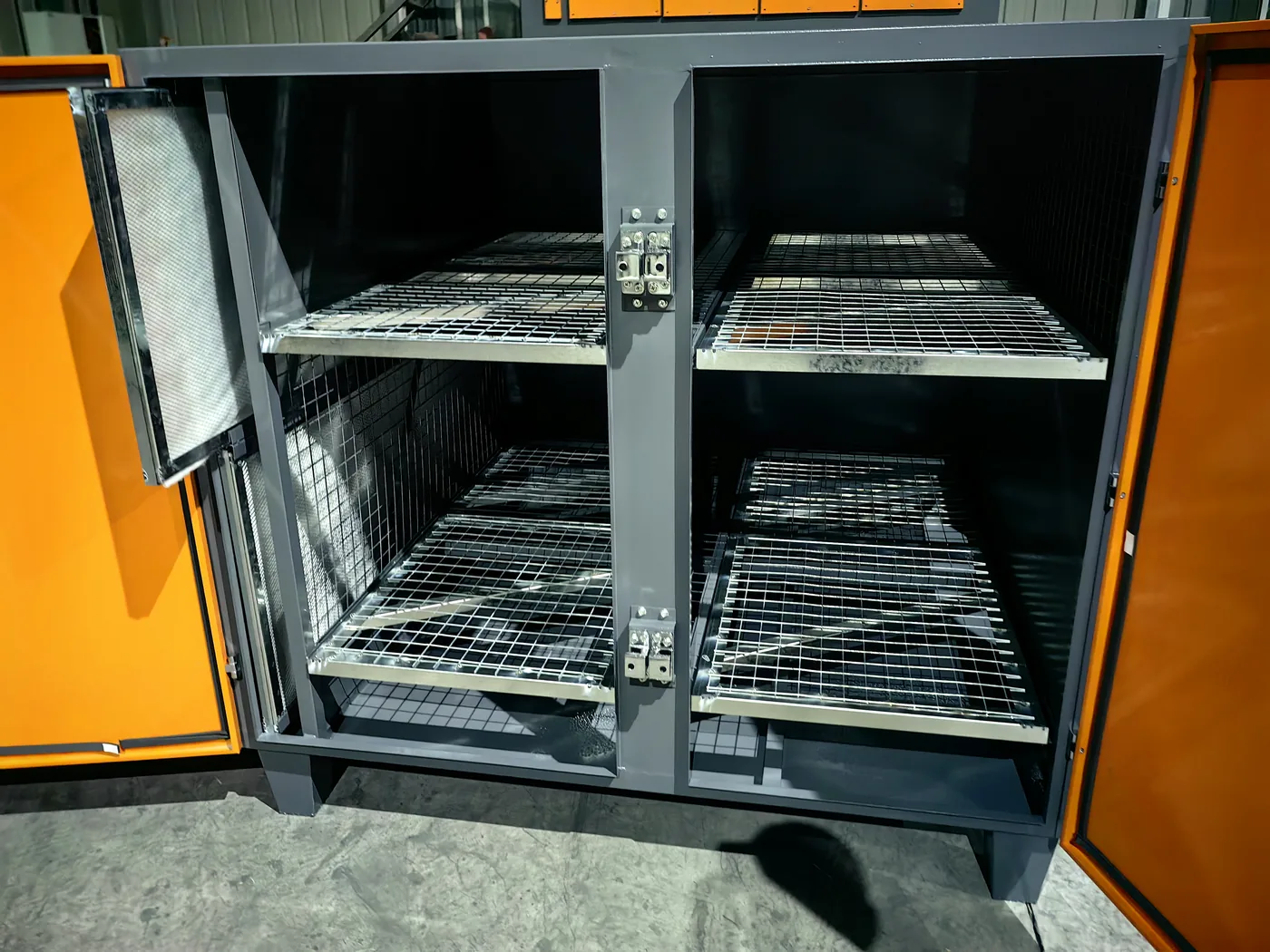
Activated carbon adsorption unit
Activated carbon catches solvent and VOC molecules on a high-surface-area bed. Because the bed is a consumable, the economics depend on inlet concentration and empty-bed contact time — we size the bed so replacement falls inside a sensible service window, not every few weeks.
We specify the housing in PP, FRP or stainless steel to match the gas, and we always ask about humidity and droplet carry-over before we commit to carbon, because both shorten bed life.
See carbon bed, housing and change-out details →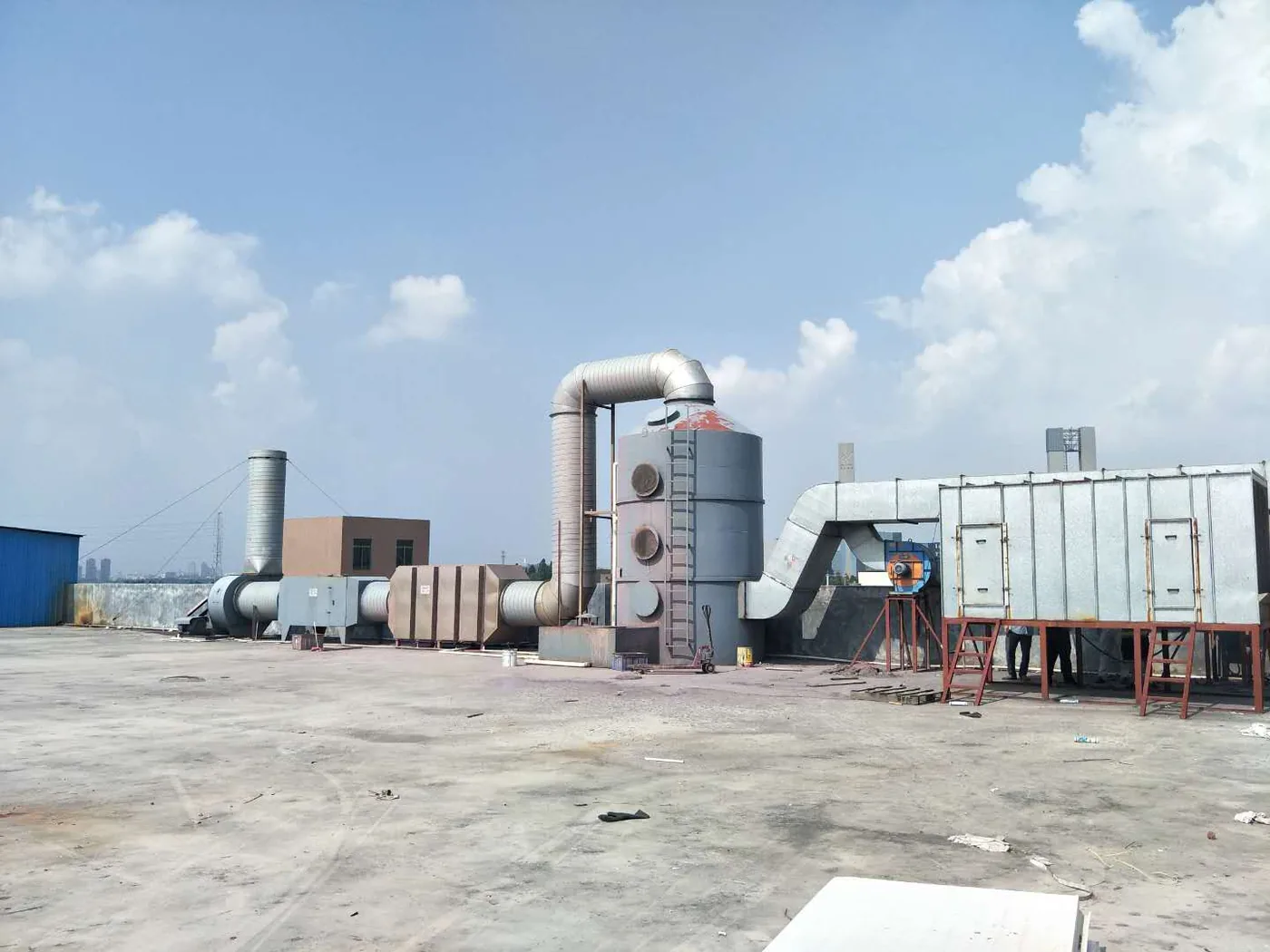
Wet scrubber tower
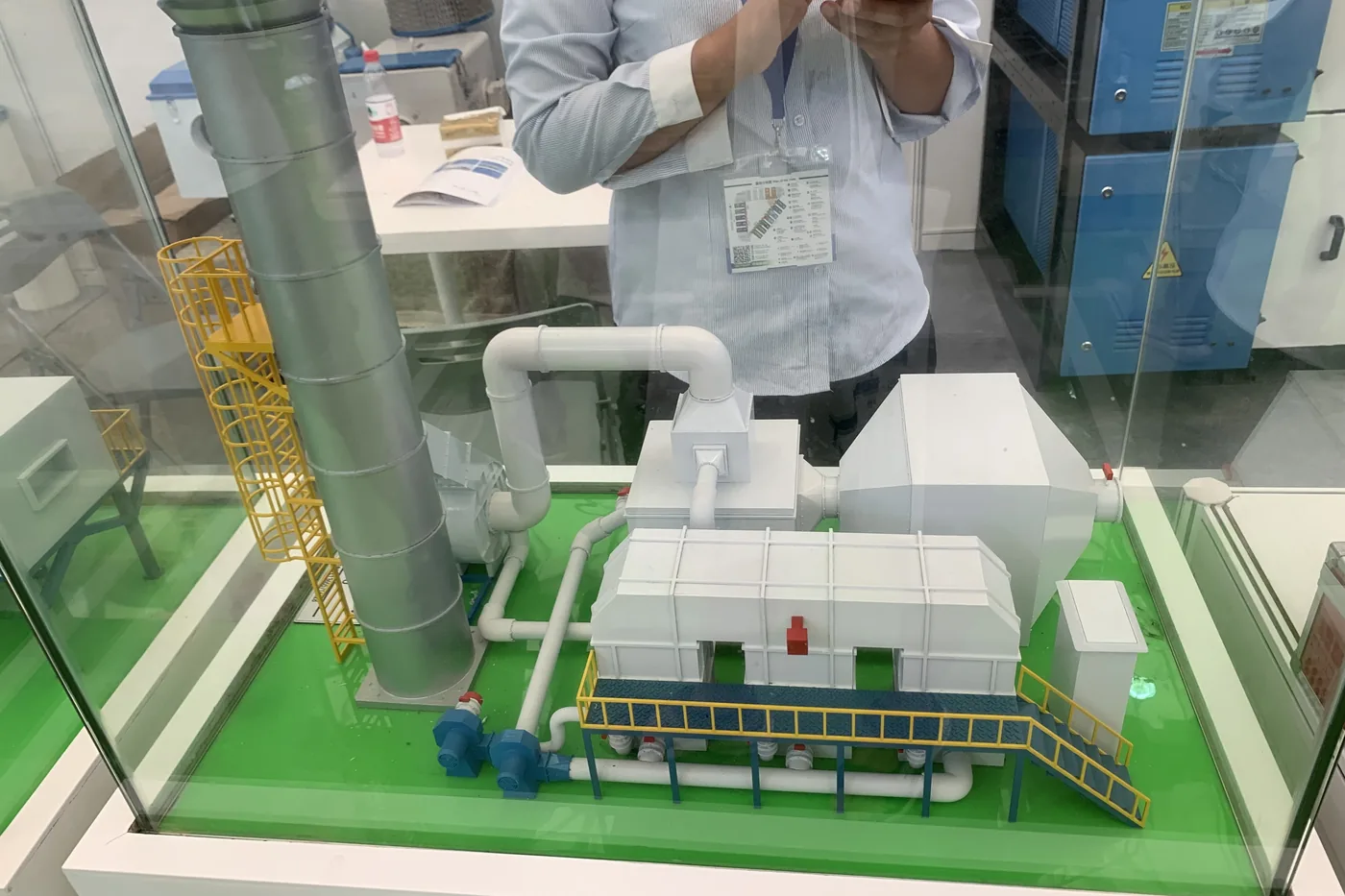
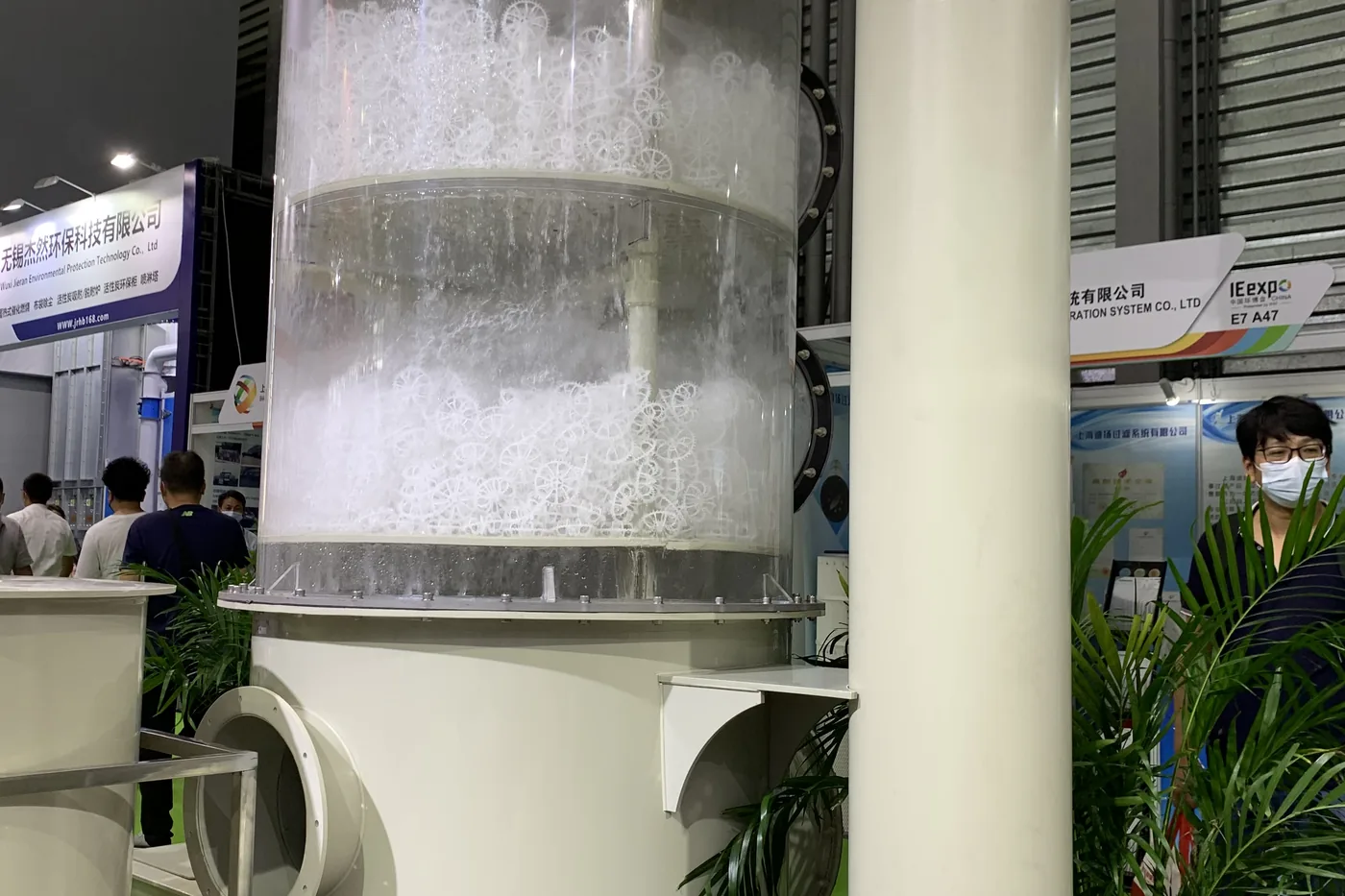
A packed-bed scrubber washes soluble gases out of the stream and neutralises them in a circulating liquor loop. You control removal by setting the liquid-to-gas ratio and the pH, so the system keeps performing even as the inlet load moves. Material selection follows the acid type and temperature — PP, FRP or SS316L depending on the chemistry.
The trade-off is a liquid side stream. Where the plant limits wastewater discharge, we add liquor treatment or a closed loop rather than pretend the water does not exist.
Review scrubber packing, pH control and materials →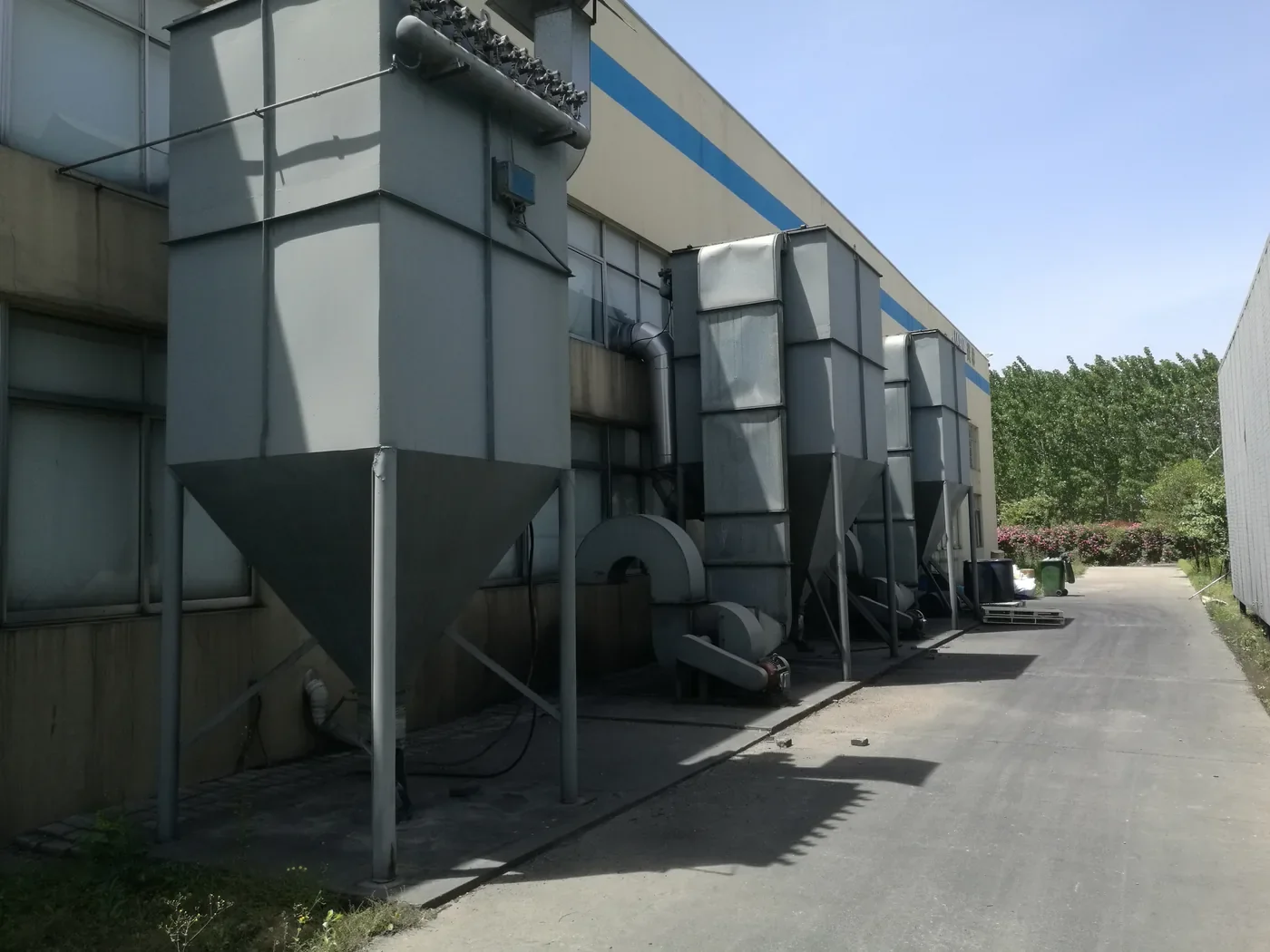
Baghouse dust collector
A baghouse traps dust on fabric filters and cleans them with a pulse-jet or reverse-air cycle. You choose the unit by filtration velocity and cleaning cycle, not by a nominal efficiency claim, because those two numbers set bag life and fan power. We add a cyclone or spray pre-conditioning stage when the inlet carries coarse, hot or sticky dust.
Where the dust is explosive or the process runs at high temperature, we size the housing and venting to match the hazard.
Compare filtration velocity and cleaning options →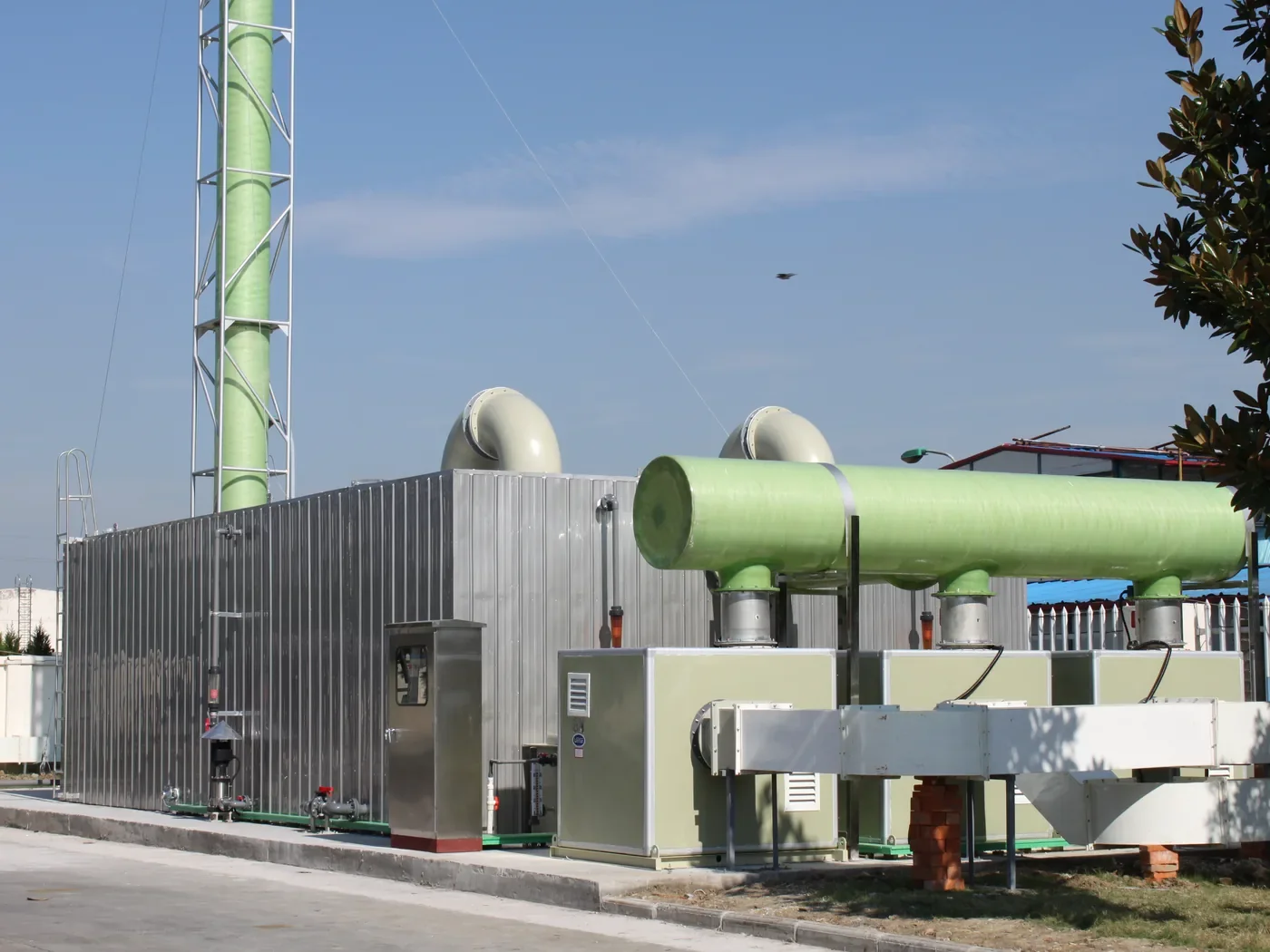
Spray deodorization system
Odour complaints usually arrive in odour units or by community response, not as a simple concentration figure. A spray deodorization system answers this by contacting the exhaust with a fine mist or packed wet stage that absorbs and neutralises odorous compounds, often downstream of a scrubber. Nozzle selection, dosing control and contact time decide whether the system holds its performance through seasonal load changes.
Because these systems often run continuously at wastewater sites, we build in pump redundancy and easy access for nozzle cleaning.
Read the odour control design guide →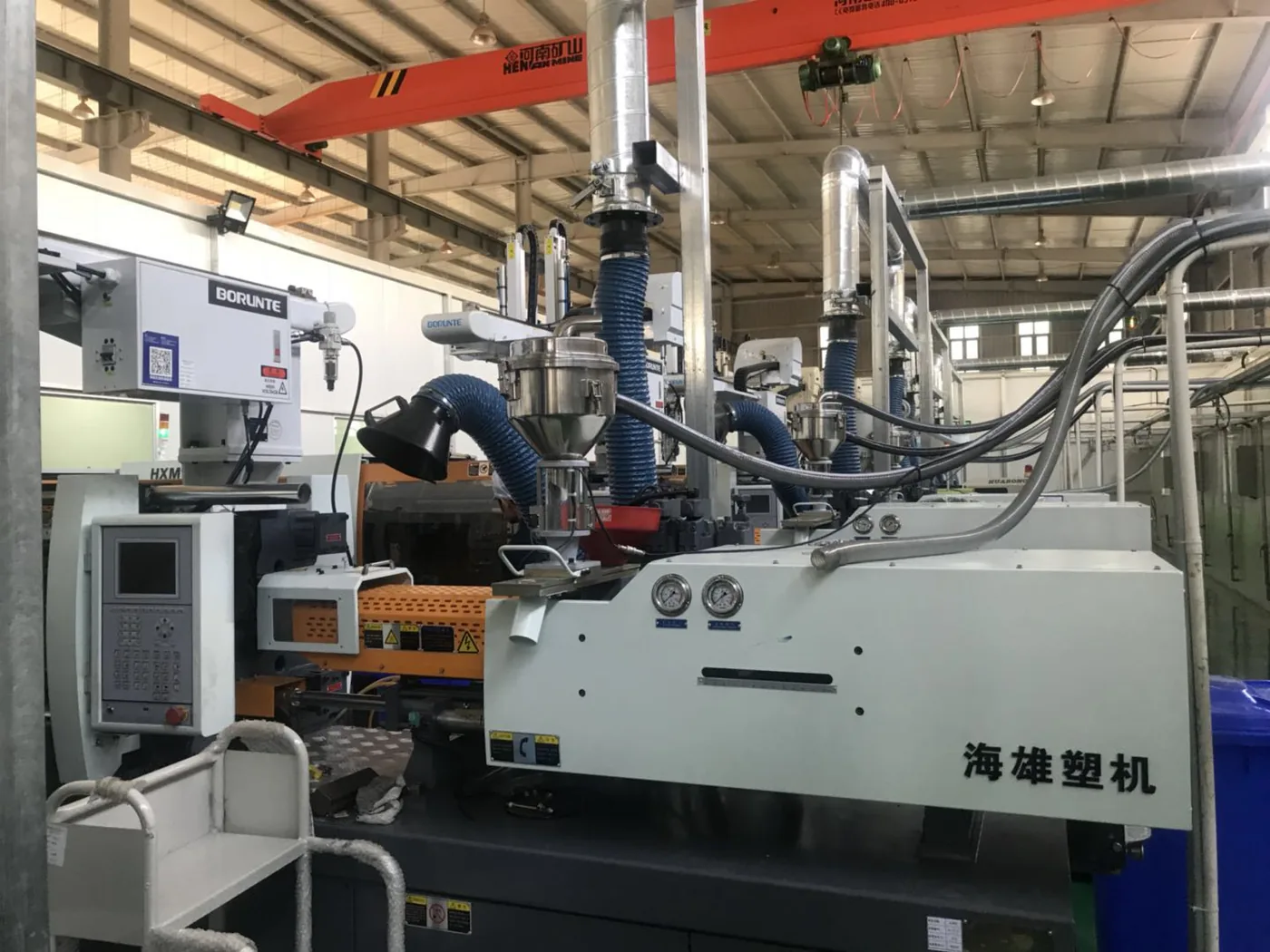
Animal room waste gas treatment
Laboratory animal room exhaust is a special case: high air-change rates, ammonia, biological aerosol and strict corrosion-resistant construction all meet in one stream. A single carbon box rarely survives this duty. A staged arrangement — pre-filtration for dander and dust, a wet or chemical stage for ammonia, then a polishing stage for residual odour — runs more reliably and is easier to maintain.
Materials must tolerate both cleaning agents and continuous humidity. Because the exhaust fan and ductwork form part of the facility’s life-safety system, we treat the whole train, not just the treatment unit.
See the multi-stage animal room arrangement →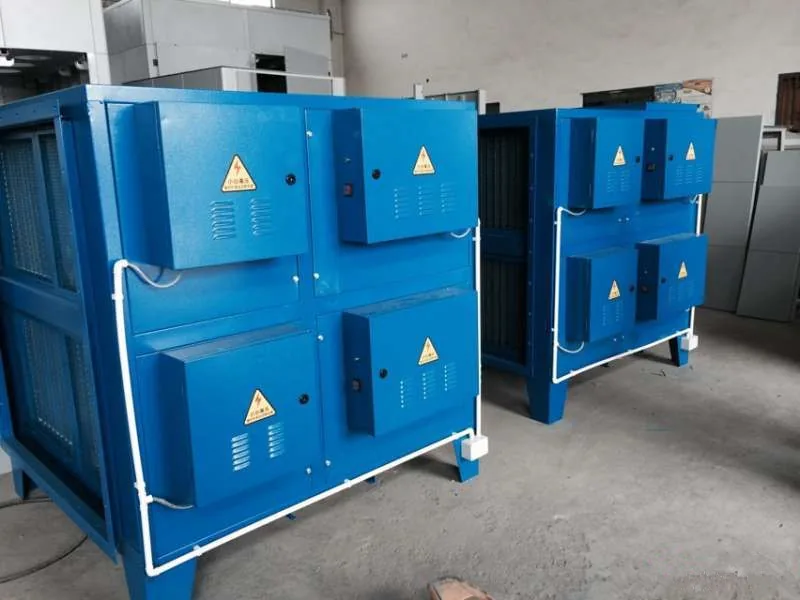
Low-temperature plasma waste gas system
Non-thermal plasma systems treat high volumes of dilute exhaust without the fuel cost of thermal oxidation. Their practical constraint is the inlet condition: moisture, oil droplets and particulate shorten electrode life and reduce stability, so upstream pre-filtration and demisting belong in the design rather than in the options list.
Energy use scales with airflow, which makes the route attractive exactly where the stream is large and dilute. We normally compare it with carbon adsorption and UV photolysis on a lifetime-cost basis before we recommend it.
Compare plasma with carbon and UV routes →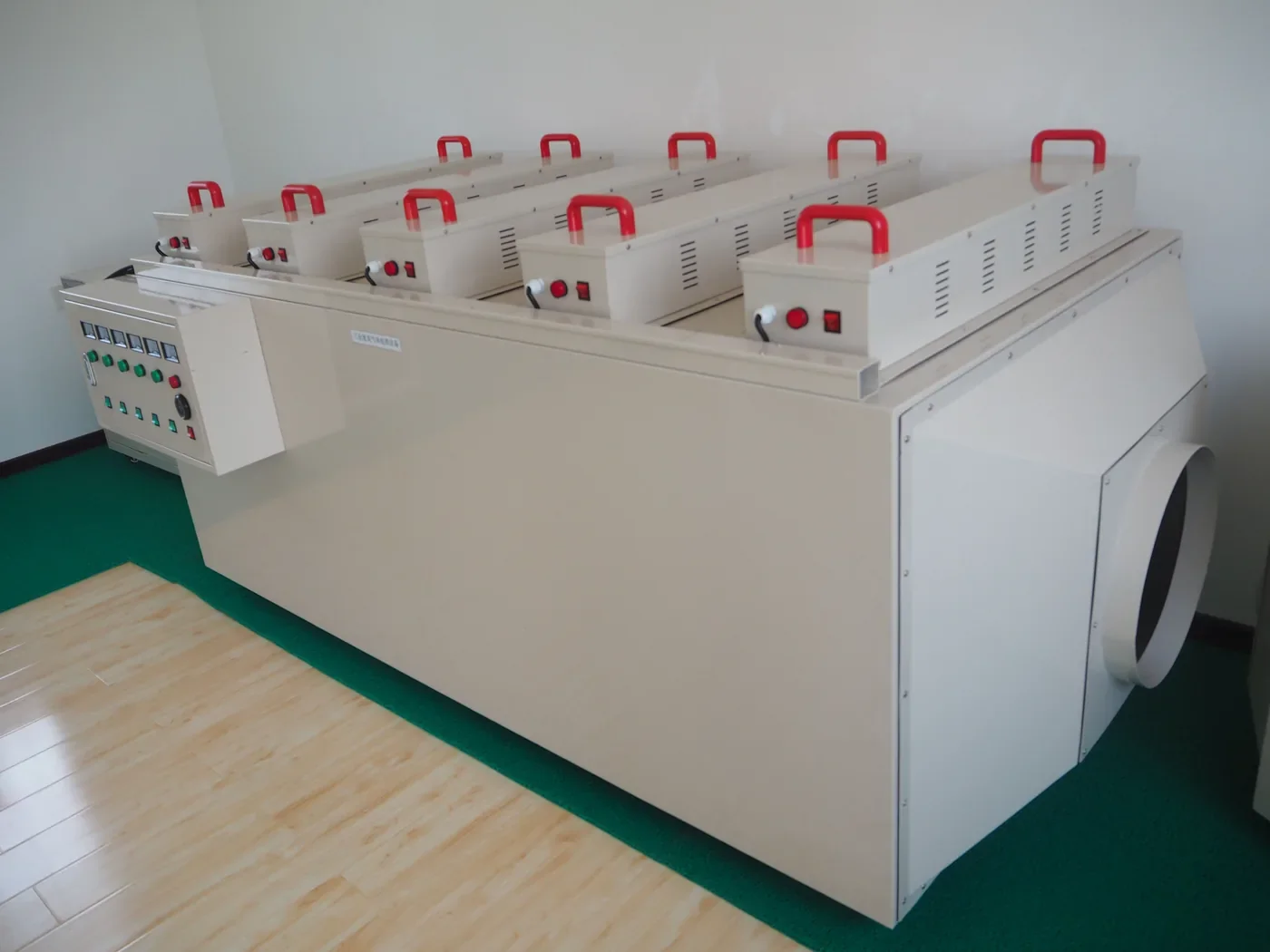
Oil fume purification unit
Electrostatic units charge and collect oil droplets that would otherwise deposit in ductwork and create both a hygiene problem and a fire hazard. Pre-filtration protects the cells, and the cleaning interval follows the actual grease load of the process, not a fixed calendar.
We settle duct length, airflow balance and access for washing the collector cells during layout, because a unit you cannot reach will not get maintained. Where the exhaust also carries odour, we usually add a downstream carbon or UV polishing stage.
Read oil fume unit selection and cleaning notes →
Applications
Application scenarios by industry
The same pollutant behaves differently in different plants. A solvent stream from a printing line, an acid mist from a plating bath and ammonia from an animal room may all carry the label “waste gas”, but they need different materials, pre-treatment and acceptance tests.
The scenarios we engineer most often
These are the cases we get asked to engineer most often. Treat them as starting points for a conversation with your process or EHS team, not as fixed packages. In every case the decisive questions stay the same: what sits in the stream, how much air moves, what limit applies, and how much space and downtime the plant can tolerate. Answer those four questions and you will usually shorten the enquiry cycle more than any amount of catalogue browsing.
| Industry | Typical pollutants | First route considered | What changes the decision |
|---|---|---|---|
| Food and beverage | Odour, steam, oil mist, cleaning fumes | Spray deodorization with pre-filtration | Seasonal load swings, wash-down chemicals |
| Chemical and pharmaceutical | Solvent VOCs, acid gases, mixed vents | Scrubber then carbon or UV polishing | Solvent recovery, ATEX zoning, batch variation |
| Electroplating and surface treatment | Acid mist, chromium fumes, alkaline mist | Packed-bed wet scrubber with droplet eliminator | Acid concentration, temperature, corrosion grade |
| Printing and packaging | Printing VOCs, ink solvent, hot air | Carbon adsorption, or UV plus carbon | Solvent type, concentration, exhaust temperature |
| Livestock and slaughterhouse | Ammonia, odour, biological load | Spray or biological deodorization | Ammonia concentration, air changes, wash-down |
| Laboratory and animal facility | Ammonia, animal odour, low-concentration VOC | Multi-stage scrubber plus carbon or UV | Air change rate, ammonia load, 24/7 duty |
Read the detailed guidance: VOC controls for printing lines, animal facility exhaust design and chemical and pharmaceutical waste treatment.
Trade-offs
How the main treatment routes compare
A comparison only helps when it says where a route is the wrong choice. We wrote the table below that way on purpose, including cases where we would advise against our own equipment.
Where each route stops working
Thermal oxidation, for example, is a legitimate and often better route for high-concentration VOC streams with heat recovery, even though it sits outside our eight-technology range. Telling a buyer that before they order an undersized carbon system is more valuable than winning the order. In the same way, simple dilution or taller stacks may settle a noise or nuisance complaint in the short term, but they rarely meet a measured emission limit — so we do not present them as treatment. We include those alternatives here so your internal review has a fair basis for comparison.
Route-by-route trade-offs
| Route | Strength | Weakness | Choose it when | Avoid it when |
|---|---|---|---|---|
| Wet scrubbing | Handles soluble gases and acid mist reliably | Creates a liquid side stream; needs pH and pump care | Acid or ammonia dominates and water is available | Insoluble VOCs dominate, or the plant limits wastewater discharge |
| Activated carbon | Low capital cost, simple operation | Bed becomes a consumable at higher loads | Low to moderate VOC load with dry, filtered inlet | High concentration, high humidity or droplets at inlet |
| UV photolysis | Compact polishing, no consumable media | Sensitive to humidity, dust and residence time | Odour polishing at low concentration after pre-treatment | Chlorinated solvents or heavy particulate loading |
| Baghouse filtration | High dust removal, proven at scale | Pressure drop and bag replacement cost | Dry, non-sticky particulate | Wet, sticky or explosive dust without pre-treatment |
| Thermal oxidation (RTO/TO) | Very high VOC destruction with heat recovery | High capital and fuel cost; not in our range | High-concentration VOC with steady load | Low concentration where fuel cost dominates |
Further reading: wet scrubber tower design guide, carbon, UV and RTO comparison and the industrial waste gas treatment buyer’s guide.
Process
From enquiry to acceptance: how a project runs
Uncertainty about what happens after you submit the form is one of the main reasons industrial buyers delay an enquiry. Here is the sequence, with the output you should expect at each step.
Nothing in this sequence asks you to place an order before we agree the engineering basis. The first two steps are written deliverables you can circulate internally — useful when a design institute, an EHS department and a purchasing team all have to approve the same project. For export projects we also clarify Incoterms, packing, documentation and who runs on-site commissioning before manufacture begins, so you do not discover responsibility at the port.
1
Gas data and constraints
You send pollutants, airflow, temperature, humidity, space and the applicable limit. We reply with any missing measurements and a short list of assumptions.
2
Selection note and layout
A written route comparison, preliminary equipment list, footprint and pressure-drop estimate, plus a general arrangement drawing for review.
3
Quotation and scope
Itemised capital cost, materials, instrumentation, spare parts, packing and freight terms. Exclusions stated explicitly, not discovered later.
4
Design and manufacture
Approved drawings, material certificates and factory quality checks, with documented changes if the layout or standard shifts during design.
5
Factory acceptance and delivery
Test records, packing list, export documentation and installation instructions, with remote support for the receiving team.
6
Commissioning and handover
Start-up against the agreed acceptance criteria, operator notes and a clear record of the operating point for future maintenance.
Pricing
What drives the price, and what does not
We do not publish a single price for a waste gas treatment system, because we size each one to a stream rather than sell it off a shelf. We do publish the variables, so you can compare three competing quotations on the same basis.
Six inputs that set the capital cost
Six inputs account for most of the capital cost: design airflow; pollutant concentration and chemistry; the required removal performance and the test method; materials of construction; the degree of instrumentation and automation; and the ductwork, fan and civil interface around the unit. Operating cost is a separate calculation that fan power dominates — fan power follows pressure drop and airflow — alongside consumables such as carbon beds or filter bags, dosing chemicals and their wastewater, and routine inspection labour.
For example, a quotation that runs ten percent cheaper at purchase can cost far more over five years if it uses a higher filtration velocity or a shorter carbon bed. We point these differences out when they show up in a comparison.
What does not move the price
Your company size does not change the price, nor does how quickly you need a nominal number, nor whether the enquiry arrives through a distributor. We would rather issue a scoped estimate with clearly listed assumptions than a headline figure that needs revising. If you only hold a budget figure at this stage, say so in the enquiry: we can respond with the airflow and performance envelope that figure realistically covers, and name which requirements would have to move first. That is a more useful answer than a discount applied to an undefined scope.
For plants comparing a new system with an existing one, the useful metric is the cost per unit of clean gas, not the sticker price.
Typical ranges
Standard single-stage skids ship in 30–45 days ex-works; two-stage systems with custom ductwork run 60–90 days. As an order of magnitude, a 20,000 m³/h carbon adsorption system typically lands between USD 18,000 and USD 35,000 FOB Qingdao, depending on housing material, instrumentation and whether a pre-filter is included.
Operating cost follows pressure drop, consumable replacement and dosing chemicals rather than capital cost, so two systems at the same airflow can differ by a factor of two over five years.
These are ranges, not quotations. Final scope and price are confirmed on the selection note.
Why Soto
Why engineers specify Soto
The honest answer is not “we are the largest” or “we are the cheapest”. It is that we can select across eight technologies instead of defending one, and that we put the decision logic in writing before asking for an order.
Independence, not a product line to push
A supplier with a single product line has every reason to recommend that product for every stream. A supplier with eight routes, a factory and an export process can recommend a scrubber ahead of carbon, a baghouse ahead of a scrubber, or a competitor’s thermal oxidiser when the concentration makes it the correct answer. That independence is the practical reason buyers involve us early: the first engineering decision sets most of the capital and operating cost, and it is the hardest to reverse later.
We write the boundaries down
If the gas data is missing, we say which measurements we need. If a route cannot meet a stated limit under the given humidity or temperature, we say so in the selection note. If the local contractor owns installation, that appears in the scope rather than in a footnote after delivery. This approach is slower than sending a price on the first reply, and it produces fewer systems that fail their acceptance test. For an export project, where a site visit is expensive and a re-shipment is worse, that is the trade worth making.
Our manufacturing and engineering background covers both waste gas and wastewater treatment equipment, which matters on sites where scrubber liquor, odour control and effluent treatment sit under the same permit. You can also review the project archive.
Evidence
Certification and project evidence
Certificate scans and exhibition records are shown below. Project references — airflow, inlet and outlet concentration, test method and commissioning date — are available on request under NDA.
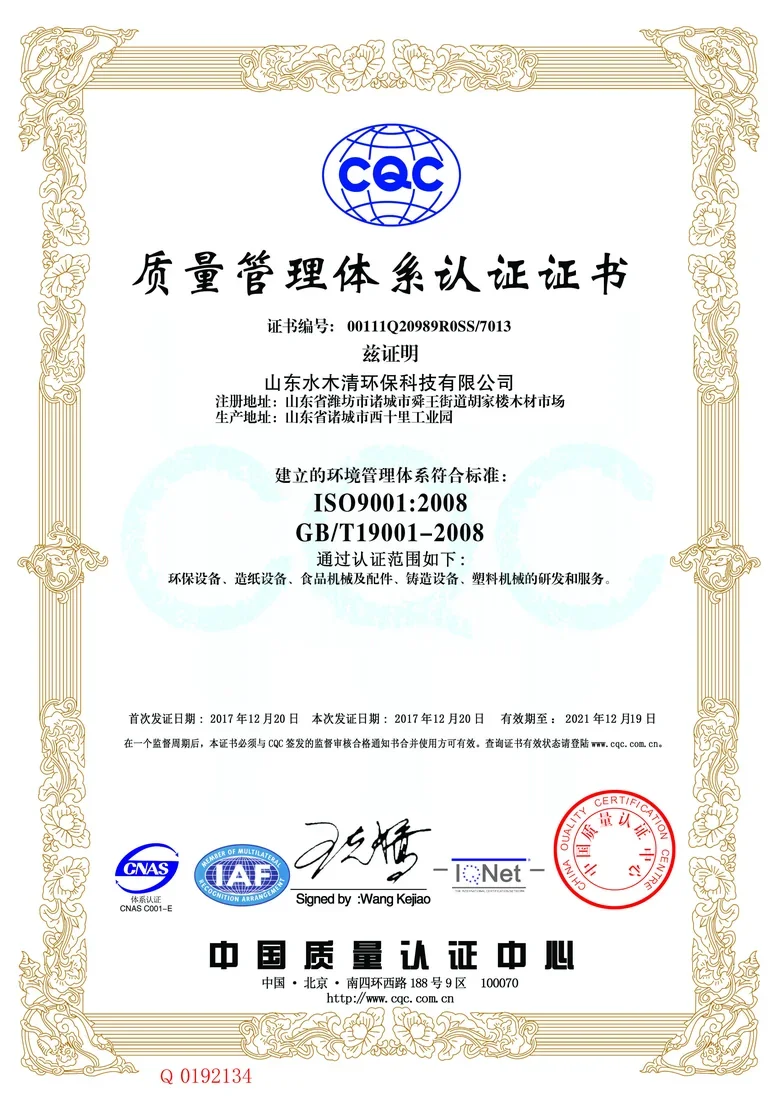
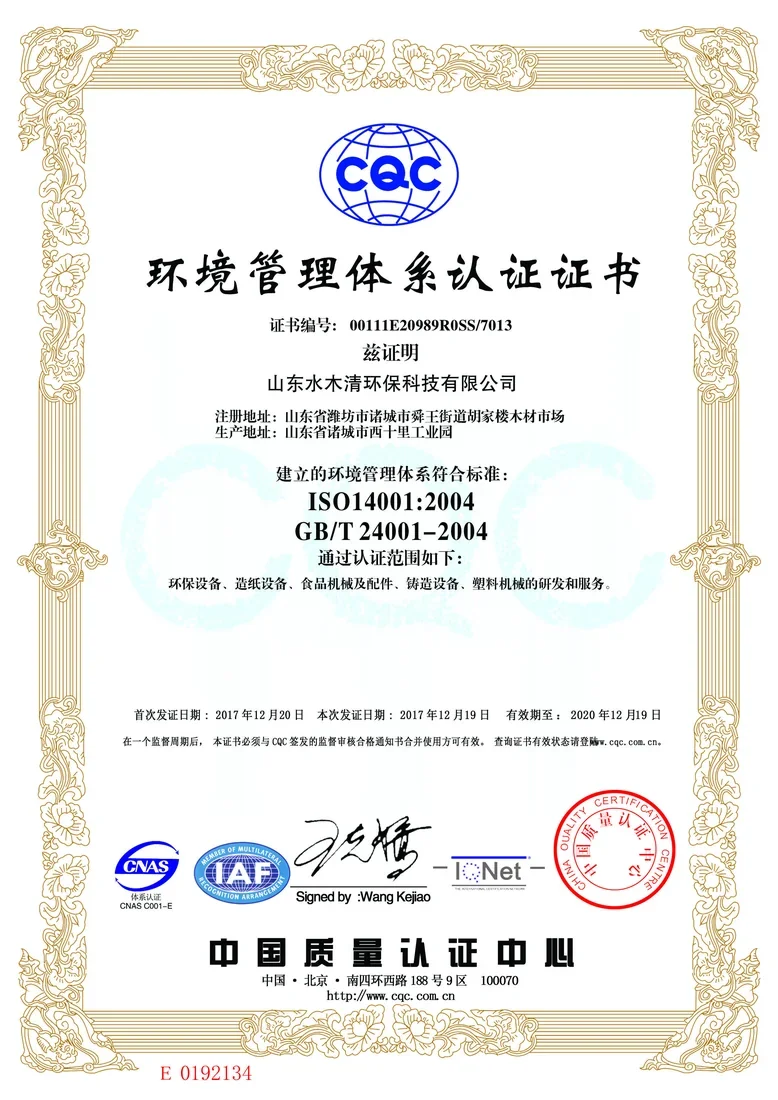
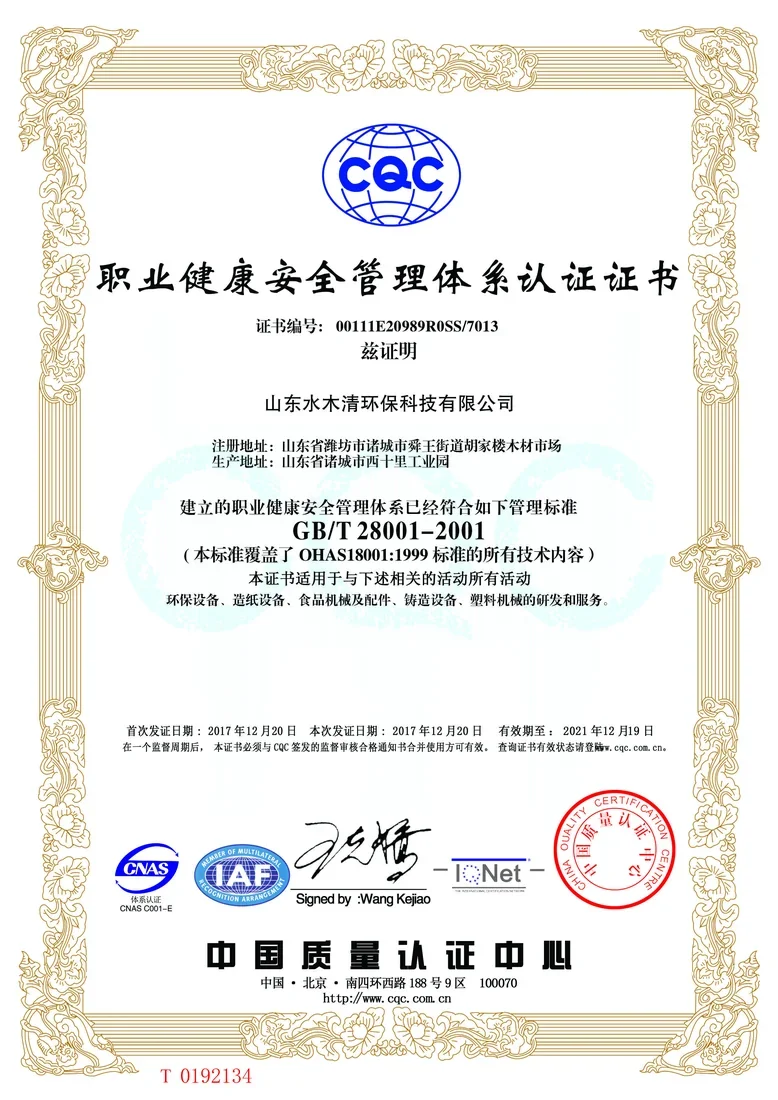
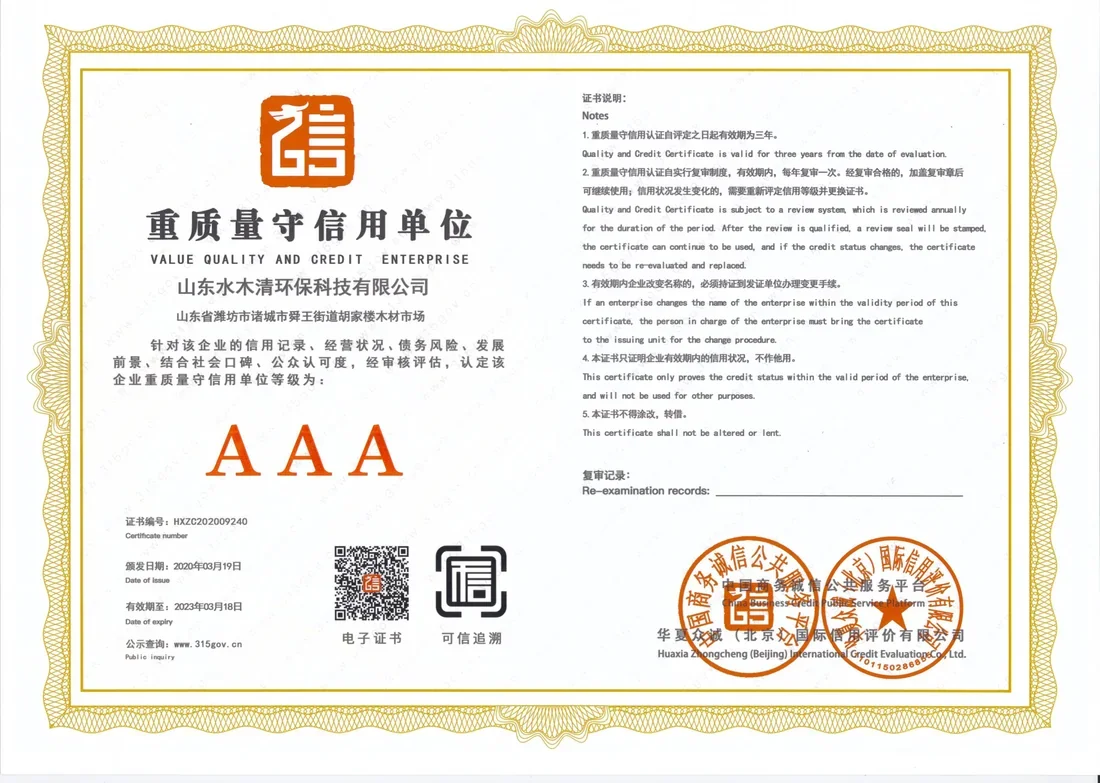
What each certificate covers
- Quality management — ISO 9001:2015; scope: design and manufacture of waste gas treatment equipment, including on-site commissioning support.
- Environmental management — ISO 14001:2015 for the manufacturing site.
- Occupational health and safety — ISO 45001:2018 for the manufacturing site.
- AAA credit rating — corporate credit standing, reviewed annually.
Certificate numbers and validity dates are shown on the scans and provided with the quotation package.
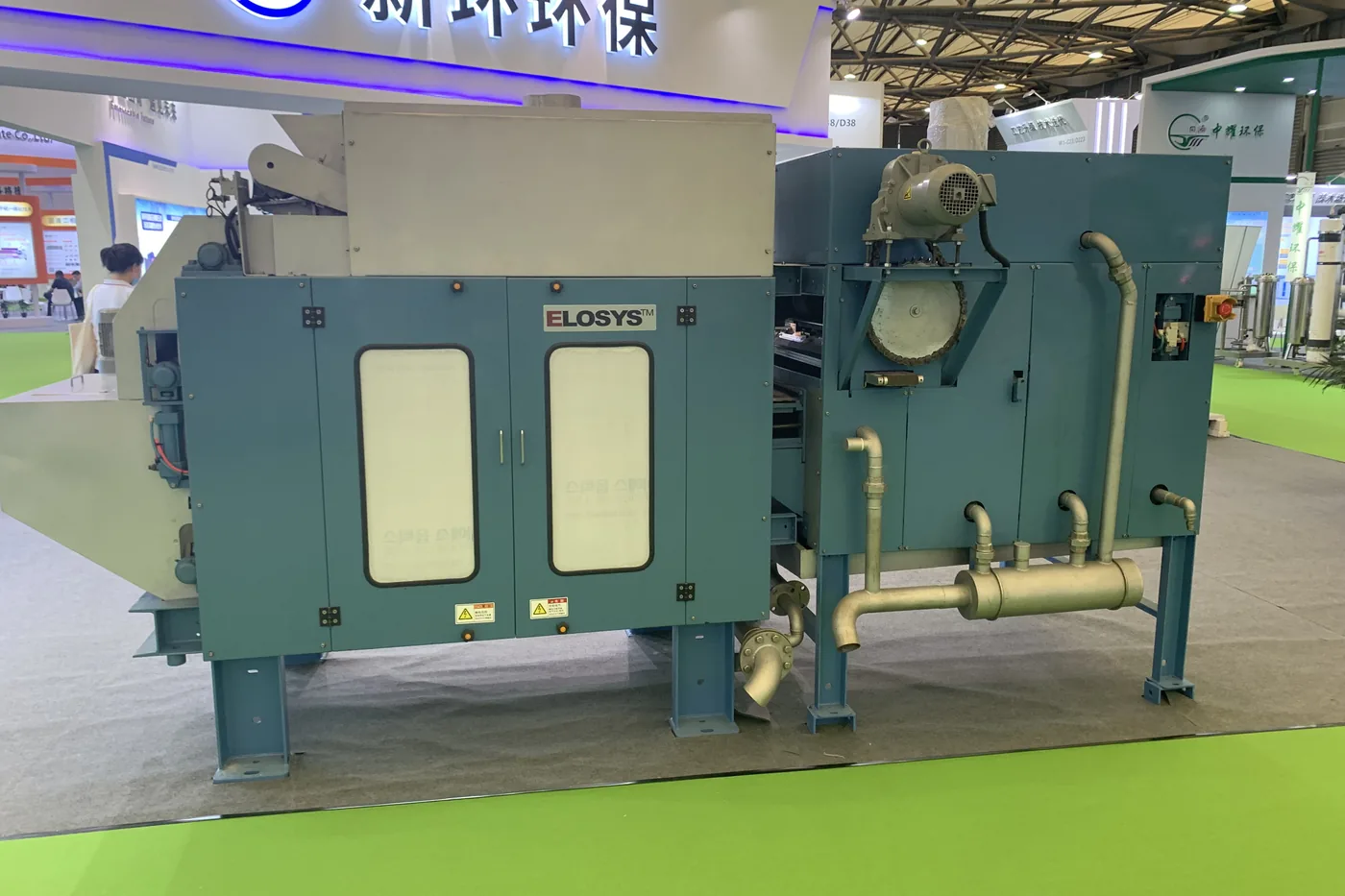
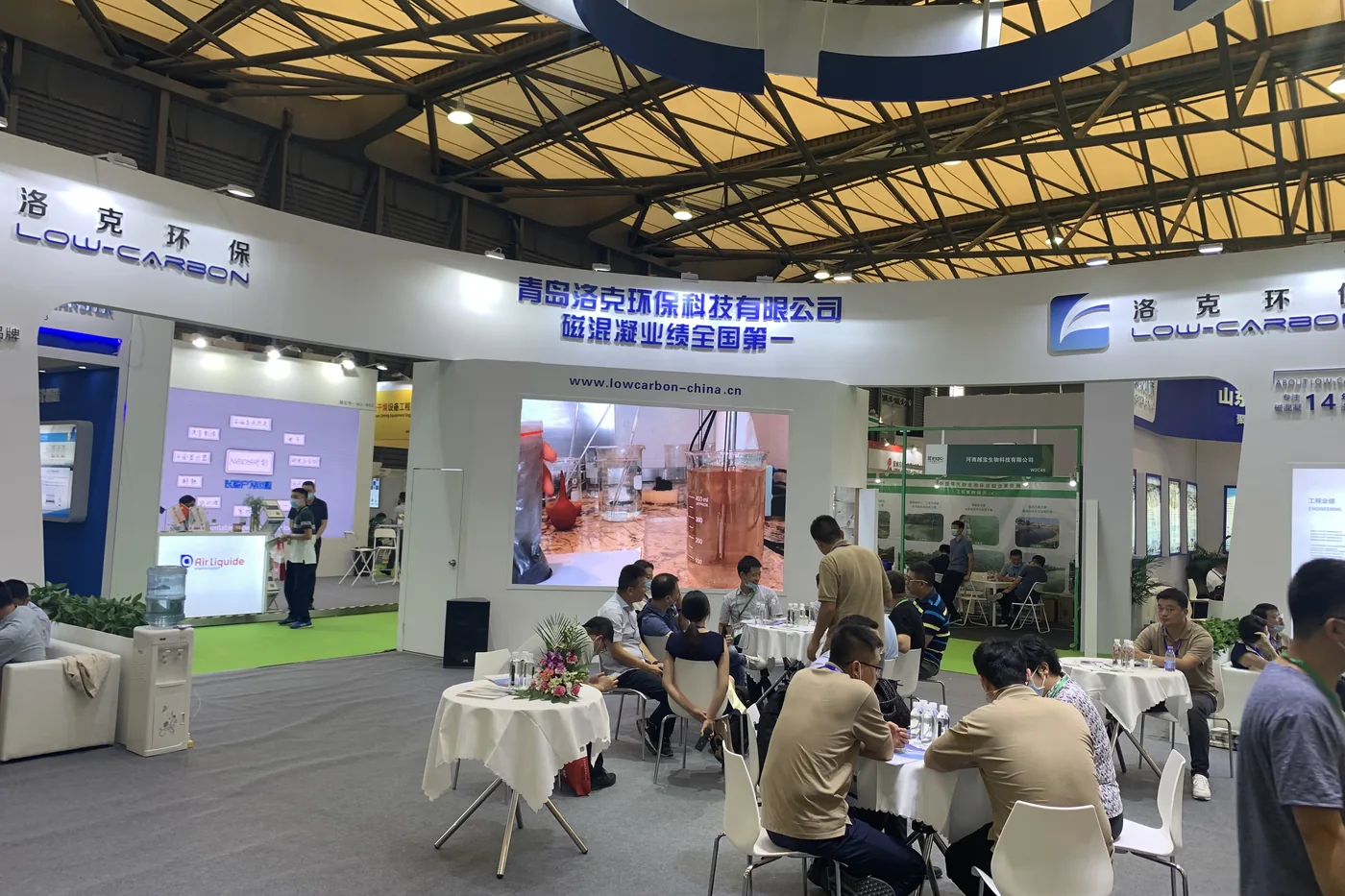
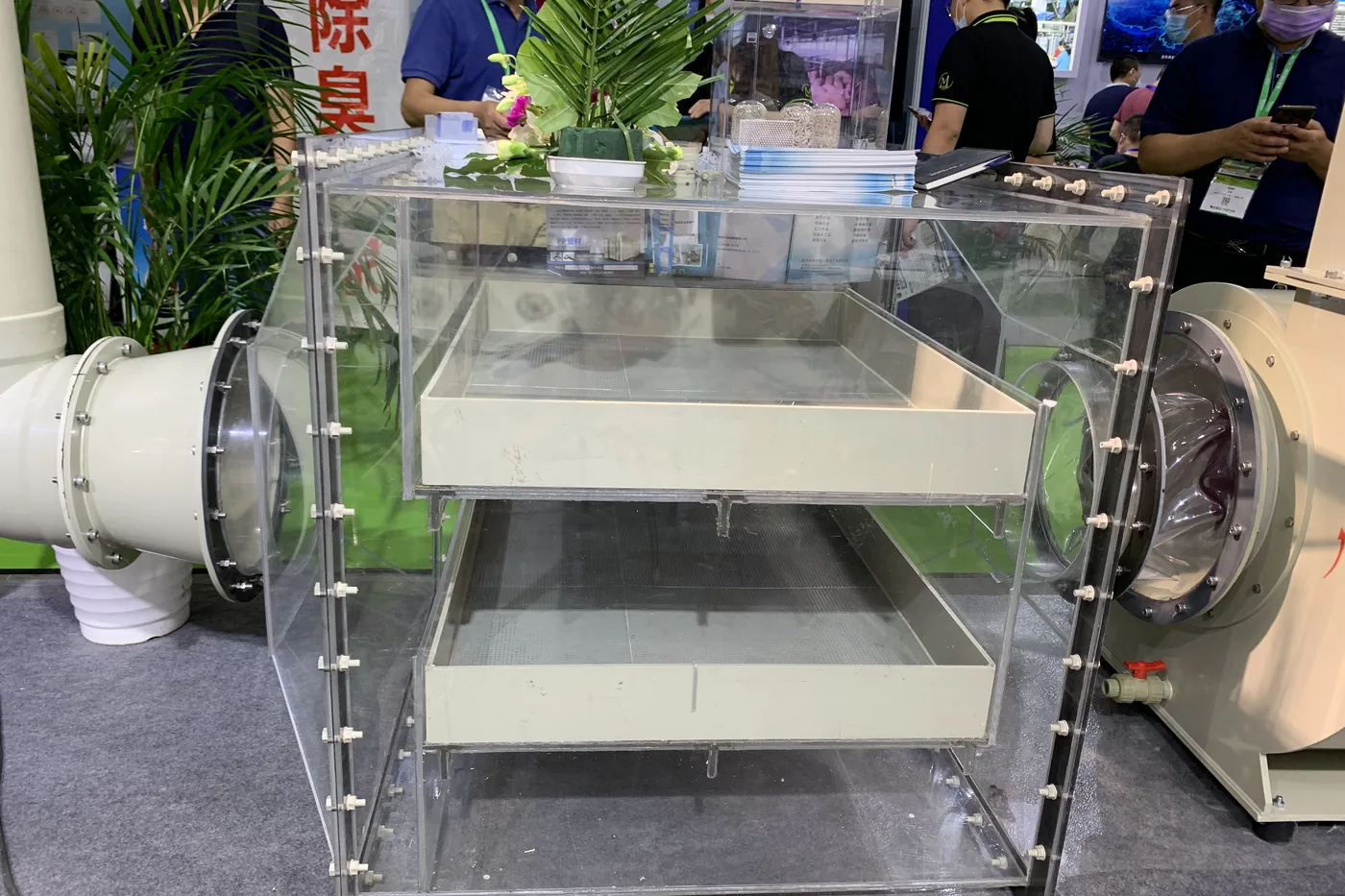
Project references
We publish case details only with the client’s permission, so full references — industry, airflow, inlet and outlet concentration, test method and commissioning date — are available on request under NDA. The scopes we engineer most often:
- Printing and packaging — solvent VOCs from flexo and gravure lines, carbon adsorption with pre-filter.
- Food processing — cooking odour and oil mist, electrostatic purification with wash-down.
- Metal finishing — acid mist scrubbing, packed-bed tower with neutralising liquor.
Read the project archive for published examples.
FAQ
Common questions about waste gas treatment
These are the questions that usually decide whether an enquiry proceeds. Each answer states what we can confirm and what depends on your gas data.
Choosing a technology
Which waste gas treatment technology do I need?
It depends on the pollutant, concentration, airflow, temperature and the limit you must meet. Soluble acid gases usually point to a wet scrubber; dry VOC streams to activated carbon; particulate to a baghouse; odour at low concentration to UV photolysis or a biological stage; mixed streams to two or more stages in series. Send those five inputs with your enquiry and we return a written selection note that names the primary route and explains why we set the alternatives aside. Without the inputs, any single answer would mislead you.
Can you guarantee the outlet concentration?
A removal figure only means something alongside the inlet condition and the test method. We state the performance envelope for the specified airflow, concentration, temperature and humidity, and we record the operating point during commissioning against the acceptance criteria we agreed in the scope. We do not offer open-ended guarantees that ignore inlet variability. If your permit sets a hard limit, share the standard and the expected worst-case load so we size the design to that case rather than to an average.
What information should the enquiry include?
Pollutants and rough concentration, airflow in m³/h, gas temperature and humidity, available footprint and duct route, the applicable emission or odour standard, and whether the process runs continuously or in batches. Photographs of the existing extraction point and a simple duct-route sketch help more than a long description. If you do not know some values, tell us which ones and we list the measurements worth taking first.
Cost and spare parts
How do you calculate the price, and why is there no price list?
Capital cost follows airflow, gas chemistry, materials, instrumentation and the fan and ductwork interface; operating cost follows pressure drop, consumables and dosing chemicals. Two systems with the same nominal airflow can differ a lot in price because one needs stainless construction or a second treatment stage. We publish the variables rather than a headline figure so you can compare quotations like for like. If you hold a budget ceiling, include it and we describe the envelope it realistically covers.
What spare parts and consumables should we budget for?
The answer varies by route: carbon beds and pre-filters for adsorption, filter bags for a baghouse, lamps for UV photolysis, nozzles and dosing pumps for spray systems, collector-cell cleaning for electrostatic units, and packing inspection for scrubbers. The specification table above lists the deciding variable for each. Your selection note should estimate the interval from your actual load, not from a generic calendar, because load is what consumes the part.
Delivery, installation and scope
Who handles installation and commissioning on an export project?
Step 3 of the project sequence defines this. Some buyers use a local contractor with our remote commissioning support and a documented test procedure; others prefer our engineers on site. Either way, the scope states who provides cranage, civil works, power, water and duct connection, and who signs the acceptance record. Clarifying this before manufacture avoids the most common source of delay in overseas projects.
Can one system handle both dust and VOCs?
Usually not in a single stage. Particulate blinds carbon beds and fouls UV or plasma equipment, so a baghouse or pre-filter normally sits upstream of the gas-phase treatment. This is one of the most common reasons a single-unit purchase underperforms. We size the stages together so the pressure drop across the whole train stays within the fan’s capability.
How long does delivery take?
Lead time depends on the degree of customisation, the materials and the shipping destination, so we confirm it with the quotation rather than quote it generically here. Standard units ship faster than multi-stage systems with custom ductwork and instrumentation. Tell us your shutdown window or commissioning deadline in the enquiry; where the schedule is tight we say early whether it is achievable or whether a phased scope is more realistic.
Do you also handle wastewater and odour from the same site?
Yes. Scrubber liquor, sludge-area odour and process effluent often fall under the same permit, and our range covers both effluent treatment systems and odour control. Treating the interfaces together usually avoids a second retrofit. Mention the effluent side in your enquiry if it exists.
Related reading
Related equipment, industries and guides
Use these to move from a general route to a specific unit, industry case or design calculation.
Equipment detail
Industry solutions
Enquire
Request a quote with your gas data
Three fields. Tell us what sits in the stream and what limit applies; we return a written selection note, a preliminary layout and an itemised scope.