Environmental protection equipment supplier

MBR Membrane Bioreactor
Advanced biological treatment with membrane filtration for superior effluent quality
Capacity
10-1000 m³/day
Membrane
PVDF hollow fiber
Pore Size
0.1-0.4 μm
MLSS
8000-12000 mg/L
Membrane Life
3-5 years
Flux
10-25 LMH
What Is an MBR Membrane Bioreactor?
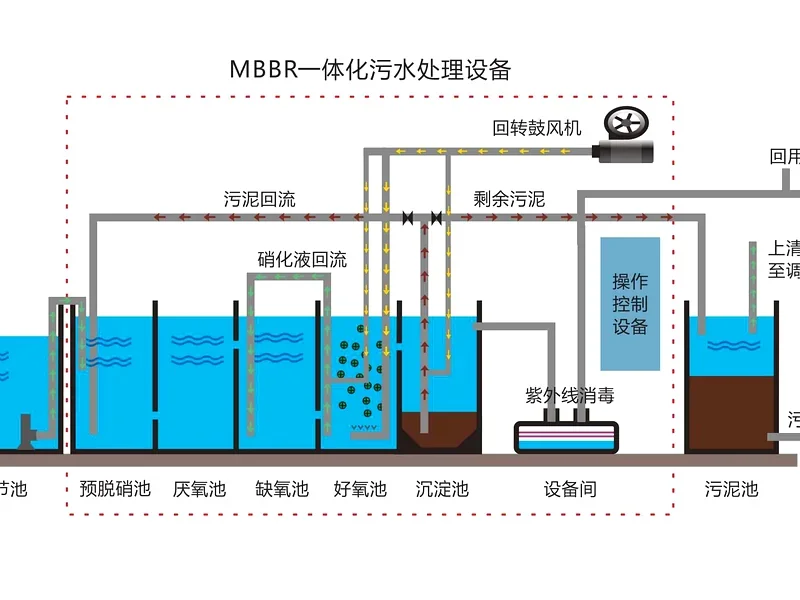
MBR replaces the traditional secondary sedimentation tank with membrane filtration. The membrane directly separates activated sludge from treated water, allowing higher bacterial concentration, better treatment, and cleaner effluent that can be directly reused.
Technology Comparison
MBR vs Conventional Treatment
MBR Advantages
- Effluent quality meets reuse standards (SS <5 mg/L)
- 50% smaller footprint
- MLSS 8000-12000 mg/L (2-3x higher)
- Less sludge production
- Complete removal of large bacteria & viruses
- Stable performance under load variations
Conventional Limitations
- Effluent SS 20-30 mg/L
- Large footprint needed
- MLSS only 2000-4000 mg/L
- More sludge to handle
- No pathogen removal
- Sensitive to shock loads
Technical Specifications
MBR Membrane Specifications
| Capacity | 10-1000 m³/day |
|---|---|
| Membrane Type | PVDF hollow fiber |
| Pore Size | 0.1-0.4 μm |
| MLSS Range | 8000-12000 mg/L |
| Membrane Life | 3-5 years |
| Design Flux | 10-25 LMH |
| SS Removal Rate | 99.9% |
Effluent Quality
Before & After Treatment
See how MBR transforms wastewater into reusable quality water across every key parameter.
COD
300-800 mg/L
→
<50 mg/L
BOD
150-400 mg/L
→
<10 mg/L
SS
200-500 mg/L
→
<5 mg/L
NH₃-N
25-50 mg/L
→
<5 mg/L
Turbidity
50-100 NTU
→
<1 NTU
Applications
Where MBR Excels
Industrial park wastewater
Pharmaceutical
Food & beverage
Electronics
Municipal upgrade
Water reuse projects
Product Overview
What Is MBR Membrane Bioreactor?
An MBR (Membrane Bioreactor) is an advanced wastewater treatment technology that combines biological treatment (activated sludge process) with membrane filtration. Instead of using a secondary sedimentation tank to separate sludge from water, MBR uses semi-permeable membranes to directly filter out solids, bacteria, and viruses.
The membrane acts as a physical barrier that allows clean water to pass through while retaining all suspended solids and microorganisms. This means the bioreactor can operate at much higher MLSS concentrations (8,000-12,000 mg/L) compared to conventional activated sludge (2,000-4,000 mg/L), resulting in a smaller footprint and better treatment efficiency.
MBR systems produce effluent of exceptional quality — typically SS below 5 mg/L and turbidity below 1 NTU — that is often suitable for direct reuse in irrigation, industrial cooling, or toilet flushing. It is the technology of choice when discharge standards are strict or water reuse is planned.
Key Benefits
Why Choose MBR Technology?
Four core advantages that make membrane bioreactors the premium choice for advanced wastewater treatment and reuse.
01
Superior Effluent Quality
Produces crystal-clear effluent with SS < 5 mg/L and turbidity < 1 NTU. Removes 99.9% of suspended solids and effectively retains bacteria and viruses. Effluent is often suitable for direct reuse.
02
50% Smaller Footprint
High MLSS concentration (8,000-12,000 mg/L) means a much smaller bioreactor volume. No need for a secondary sedimentation tank. Saves 50-60% of space compared to conventional treatment.
03
Less Sludge Production
Higher sludge age and longer retention time reduce excess sludge production by 30-50% compared to conventional activated sludge. Lower sludge handling and disposal costs.
04
Stable & Flexible Operation
Membrane filtration ensures consistent effluent quality regardless of hydraulic or organic load variations. System is easy to automate and can handle variable flow rates without performance drops.
MBR Types
Three Types of MBR Membranes
Different membrane configurations to match your specific application, budget, and maintenance preferences.
Hollow Fiber
Hollow Fiber MBR
Thousands of fine PVDF hollow fibers bundled together, providing the largest membrane surface area per unit volume.
- Material: PVDF, high durability
- Highest packing density
- Outside-in filtration
- Most widely used type
Flat Sheet
Flat Sheet MBR
Rigid flat panel membranes stacked in cassettes, known for excellent fouling resistance and easy maintenance.
- Strong mechanical strength
- Resistant to fiber breakage
- Easy to replace individual sheets
- Good for high-strength wastewater
Multi-Tube
Multi-Tube MBR
Tubular membranes arranged in parallel inside a pressure vessel, operated in inside-out filtration mode.
- Handles high TSS feed water
- Easy chemical cleaning
- Side-stream configuration
- Industrial specialty applications
Custom Solutions
Custom MBR Systems for Every Need
From small package plants to large-scale industrial MBR systems, we design and build custom solutions tailored to your exact requirements. Our engineering team selects the right membrane type, configuration, and capacity to meet your effluent targets.
Capacity: 10-1000 m³/day
Membrane: PVDF hollow fiber / flat sheet
Immersed or side-stream design
Containerized / skid-mounted
OEM & private labeling
CIP & membrane cleaning systems
FAQ
Frequently Asked Questions
Common questions about MBR membrane bioreactors answered by our wastewater treatment engineers.
How long do MBR membranes last?
With proper operation and maintenance, PVDF hollow fiber membranes typically last 3-5 years. Flat sheet membranes can last 5-7 years. Membrane life depends on wastewater characteristics, cleaning frequency, and operating conditions. We provide detailed operation guidelines and remote support to maximize membrane lifespan.
What maintenance does MBR require?
Routine maintenance includes: daily checks of transmembrane pressure (TMP) and flux, weekly maintenance cleaning with NaClO, monthly chemical cleaning with citric acid or oxalic acid, and periodic integrity testing. The automated control system monitors key parameters and alerts operators when cleaning is needed.
Can MBR effluent be reused directly?
MBR effluent has very low SS (<5 mg/L) and turbidity (<1 NTU), making it suitable for many reuse applications such as irrigation, toilet flushing, and industrial cooling. For potable reuse or higher purity requirements, additional polishing steps like RO (reverse osmosis) or UV disinfection can be added after MBR.
Is MBR more expensive than conventional treatment?
MBR has higher initial capital cost but lower operating cost in terms of space, labor, and sludge disposal. When land is expensive or reuse value is high, MBR often has a better total cost of ownership. The payback period is typically 2-5 years depending on local conditions. We can help you compare both options for your specific project.
Get in Touch
Request a Free MBR Quote
Tell us your flow rate and effluent quality targets. Our engineers will design an MBR system that meets your requirements and send a detailed quotation within 24 hours.
Email Us
david@sotomachinery.com
+86 18653221918
Factory Location
Qingdao, Shandong, China
Send Us Your Requirements
Fill in the form below and we will get back to you within 24 hours.
Ready to Upgrade to MBR?
Tell us your flow rate and effluent targets. Our engineers will design an MBR system that meets your reuse standards and send a quote within 24 hours.