Environmental protection equipment supplier

Animal Room Exhaust Scrubber: Two-Stage Design, Sizing and Running Cost
An animal room exhaust scrubber has to strip ammonia, hydrogen sulfide and organic sulfides from the air leaving a cage rack or room extract. It must do that every hour of the year, and the usual options all carry a consumable bill. Carbon beds saturate, while plain spray towers burn reagent. A two-stage scrubber instead pairs photocatalytic oxidation with turbulent gas-liquid contact, so the pollutants leave in the drain rather than in a filter.
What the Exhaust Actually Contains
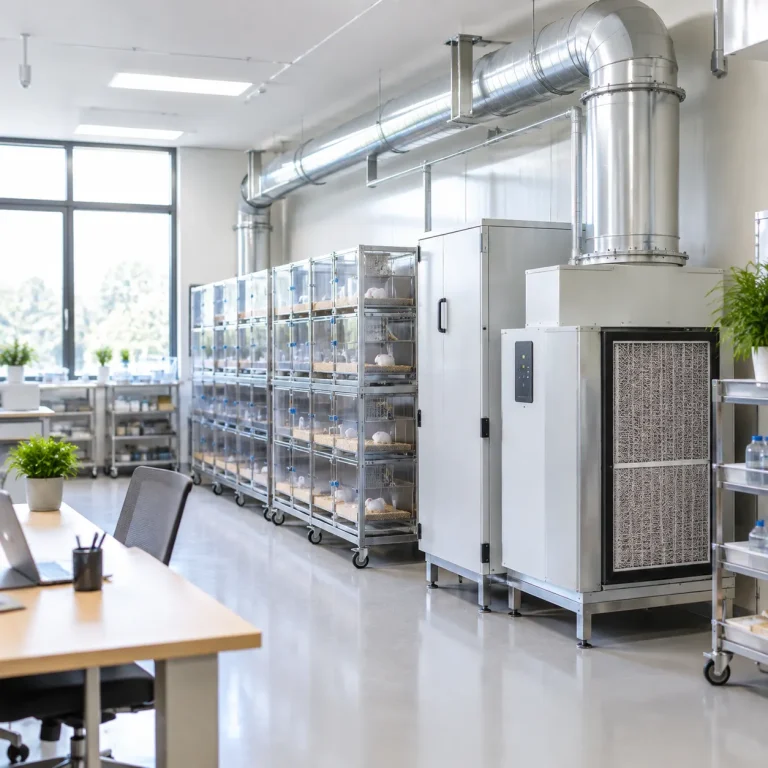
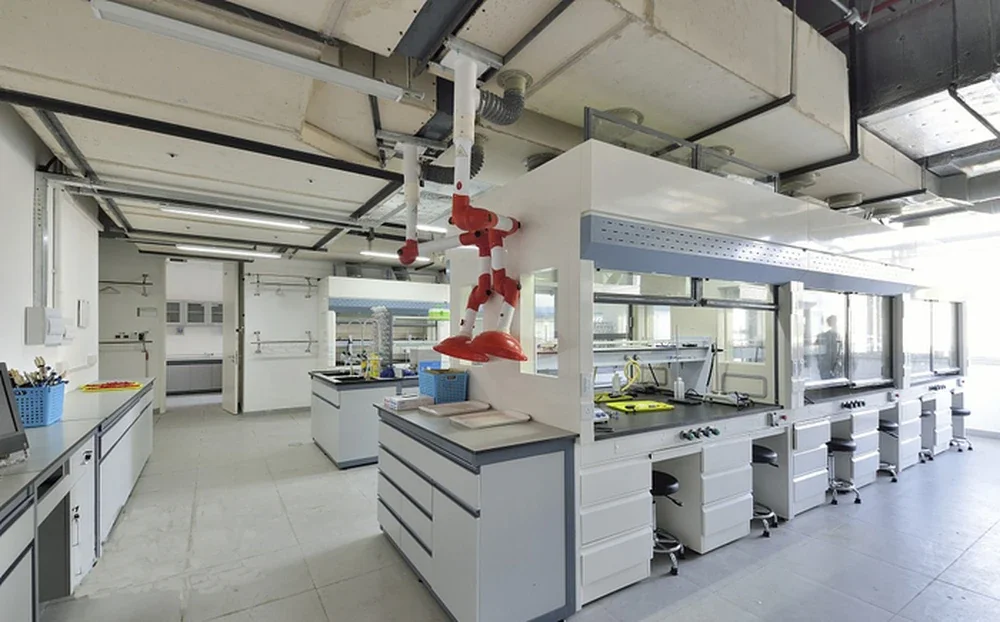
Animal rooms produce a mixed gas stream that never settles, because waste keeps breaking down around the clock. Urine and wet bedding release ammonia continuously, so the load rarely drops to zero. Faeces and bedding break down under microbial action and give off hydrogen sulfide, methanethiols, skatole and indole. Feed residue adds fine dust, and that dust carries much of the odour with it. Cage changes, feeding and the light cycle all move the load within a single day. The inlet concentration therefore swings widely.
Two limits therefore apply at the same time. Inside the room, ammonia must stay at or below 14.0 mg/m³ under GB 14925-2023. Chronic exposure otherwise stresses the animals and skews research data. At the fence line, the plant must still meet the national odour standard for ammonia, hydrogen sulfide and odour concentration. A working scrubber therefore serves animal welfare and neighbour relations at once.
| Pollutant | Main source | Behaviour in a scrubber | Stage that removes it |
| Ammonia | Urine, wet bedding | Very soluble, absorbs fast in acid | Spray stage |
| Hydrogen sulfide | Faecal breakdown | Poorly soluble, needs alkaline pH | Spray stage at high pH |
| Methanethiol, dimethyl sulfide | Anaerobic decomposition | Slow to absorb, breaks down under UV | Photocatalytic then spray |
| Skatole, indole | Faecal and bedding decay | Almost insoluble, resists absorption | Photocatalytic stage first |
| Bacteria and fungi | Bedding dust, aerosols | Not a gas, needs inactivation | Photocatalytic stage |
Why Carbon Beds and Plain Spray Towers Disappoint
Activated carbon works well at a steady, low concentration. An animal room is the opposite case, because the load follows the husbandry schedule. Capacity also falls as humidity rises, so the bed saturates faster than the replacement calendar assumes. Once saturated, efficiency drops sharply and odour returns before anyone checks the date. Spent carbon from an animal facility can also fall under hazardous waste rules. That adds a disposal cost on top of the replacement cost.
A plain spray tower, however, fails for different reasons. Droplets are coarse, contact time is short, and hydrogen sulfide absorbs poorly into water at neutral pH. Capture stays low while the pump and the dosing unit run flat out. Operators then raise the liquid flow to compensate, and that raises water consumption and wastewater load rather than removal.
How a Two-Stage Turbulent Spray Scrubber Works
The design that answers both problems puts two stages inside one housing, so each one covers what the other cannot.
Stage 1: Photocatalytic Oxidation Breaks the Molecules
Exhaust enters a photocatalytic section built around a MnOx-TiO₂ catalyst and vacuum-UV lamps. The lamps generate hydroxyl radicals and superoxide ions. These ions then oxidise skatole, larger organics and the odour molecules that water cannot dissolve. The reaction converts them into smaller, soluble compounds. It also inactivates bacteria and fungi carried on bedding dust.
The purpose of this stage is to change chemical form rather than to destroy everything outright. Material that the spray stage could never capture becomes material that it can.
Stage 2: Turbulent Contact Moves Them into the Liquid
Gas then passes through a bed of 50 mm polypropylene hollow spheres. Porosity exceeds 91% and specific surface exceeds 200 m²/m³, while bed depth is at least 300 mm. The packing forces repeated collision, shear and rotation, so the flow breaks into micro-vortices. Ceramic nozzles atomise the scrubbing liquor into droplets of 1 to 30 µm. Contact time therefore exceeds five seconds.
The chemistry inside that zone is then simple. Ammonia reacts with dilute sulfuric acid to form ammonium sulfate. Hydrogen sulfide reacts with sodium hydroxide to form sodium sulfide. Both leave in the liquid rather than in the stack. For this configuration, published figures put removal at 90% to 98% for ammonia and hydrogen sulfide, although controlled tests show higher peaks.
What It Costs to Run
For an animal room exhaust scrubber, the operating story matters more than the mechanism. The unit runs 8,760 hours a year, so every kilowatt and every litre counts. This design consumes water and power, but nothing else. There is no carbon to replace and no spent media to dispose of.
Published figures for a unit rated at 40,000 m³/h give a maximum draw of 4.6 kW, so annual electricity use lands near 40,000 kWh. Average water use of 1.2 t/day then adds up to roughly 440 t a year. However, the same sources describe a conventional spray tower on that duty as drawing roughly five times the power. Water use rises by a factor of ten.
| Cost item | Published figure | Annual total at 24/7 |
| Power | 4.6 kW maximum | About 40,000 kWh |
| Water | 1.2 t/day average | About 440 t |
| Reagent | Metered by pH control | Scales with load |
| Carbon replacement | None | Zero |
| Hazardous waste from media | None | Zero |
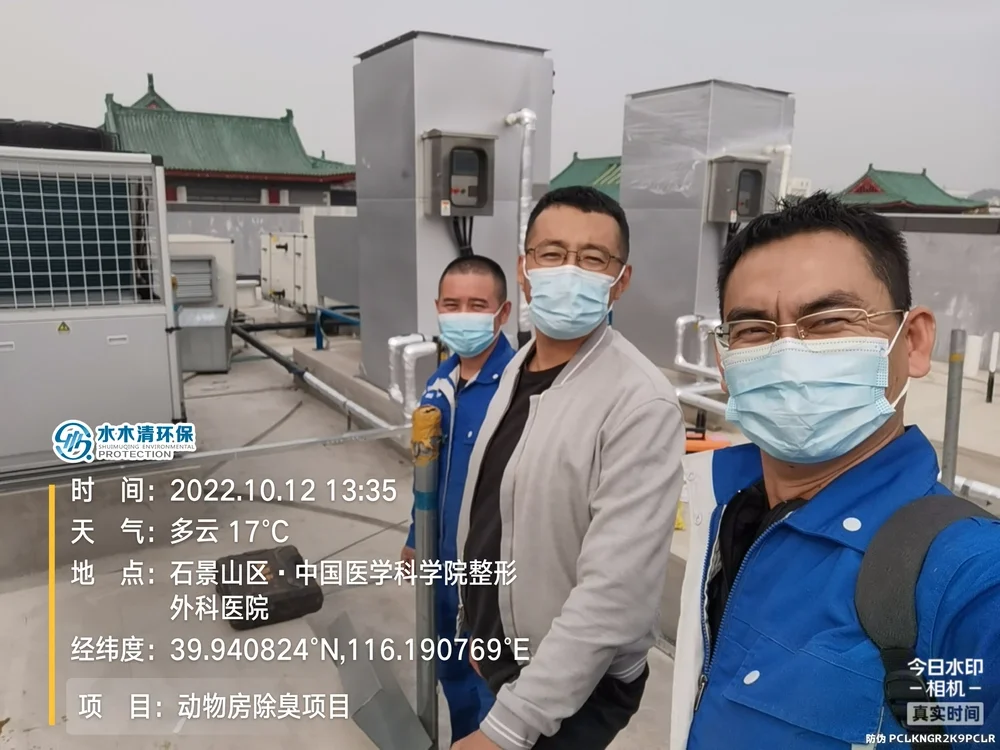
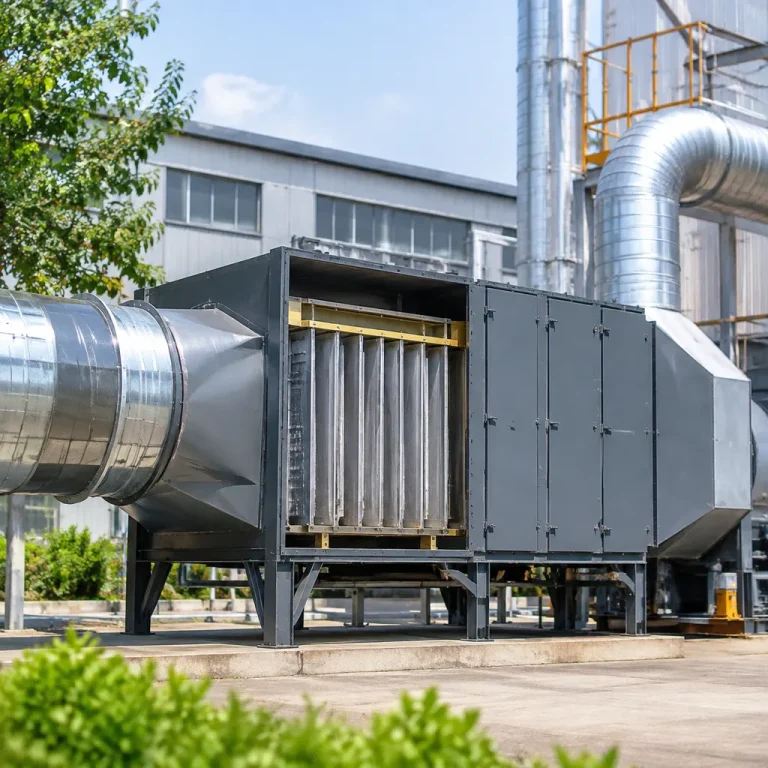
Footprint is the other number that decides whether a retrofit happens. An integrated unit rated at 40,000 m³/h measures roughly 5,250 × 1,650 × 3,000 mm. The inlet, photocatalytic, turbulent, spray, mist-elimination and outlet sections share one casing. An all-PP mesh eliminator then captures entrained droplets, so low-level discharge shows no visible plume.
Sizing an Animal Room Exhaust Scrubber
Sizing starts with airflow and then ends with chemistry. Both have to be settled before the quotation stage, because neither can be fixed afterwards.
Airflow
A common first estimate is room volume multiplied by 15 air changes per hour. Treat that as a floor rather than a target. Real sizing depends on cage density, rack type, whether rack exhaust is treated separately, and where the extract points sit. Undersizing leaves ammonia in the room. Oversizing raises both capital cost and running cost for the life of the unit.
Scrubbing Liquor
So choose the liquor from a gas test, not from habit. Where ammonia and hydrogen sulfide both appear at high concentration, sodium hypochlorite removes both in a single pass. Where ammonia dominates, dilute sulfuric acid is more targeted. Where sulfides dominate, sodium hydroxide suits better. Settling this after the unit arrives means running the wrong chemistry for months.
Materials and Layout
Wet, salty, sulfide-bearing air corrodes mild steel quickly. So specify SS304 or an equivalent grade for the housing, plus an all-PP mist eliminator at the outlet. The unit also needs a drain, reagent storage and enough clearance to reach the nozzles. On a retrofit the available plant room usually sets the maximum footprint, so confirm dimensions before the design freezes.
Discharge Path
A standard unit discharges at low level. Where the stack sits close to sensitive buildings or a visible façade, a jet configuration lifts the plume 20 to 40 m above roof level. That choice changes fan pressure, and therefore power, so settle it during sizing rather than in the site works package.
Retrofits: What to Check Before You Order
In practice, most facilities that buy an animal room exhaust scrubber are replacing something already on the roof. Five items decide whether the project runs smoothly. Space is the first, because the unit is compact but the duct run needed to reach it often is not. Structure comes next, since a wet scrubber full of liquor is heavy and roof loading needs checking. Drainage has to be legal, because scrubber blowdown is a wastewater stream. Power must match the fan and lamp load. Access finally decides maintenance quality, and a unit boxed in by ductwork will not get its nozzles cleared.
Frequently Asked Questions
Performance and Compliance
What removal rate can an animal room exhaust scrubber reach?
Published figures for two-stage turbulent spray units fall between 90% and 98% for ammonia and hydrogen sulfide. Some test reports then quote 99% for ammonia and 98% for hydrogen sulfide. Treat vendor numbers as claims and verify them against an outlet target agreed at commissioning.
Does it remove odour or only ammonia?
It removes both, although by different routes. Ammonia and hydrogen sulfide are neutralised in the liquid. Skatole, indole and other poorly soluble odorants need the photocatalytic stage first, because absorption alone barely touches them.
Does it disinfect the exhaust?
The UV stage inactivates bacteria and fungi carried on dust and aerosols. That lowers the microbial load at the stack. Even so, the system cannot replace HEPA filtration inside the animal room.
Cost, Maintenance and Delivery
What maintenance does it need?
Routine work then covers topping up the scrubbing liquor, checking pH and clearing nozzle blockages. There is no media change and no spent carbon to send for disposal.
How much water and power does it use?
At 40,000 m³/h, published figures are 4.6 kW maximum and 1.2 t/day of water, so running cost stays predictable. A PLC handles dosing and spray timing, so consumption follows the actual load instead of running at a fixed rate.
Can it replace an existing carbon unit?
Usually yes, and the ductwork normally stays. The scrubber needs a drain and a reagent store, which a carbon unit did not. Check those two services before committing to the swap.