Environmental protection equipment supplier

Aeration Tank Odor: Foaming, Septic Conditions and Fixes
Aeration tank odor is usually a process message, not a ventilation problem. Dissolved oxygen below about 1.5 mg/L lets sulfate-reducing bacteria take over. Sewage that arrives already septic does the same thing before the blowers even start. Fix the oxygen, the sludge age and the dead zones, and most of the smell leaves with them. Air treatment comes last, and only for what the biology cannot fix.

Start at the tank, not the fan
Most odour projects open with a quotation for a scrubber. That is the wrong order. The tank usually explains why within five minutes of looking at it. An aeration tank both makes odour and can destroy it, because it already holds the biology and the oxygen that oxidise sulfide.
So the diagnosis comes first. Four surface conditions cover most cases. Each one points at a different cause and a different fix. Get the call wrong and you will spend a season dosing antifoam against a problem that only sludge wasting solves.
Two-minute triage
Thick brown foam that survives a water spray
→
Check sludge age and FOG, not oxygen
White lather that breaks up within minutes
→
Look upstream for a surfactant or CIP discharge
Sludge rising in the clarifier, no foam on the tank
→
Suspect denitrification, check nitrate and anoxic volume
Rotten-egg smell with a clear, well-mixed surface
→
Measure DO across the tank, not at one probe
Four surface conditions and what each one means
Foam is the most misread symptom at a treatment plant. A blanket of two to ten centimetres is normal. A chocolate layer thirty centimetres thick is not. When it climbs the wall and holds its shape after a hose hits it, you are looking at a different system.
Stiff brown foam that lasts for hours
Looks likeDark tan to chocolate, greasy to the touch, leaves a brown ring at the weir.
Most likelyNocardia or Gordonia. Slow growers that feed on fats and oils, and produce surface-active lipids that hold the bubbles together.
Confirm in 5 minutesSVI above 150 mL/g. Sludge age above 10 to 12 days. Influent FOG above 50 mg/L. Any two of the three makes it near certain.
Do this firstWaste more sludge to pull the age down. Then find the grease. Do not start with antifoam.
Pale brown foam that arrives with cold weather
Looks likePaler than the first type and less greasy. Appears with cold mixed liquor around 10 to 15°C.
Most likelyMicrothrix parvicella. A coiled filament that prefers cold, low-oxygen, long-sludge-age conditions.
Confirm in 5 minutesThe season matches. DO sits under 1.5 mg/L in the aerated zone. The same foam appeared last cold season.
Do this firstLift oxygen in the aerated zone and keep wasting. Microthrix loses its edge as DO rises.
White lather that collapses in minutes
Looks likeBright white and light. Collapses fast, and sometimes smells of detergent or solvent.
Most likelyA surfactant pulse. Laundry, CIP rinse, tanker washing or a cleaning chemical reaching the inlet in one slug.
Confirm in 5 minutesCheck the plant log against the time the foam appeared. Test the inlet for surfactants.
Do this firstTrace the discharge and stop it. Biology clears the rest without intervention.
No foam, but a rotten-egg smell at the surface
Looks likeA clean tank with a sharp sulfide smell. Usually strongest at the inlet end or in one corner.
Most likelySeptic influent, a dead zone, or a diffuser grid that has failed in one section.
Confirm in 5 minutesWalk the tank with a DO meter. A drop above 1 mg/L between two points means a dead zone.
Do this firstMap DO spatially, then fix the diffusers or the mixing. More air at the blower will not reach a short-circuited corner.
One pattern matters more than the labels. Biological foam is a wasting problem. Chemical foam is a source problem. Rising sludge is a nitrogen problem. Aeration tank odor that arrives with brown foam is telling you the sludge is old. Odor without foam is telling you the oxygen is missing somewhere specific.
| Type | Colour and feel | Trigger | First move |
|---|---|---|---|
| Nocardia | Dark brown, greasy | FOG, sludge age above 10 days | Waste more, cut the grease |
| Microthrix | Pale brown, winter | Cold liquor, low DO | Raise DO, keep wasting |
| Surfactant | White, breaks in minutes | Laundry, CIP, cleaning slug | Find the source |
| Denitrification | Brown, floats in clarifier | Nitrate in the aerobic zone | More anoxic volume |
| Start-up | Light grey, thin | Young sludge, new plant | Wait, it passes |
The oxygen number that matters is not the one on the probe
Every plant reports a DO value. Most of those values come from one probe in one place. That single number hides the failures which cause most odour. A tank can read 2 mg/L at the probe and 0.3 mg/L in the corner where the flow short-circuits.
0 mg/L3 mg/L and above
Map the tank before sizing anything
Take readings at the inlet end, the outlet end, both side walls and the middle. Use the same depth each time. Two things usually show up. The first is a gradient along the tank, which means uneven aeration. The second is a corner reading near zero, which means a blocked diffuser or a volume the flow never reaches.
Oxidation-reduction potential is the second reading worth having. A value below minus 100 mV confirms anaerobic conditions, even when a DO probe flickers. Sulfide also stays dissolved while pH holds above 7. When pH drifts below neutral, the same sulfide leaves the water much faster. That is why some tanks smell worse after an acidic industrial discharge.
Do not confuse the two readings
A low DO at one point is a mixing problem. A low DO everywhere is a capacity problem. The first needs a diffuser or baffle fix. The second needs a blower or a load reduction. They cost very different amounts, and the probe in the control room cannot tell them apart.
Why aeration tank odor rarely needs a scrubber
Cover the tank and you must extract the air that the blowers just pushed through it. That is the whole problem in one sentence. A tank treating 10,000 m³ of sewage a day moves several thousand cubic metres of air an hour. Almost all of it leaves through the surface.
Now compare the value of that air with the air from the inlet works. Both might be 4,600 m³/h. The screened channel carries around 5 ppm of sulfide from a sharp, local source. The aeration tank carries one or two ppm spread across a surface the size of a tennis court. It carries that load because the biology is working, not because it has failed.

So the money goes further elsewhere. Every kilogram of sulfide you prevent at the tank is a kilogram you do not pay to absorb. The prevention usually costs less than the fan power alone. This is the same logic that puts covers on the inlet works first. It is also why the sequence in a plant-wide odour programme starts upstream.
When the tank does need air treatment
Not every aeration tank odor case can be fixed in the biology. Some plants inherit a condition they cannot change, and then the tank earns a cover. Three cases come up often.
The first is a plant with no room to expand. If the aeration volume is already short, oxygen will sag every summer. No diffuser arrangement fixes a basin that is too small. The second is a site with houses inside 100 m. At that range a complaint arrives long before a process correction takes effect. The third is a septic influent that arrives that way because the sewer is long and the retention time runs to hours.
In those cases, cover part of the tank and extract at a low rate. Target the headspace, not the whole basin volume. A partial cover over the inlet half captures most of the mass for a fraction of the airflow. That smaller stream then goes to a unit sized for it, not to a unit sized for the basin.
The trap
Sealing a tank that is already low on oxygen makes things worse. The biology needs surface transfer, and a cover removes it. Fix the oxygen first, then cover. Otherwise the tank turns anaerobic underneath and the sulfide load rises.
Choosing the stage behind the cover
The stream from a covered aeration tank is large, wet and weak in sulfide. That profile suits some stages and rules out others.
A biofilter handles high volume and low concentration well, and it needs little chemical attention. The trade-off is footprint. Residence time runs to tens of seconds, so the media bed stays wide. A chemical scrubber takes the same volume in a much smaller vessel, but the chemical bill arrives every month. Carbon suits a small, intermittent stream and struggles with the humidity of an aeration headspace.

Whichever stage you pick, size it on the mass of sulfide and not on the airflow. Two streams of 4,600 m³/h behave very differently at 1 ppm and at 5 ppm. A unit that removes 95% of the second case does almost nothing useful in the first. The outlet is already near the detection threshold.
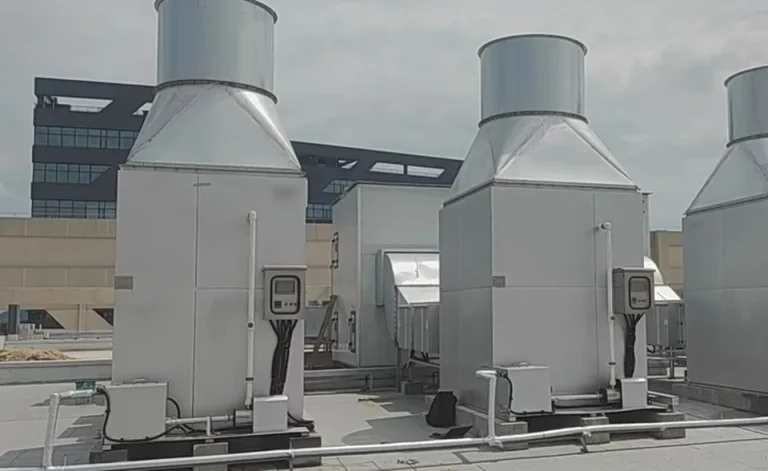
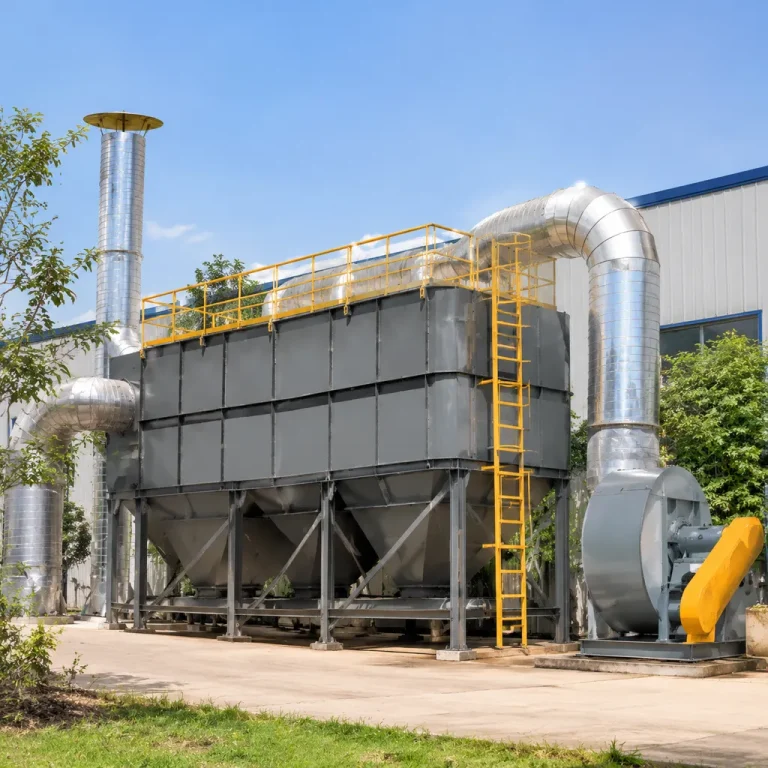
Then house it properly. A roof cabinet needs access to every stage and a drain for condensate. It also needs clearance for a person to change media without removing the duct. The glazed enclosure below is what that looks like when the site sits close to housing.

Using the tank as the treatment stage
There is a cheaper option that more plants should consider. Skip the separate unit. Blow the odorous air into the aeration tank and let the biology oxidise the sulfide to sulfate. The tank already has the oxygen, the mixing and the biomass. The air you inject is air the blowers were going to supply anyway.
Full-scale work at the Schönerlinde plant in Berlin tested this on the exhaust from an aerated grit chamber. The sulfide converted to sulfate in the basin. Oxygen demand even fell, because the injected air carried its own oxygen. The catch is practical. The tank needs capacity, the distribution needs to be even, and the operator has to accept a small change in the air balance.
For a plant with a modest source and a tank running above 2 mg/L, this is often the lowest-cost route. It also removes the fan, the duct and the chemical store from the project.
What to log, and what to stop doing
Four numbers tell you whether an aeration tank odor problem is getting better. Log them weekly and the trend does the diagnosis.
- DO at four points across the tank, not one. A widening spread is an early warning.
- Sludge age, calculated rather than guessed. Above 12 days, expect brown foam in warm weather.
- SVI, which separates a foam problem from a bulking problem before either reaches the weir.
- Influent FOG and pH, because most foam episodes start upstream of the tank.
Two habits are worth dropping. The first is reaching for antifoam as a first response. Silicone antifoam has a place as a stop-gap above 25% surface cover. Fatty-acid products feed the filaments that caused the problem. The second is returning skimmed foam to the tank. That recycles the organisms straight back into the mixed liquor, and the foam returns within a week.
Frequently asked questions
These questions come up most often once the aeration tank odor diagnosis is done and the budget question arrives.
Diagnosis
Why does my aeration tank smell worse in summer?
Warmer water holds less dissolved oxygen, so the same blower delivers a lower DO just as biological demand peaks. Sulfide also leaves the liquid faster as temperature rises. Both effects push the tank toward septic conditions. That is why the same plant can pass all winter and fail in July.
Can low DO alone explain a strong sulfide smell?
It can, but check for a dead zone first. One blocked diffuser section creates a local anaerobic pocket that smells strongly while the plant probe still reads normal. Walk the tank with a portable meter before you blame the blowers.
What is the difference between septic and anaerobic here?
Septic describes sewage that turned anaerobic before it reached the plant, usually in a long sewer or a wet well. Anaerobic describes conditions inside the tank. The first is a collection problem you inherit. The second is an operating problem you can correct. Both produce sulfide, and they need different fixes.
Treatment and cost
Should I cover the whole aeration tank or just part of it?
Usually part. The load concentrates near the inlet, where fresh sewage meets the highest oxygen demand. A partial cover over that zone captures most of the mass with a fraction of the airflow. It also leaves the rest of the surface open for oxygen transfer, which the biology still needs.
Is a biofilter or a scrubber better for aeration tank air?
For high volume and low concentration, a biofilter usually wins on running cost and loses on footprint. A scrubber wins when space is tight or when the sulfide load swings sharply. Size either one on the sulfide mass. A 95% removal figure means very different things at 1 ppm and at 5 ppm.
Can I dose nitrate or iron instead of building anything?
Sometimes yes. Nitrate keeps the sewer and the tank from turning septic. Iron salts precipitate sulfide before it leaves the water. Both work well as source control for a moderate problem, and both add a monthly chemical cost. Price them against a cover and a fan before the capital project goes for approval.
Send us the tank data and we will size the stage
Share the tank volume, the DO profile across the basin, the measured or expected sulfide level and whether the source is septic influent or a dead zone. We will come back with a stage, an airflow and the yearly operating cost, so you can weigh it against fixing the process instead.
Talk to an engineer