Environmental protection equipment supplier

Biofilter Odor Treatment: Media Choice and Residence Time
Biofilter odor treatment succeeds or fails on two decisions taken before any drawing exists. The first is which media goes into the bed. The second is how much of it the airflow has to cross. Empty bed residence time is the number every proposal quotes, yet on most projects it is an output rather than an input. You fix the surface loading first, let the depth turn area into volume, and then read the residence time that falls out. Reverse that order and you get a bed that looks correctly sized on paper and smells at the fence.
What empty bed residence time actually measures
Empty bed residence time is media volume divided by airflow, with no allowance for the space the media itself occupies. That makes it a comparison unit rather than a contact time. Because the media takes up the rest of the volume, the air spends less time in the voids, usually 40 to 60% of the quoted figure.
EBRT (s) = media volume (m³) / airflow (m³/h) x 3600
actual contact time ≈ EBRT x bed porosity (0.40 to 0.60)
Porosity of a bark bed sits near 0.5, so a 30 second empty bed figure is roughly 15 seconds of real contact.
The distinction matters when two suppliers quote different numbers. If one quotes actual contact time and the other quotes empty bed time, the beds are not comparable at all. Always ask which basis a figure uses before you compare it with another.
Residence time also hides the two variables that decide performance. Surface loading sets how fast the air crosses the media face, while mass loading sets how much the microbes have to consume. A bed can show a generous residence time and still fail. That happens because the air moves too quickly across a thin layer of media.
How biofilter odor treatment responds to residence time
Removal does not rise in a straight line with time, so the shape of the curve matters more than any single figure. Three regimes show up on every curve we measure, and each one calls for a different response.
Below 10 seconds: kinetics
Here the culture has not had time to take up the compound. Removal climbs steeply here, so every extra second is worth a lot. Beds in this range are usually under-sized.
10 to 30 seconds: diffusion
At this range transfer into the biofilm becomes the limit. Removal still rises, but the slope flattens, and doubling the bed buys less than half the improvement.
Above 30 seconds: the plateau
By now the bed is doing what the culture can do. Media added past this point costs capital, pressure drop and land, yet returns almost nothing.
Where the plateau sits depends on the compound. Hydrogen sulfide reaches its limit sooner than ammonia. A bed removing 95% of ammonia may remove only 70% of the same concentration of dimethyl sulfide, because that molecule is far less soluble.
| Compound | Working EBRT | Removal at that figure | Note |
|---|---|---|---|
| Hydrogen sulfide, low load | 15 to 25 s | 90 to 98% | Acidifies the bed, so lime dosing follows |
| Hydrogen sulfide, high load | 30 to 45 s | 85 to 95% | Check elimination capacity before depth |
| Ammonia | 15 to 25 s | 90 to 98% | Very soluble, so it transfers fast |
| Organic acids, aldehydes | 15 to 30 s | 85 to 95% | The easiest family to treat biologically |
| Mercaptans, dimethyl sulfide | 40 to 60 s | 60 to 85% | Poorly soluble, so budget a polisher |
| Solvent VOC | not advised | variable | Use carbon or oxidation instead |
Pre-treatment decides what reaches the bed
Since a biofilter cannot reject what it is unable to consume, everything in the stream arrives in the media. Grease, dust, oil mist and solvent peaks all arrive in the media, and the bed degrades from the inlet face inward. That is why most installations put a scrubber or a humidifier ahead of the bed.
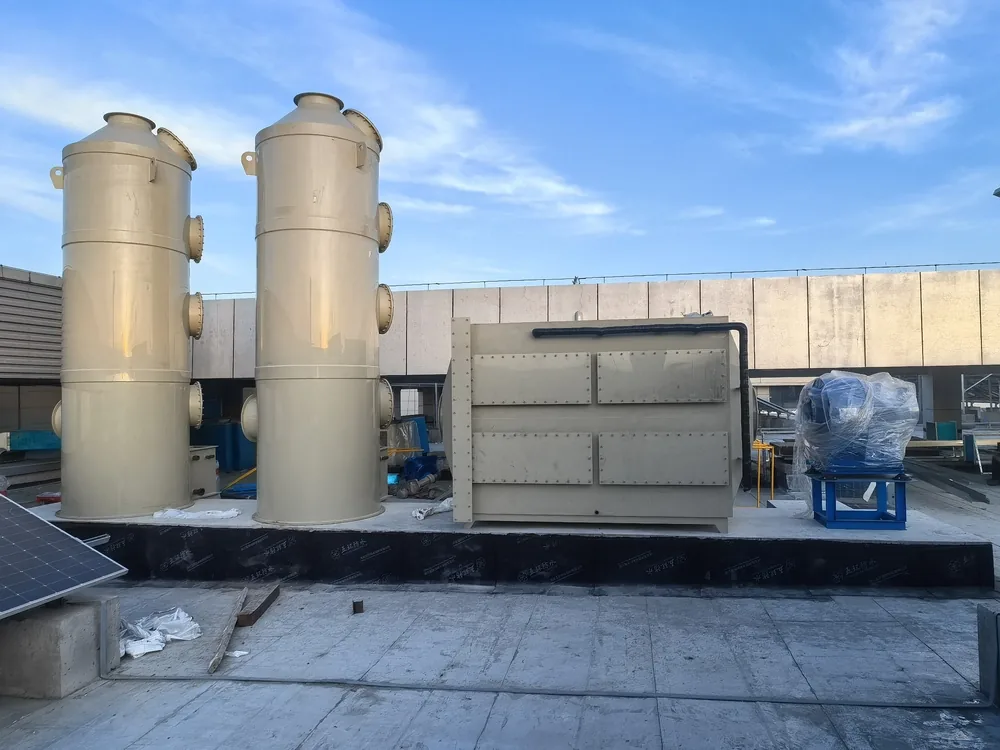
In practice the pre-stage does three jobs. It saturates the gas, so the bed does not dry out at the inlet face. It shaves sulfur peaks that would otherwise acidify the media. And it cools hot exhaust before that heat reaches the culture.
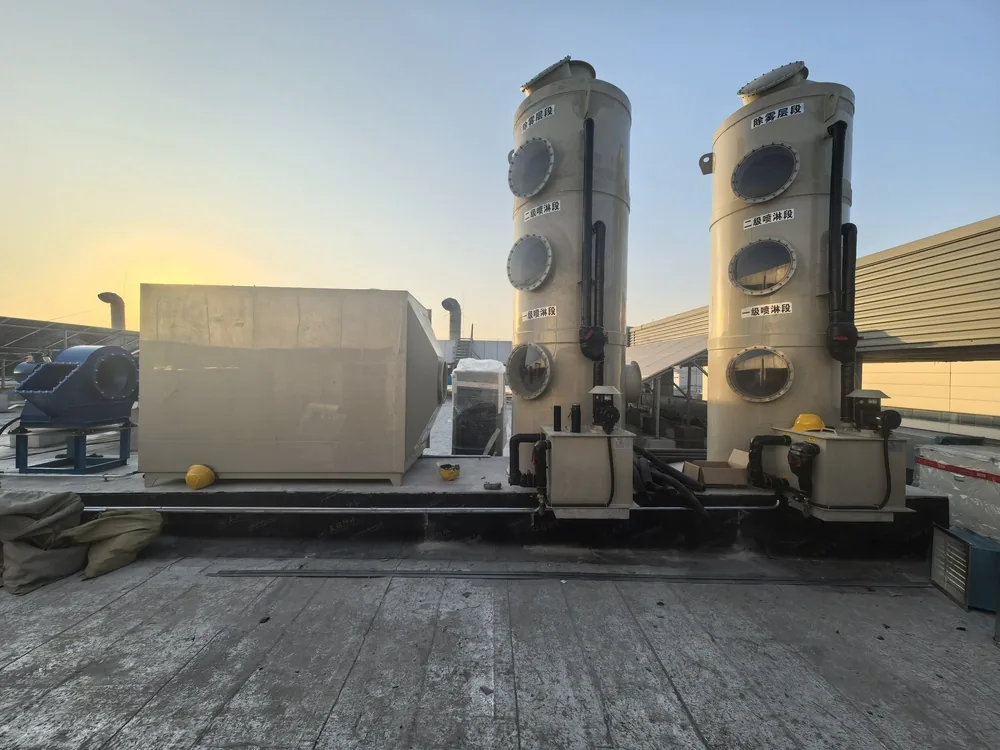
Where the stream is already cool, clean and saturated, a simple humidification chamber is enough. Where it carries grease, a small packed scrubber with an alkaline loop pays for itself through media life alone. Our packed scrubber tower page covers the sizing basis.
Media families and what each one is good for
Because five media dominate the market, the choice sets media life, pressure drop, water holding and how often the bed has to be opened. The figures below are the ranges we work to in biofilter odor treatment design.
Aged bark and wood chips
- Surface area
- 150 to 400 m²/m³
- Life
- 3 to 7 years
- Behaviour
- Holds water well, needs nitrogen dosing
- Best for
- General municipal and food odour
Compost and green waste
- Surface area
- 300 to 1,000 m²/m³
- Life
- 2 to 4 years
- Behaviour
- High initial activity, settles about 15%
- Best for
- Fast start-up on soluble compounds
Heather and peat mixes
- Surface area
- 200 to 500 m²/m³
- Life
- 5 to 10 years
- Behaviour
- Excellent structure, hard to rewet once dry
- Best for
- Long-life beds in wet climates
Inorganic media
- Surface area
- 200 to 600 m²/m³
- Life
- 10 years and beyond
- Behaviour
- No settling, low water holding
- Best for
- Beds that cannot be reopened often
Structured plastic packing
- Surface area
- 100 to 300 m²/m³, high void
- Life
- 10 to 15 years
- Behaviour
- Low pressure drop, needs a trickling loop
- Best for
- Higher loads in a biotrickling filter
Two practical notes. Media settles as it composts, so specify 10 to 15% extra depth and expect to top up after the second year. Mixing grades inside one bed also makes airflow uneven, because the air takes the path of least resistance.
A worked design for 10,000 m³/h
Numbers settle an argument faster than a datasheet, so start the comparison with a mass balance. Here is the first-pass calculation we run on a food plant exhaust at 10,000 m³/h carrying 20 ppm of hydrogen sulfide. It shows why biofilter odor treatment is rarely sized on mass alone.
| # | Item | Value |
|---|---|---|
| 1 | Airflow | 10,000 m³/h |
| 2 | Inlet hydrogen sulfide | 20 ppm |
| 3 | Convert to mass concentration | 20 x 34 / 22.4 ≈ 30 mg/m³ |
| 4 | Mass load | 10,000 x 30 mg = 300 g/h |
| 5 | Media from elimination capacity | 300 / 20 g/m³/h = 15 m³ |
| 6 | Bed area from surface loading | 10,000 / 150 m³/m²/h = 67 m² |
| 7 | Media volume at 1.2 m depth | 67 x 1.2 = 80 m³ |
| 8 | Empty bed residence time | 80 / 10,000 x 3600 = 29 s |
| 9 | Mass loading check | 300 / 80 = 3.8 g/m³/h |
| 10 | Irrigation at 1.5 L/m³/day | 80 x 1.5 = 120 L/day |
Read rows 5 and 6 together, because they disagree by a factor of five. Sizing on mass gives a 15 m³ bed. To cover 67 m² it would have to be 0.2 m deep, and no air crosses a layer that thin evenly. The surface loading rule overrides the mass balance on almost every dilute stream. That is why a biofilter looks oversized next to a carbon adsorption unit doing the same job.
The reverse happens on a concentrated stream, and depth takes over. At 150 ppm of hydrogen sulfide the mass balance needs 114 m³ while the area still needs 67 m². Depth then governs, so the bed goes to 1.7 m and the residence time rises to 41 seconds. Same airflow, different constraint.
Loading rates are the real constraint
Four limits apply at once in biofilter odor treatment, and the tightest one decides the design. Ask for all four in any proposal, because a supplier who quotes only residence time is quoting the least useful number.
| Limit | Typical range | What happens when it is exceeded |
|---|---|---|
| Surface loading | 100 to 200 m³/m²/h | Air channels through, residence time collapses, removal turns patchy |
| Volumetric mass loading | 5 to 30 g/m³/h as H2S | Bed acidifies, biofilm sloughs, odour breaks through |
| Peak to average ratio | below 2.5 | A bed sized on the average passes odour every afternoon |
| Pressure drop | 200 to 800 Pa per metre | Fan runs hot, and compaction goes unnoticed until it stalls |
The peak factor is the one most often missed. A rendering plant on two shifts sends three times the average load for eight hours. So a bed sized on the average fails at the same time every day. Size on the peak hour, then confirm the average still sits comfortably below the elimination capacity.
Moisture, pH and temperature decide whether the media stays alive
Media is a living support rather than a filter, and three variables keep it alive. All three are measured at the bed, not read off the control panel.
Water
Hold media at 40 to 60% moisture by weight, and check it by hand as well as by meter. Below 40 the biofilm goes dormant, and the bed cracks as it dries. Above 65 the voids fill, the bed turns anaerobic, and it starts producing the smell you were treating.
pH
Because sulfur oxidation produces acid, pH falls steadily. A bed treating hydrogen sulfide drifts from neutral toward pH 2 within months. Ammonia removal stops long before that point. Measure leachate pH weekly, and dose lime or dolomite before it falls below 5.
Temperature
The culture works between 10 and 35 °C, with the sweet spot near 25. Below 10 the rate falls away steeply, and a bed that froze needs weeks to recover even after it thaws.
Cold climate design
Northern sites need three changes, and none of them are optional. Cover or bury the bed walls so the perimeter does not freeze. Insulate the inlet duct, and pre-heat with waste heat where it is available. Then reduce the surface loading so a smaller air volume carries the same mass.
A 1 m deep bed in a covered enclosure loses little heat once biological activity starts, because the compost generates heat itself. The failure we see is a bed that was never started properly in autumn, so it entered winter cold and never recovered.
Diagnostic table for a bed that has stopped working
When a biofilter odor treatment system underperforms, the symptom usually points at one cause. Work down this table before ordering media, because most of these faults are fixed with a rake and a hose.
| Symptom | Likely cause | Check first | Action |
|---|---|---|---|
| Odour at outlet, normal pressure drop | Channeling or media shrinkage | Surface for cracks and low spots | Rotovate, top up, reseal the face |
| Rising pressure drop, odour fine | Compaction or water logging | Moisture and pressure trend | Rotovate, cut irrigation, add void media |
| H2S slips, leachate acidic | Sulfur oxidation acidified the bed | Leachate pH | Dose lime, flush, reduce loading |
| Patchy removal, dry surface | Blocked nozzles or wind drying | Spray pattern at the inlet half | Clean nozzles, add a windbreak |
| Ammonia slips only | pH below 5 or bed too dry | pH and moisture together | Correct pH first, then irrigation |
| Performance drops in winter | Bed below 10 °C | Bed temperature log | Insulate, pre-heat, cut peak load |
Media life and when to replace it
Media life is where biofilter odor treatment costs accumulate quietly. Bark and wood chips last three to seven years, compost two to four, and inorganic media ten or more. Settlement, rather than decomposition, usually forces the first intervention, and 10 to 15% of depth can disappear in the first two years.
Judge replacement on three signals rather than on age. Pressure drop that no longer responds to rotovation is one signal. So is a bed that will not hold water. Removal that falls despite correct loading points the same way, at media that has lost its structure. Replacing the top 300 mm often buys another two years at a fraction of the cost of a full change.
Commissioning and proof of performance
A new bed smells of compost for two to four weeks, and that is normal. Judge it once the culture has established, on measurements rather than on the first visit.
- Inlet and outlet samples for the target compound, taken at the same time of day and at design flow.
- Olfactometry to EN 13725 if the permit is written in odour units rather than in ppm.
- Pressure drop across the bed at design flow, recorded as a baseline for later comparison.
- Media moisture and leachate pH, logged weekly through the first quarter.
So agree the acceptance window in writing. A bed removing 90% at month three may settle at 80% in year two. So a contract written on the commission-day figure becomes a dispute later. Our notes on wastewater plant odor control equipment and processes show how that window is usually framed.
What we need to size a bed
Eight inputs turn a biofilter odor treatment enquiry into a proposal. Without them, any number is a guess dressed as an estimate.
- Airflow at normal and peak, in m³/h
- Temperature and relative humidity at the inlet
- The compound, or the gas analysis if you hold one
- Concentration at normal and peak
- Operating hours and the shift pattern
- Available footprint and access for a machine
- Winter design temperature for the site
- The discharge limit or standard you must meet
If you are still choosing between technologies, our comparison of common deodorization methods for environmental facilities places biological treatment against scrubbing, carbon and oxidation on the same duties. For ammonia-led streams the animal room waste gas treatment page shows the arrangement we build most often, and the site FAQ covers the questions we answer most. For a spray-based alternative on diffuse sources, see the spray deodorization system.
Frequently asked questions
These are the biofilter odor treatment questions that come up in most sizing calls, grouped by whether they affect the design or the running of the bed.
Sizing and media questions
What empty bed residence time should I ask for?
Between 20 and 30 seconds for hydrogen sulfide or general odour, and 40 to 60 seconds for mercaptans and dimethyl sulfide. Treat the figure as a check rather than a target, because surface loading decides the area and the depth decides the volume.
How deep should the media bed be?
1.0 to 1.5 m for a conventional biofilter, with 1.2 m as the usual starting point. Deeper beds give more residence time per square metre but raise pressure drop. Anything over 1.5 m also tends to channel along the walls.
Can a biofilter handle solvent VOC?
Only at low concentration and with the right media. Most solvents are poorly soluble and slow to biodegrade, so a biological bed removes a fraction of the load. Above 100 mg/m³ of solvent, carbon or oxidation is the better route.
Operation and maintenance questions
How much water does a biofilter use?
Roughly 1 to 2 litres per cubic metre of media per day, plus whatever evaporates in summer. For an 80 m³ bed that is 80 to 160 litres a day. That is small next to the cost of a dried-out bed.
Why does my bed smell worse in summer?
Two reasons usually combine. Higher temperature raises the inlet load from the source, and faster evaporation dries the bed surface. Both push the same bed past its capacity, so summer is when media depth and irrigation margin get tested.
Do I need a pre-scrubber in front of the bed?
Where the gas carries grease, dust or sulfur peaks, yes. A small scrubber removes what would otherwise blind the inlet face and acidify the media. On clean, cool, saturated air a humidifier is enough.
Next step
Send the eight inputs above. We will return a bed size, a media recommendation and an irrigation rate, with the loading checks shown. If biofilter odor treatment is not the right route for your stream, we will say so in the same reply.