Environmental protection equipment supplier

Industrial Odor Abatement: Technology Selection Matrix
Industrial odor abatement is a removal problem before it is an equipment problem. You identify the compound that carries the smell. Then you choose a stage that can destroy or capture it, and size that stage from flow and concentration. Skip the first step and no volume of airflow or weight of carbon will fix what the fence line smells. The matrix below is how we screen options on a first call, before any drawing exists.
Start with the smell, not the equipment
Neighbours describe odour rather than chemistry. So ask what people actually smell. Each odour family responds to a different removal mechanism, so the answer removes half the catalogue in one sentence.
| What you smell | Compounds behind it | First stage to test |
|---|---|---|
| Rotten eggs, drains, sewage | Hydrogen sulfide, detected near 0.4 to 0.8 ppb | Alkaline or oxidizing scrubber at pH 9.5 to 10.5 |
| Urine, ammonia, soiled litter | Ammonia, 1.5 to 5.2 ppm | Acid scrubber with sulfuric acid at pH 2 to 4 |
| Sour waste, rancid fat, vomit | Organic acids, aldehydes, ketones | Biofilter or biotrickling filter |
| Rotting cabbage, gas leak | Mercaptans and dimethyl sulfide, sub-ppb thresholds | Oxidizing scrubber, or impregnated carbon on small flows |
| Solvent, glue, paint, printing | Toluene, xylene, ketones, 0.3 to 2.5 ppm | Carbon adsorption, or oxidation above 100 mg/m³ |
| Burnt plastic, diesel, hot metal | Partially oxidized hydrocarbons, acrolein | Thermal oxidation or plasma, not scrubbing |
| Damp cellar, mould, wet earth | Geosmin, 2-MIB, mould VOCs | Carbon, because scrubbers miss poorly soluble compounds |
| Fishy, amine, chemical | Trimethylamine and other amines, sub-ppb | Acid scrubber followed by a carbon polisher |
This table is a first filter rather than a selection. Mixed streams exist, and a rendering plant can produce four of these families at once. Still, writing the smell down in plain language before opening a datasheet keeps the discussion honest.
What industrial odor abatement has to remove
In practice, four families cover most of the complaints we are called about. They differ in solubility, in how they respond to pH, and in whether microbes can consume them. Those three differences decide the stage, rather than the concentration alone.
| Family | Typical members | Behaviour in water | Consequence for the stage |
|---|---|---|---|
| Sulfur compounds | Hydrogen sulfide, methyl mercaptan, dimethyl sulfide | H2S dissolves and dissociates above pH 7, mercaptans resist | Needs oxidation, because absorption alone releases it again |
| Nitrogen compounds | Ammonia, methylamine, trimethylamine | Extremely soluble, volatile again above pH 9 | Acid scrubbing is the cheapest route by a wide margin |
| Organic acids and aldehydes | Acetic, butyric and valeric acid, formaldehyde | Soluble and readily biodegradable | Biofilters work well when the bed stays moist |
| Solvent VOCs | Toluene, xylene, ketones, styrene | Poorly soluble | Carbon or oxidation, because scrubbing passes them through |
Because thresholds sit so low, a small leak creates a large complaint. Hydrogen sulfide is detected near 0.4 to 0.8 ppb in published studies, and methyl mercaptan below 1 ppb. Ammonia sits three orders of magnitude higher, at 1.5 to 5.2 ppm, so the same mass reads very differently. So a plant can pass a concentration limit and still fail the smell test at the boundary.
Mass matters as much as concentration. A stream at 2 mg/m³ moving 50,000 m³/h releases 100 g of odorant every hour, which is 876 kg a year. Compliance sampling catches the first number, while neighbours respond to the second.
Six technology families on one datasheet
Almost every industrial odor abatement project we quote lands on one of these six families, or on two of them in series. Each entry lists the four lines that decide the choice, plus the way the stage usually fails.
1
Packed-bed chemical scrubbing
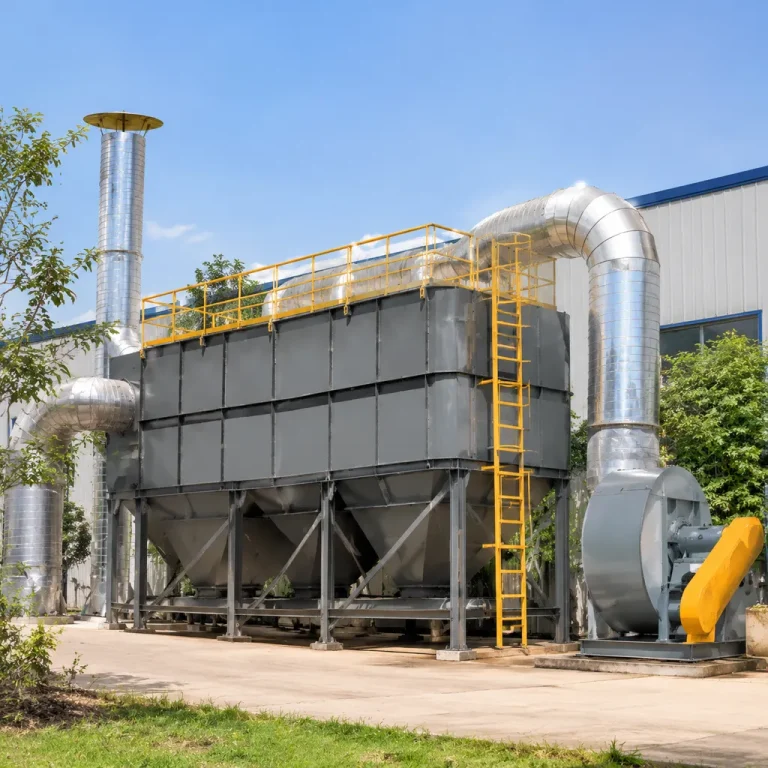
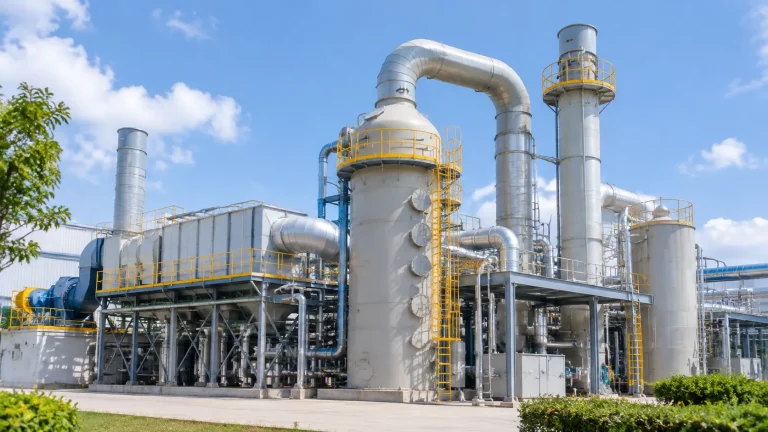
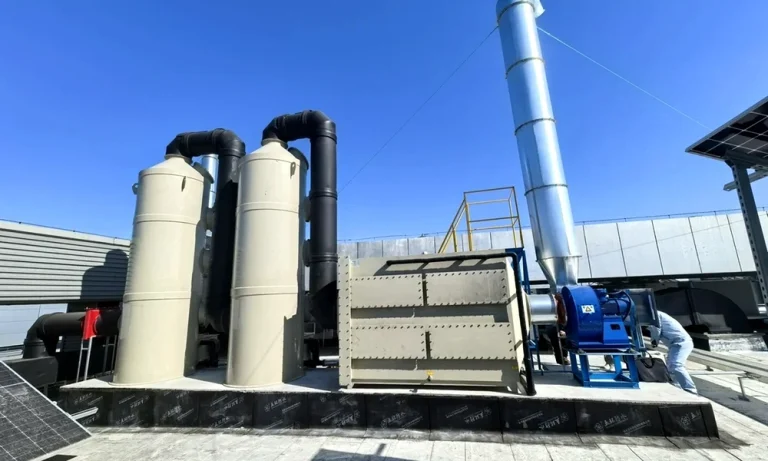
Gas rises through packing while scrubbing liquor runs down inside a packed scrubber tower. The chemistry in the liquid does the work, so pH and oxidant dose matter more than tower height. Which gases one tower can take is set out in our note on what industrial exhaust gases scrubber towers can treat.
RemovesH2S, ammonia, amines, mercaptans
Contact time1.5 to 3 s
Liquid to gas1.5 to 3 L/m³
Pressure drop200 to 600 Pa
OPEX driverCaustic, hypochlorite, blowdown
Failure modepH drifts to neutral, H2S slips
2
Biological treatment: biofilter and biotrickling filter
Microbes on packing or in a bed consume the odorant, so the bed has to stay hospitable. It needs moisture, nutrients and time, and it fails quietly when any of the three runs short. Our comparison of common deodorization methods for environmental facilities sets the biological route against the chemical ones on the same duties.
RemovesAcids, aldehydes, alcohols, some sulfur
Residence time15 to 45 s biofilter, 5 to 15 s biotrickling
Media depth0.8 to 1.5 m
Pressure drop300 to 1,000 Pa
OPEX driverIrrigation, nutrients, media replacement
Failure modeDrying, channelling, acidification
3
Activated carbon adsorption
Carbon holds the molecule instead of destroying it. That makes it excellent for solvents, but a poor choice where the load is high or the humidity sits near saturation. The activated carbon adsorption unit page lists the vessel sizes we build and the media grades we stock.
RemovesSolvents, sulfur compounds, geosmin
Contact time0.5 to 2 s
Bed depth0.6 m minimum
Space velocity500 to 2,000 per hour
OPEX driverMedia replacement and disposal
Failure modeHumidity blinds pores, breakthrough is silent
4
UV photolysis and photocatalytic oxidation
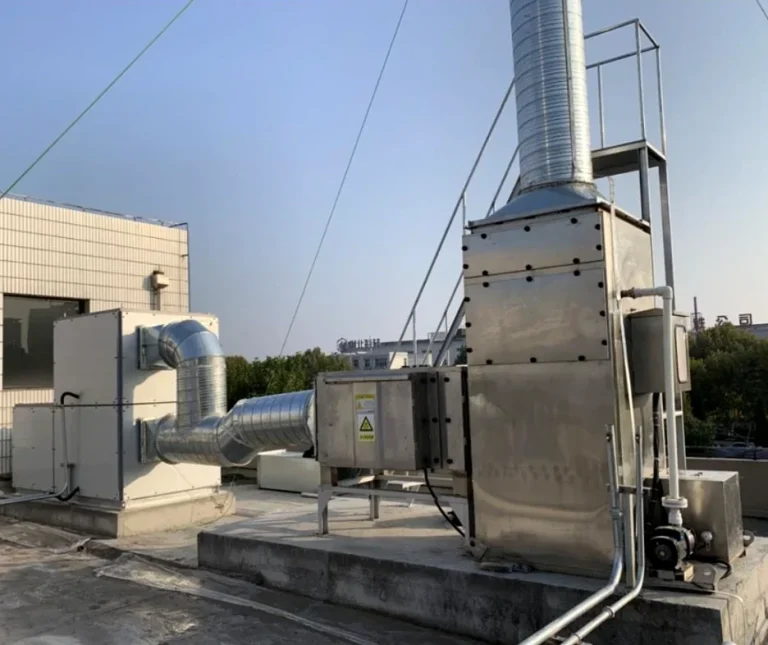
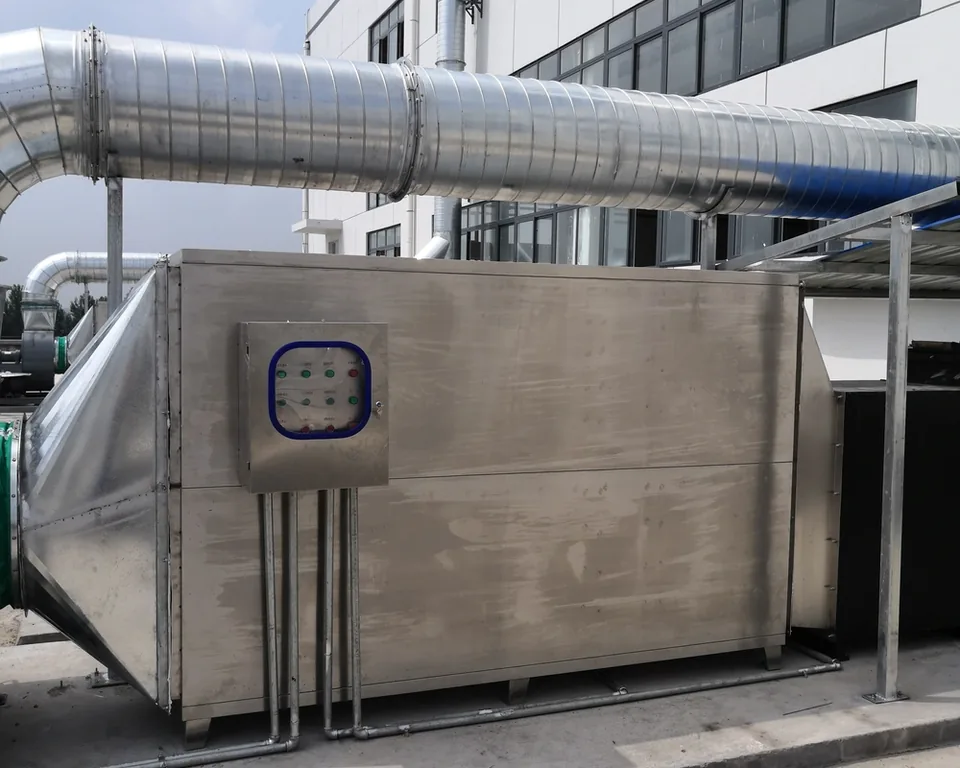
Short-wave UV splits molecules inside a UV photolysis waste gas purifier, and the radicals formed there attack the odorant. Because the reaction needs residence time and clean lamps, this stage handles light loads rather than heavy ones. Where the odour is solvent-based, the UV against carbon comparison shows where each stage stops working.
RemovesMicrobes, light solvent and odour loads
Residence time1 to 3 s
Lamp life8,000 to 10,000 h
Power0.8 to 2 kW per 1,000 m³/h
OPEX driverLamp sets, sleeve cleaning, power
Failure modeAged lamps with no hour meter
5
Non-thermal plasma
A low temperature plasma waste gas system generates reactive species at ambient temperature, without a burner. It suits intermittent, low-flow streams, and it works best as a pre-treatment, because partial oxidation can create new odours.
RemovesLow-concentration VOC and odour
Residence time0.01 to 0.05 s
Energy density5 to 30 J/L
Pressure dropLow, near 100 Pa
OPEX driverElectrode wear and power
Failure modeOzone slip, partial oxidation by-products
6
Thermal oxidation
A regenerative thermal oxidiser burns the odorant at 760 to 850 °C, so nothing leaves unburnt. Because it is the only option here that destroys everything, it appears where the load is high and the permit is tight.
RemovesAll organics, including odorous VOC
Chamber temperature760 to 850 °C
Residence time0.5 to 1 s
Heat recovery90 to 95% with an RTO
OPEX driverAuxiliary fuel and electricity
Failure modeShort residence time, particulate carry-over
The selection matrix
The matrix below is how we narrow industrial odor abatement options from six to two, and it reads the stream rather than the industry. Find the row that matches the stream, then read across for the filled cell. Anything outside the shortlist becomes a comparison point rather than a candidate.
| Stream condition | Scrubber | Biological | Carbon | UV | Plasma | Thermal |
|---|---|---|---|---|---|---|
| Continuous, above 20,000 m³/h, low concentration | A | A | – | – | – | B |
| Batch or intermittent, below 5,000 m³/h | B | – | A | A | B | – |
| High sulfur, anaerobic, near saturation | A | – | – | – | – | B |
| Ammonia dominant, dry gas | A | B | – | – | – | – |
| Solvent VOC above 100 mg/m³ | – | – | B | – | B | A |
| Solvent VOC below 20 mg/m³ | – | B | A | B | B | – |
| Oil mist or dust present, no prefilter | B | – | – | – | – | – |
| Ambient below 5 °C, outdoor installation | A | – | A | B | B | B |
| Footprint under 20 m² on an urban site | B | – | A | A | A | – |
| Neighbours within 200 m, tight limit | A | B | B | – | – | A |
A First choice for this stream
B Workable, usually with pre-treatment
– Poor fit, expect problems
Two rows carry a warning. Oil mist coats carbon and blinds UV sleeves within weeks, so a coalescing filter comes before either stage. Cold weather stops a biofilter biologically, because the bed falls below the range where the culture works. No amount of insulation brings it back in January.
Three trains we build most often
Patterns repeat across sectors, so a shortlist usually starts from a known train rather than a blank page. Between them, these three cover most of the enquiries that reach us.
Rendering and food processing. An alkaline oxidizing scrubber first, then a biofilter or a carbon polisher. The scrubber absorbs the sulfur peak, which would otherwise kill the second stage, so the polisher only takes what is left. The food and beverage industry page shows the layout we use on a cook line.
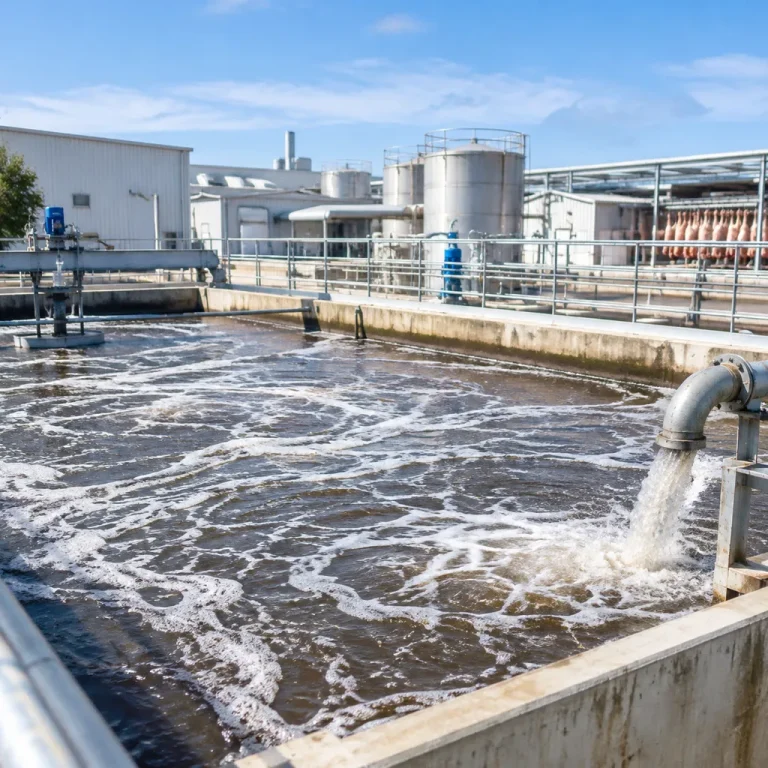
Municipal wastewater. A scrubber on covered channels and wet wells, and a biofilter on general ventilation. Splitting the stream costs less than treating the whole volume to one standard, because the dilute air carries little mass. Our notes on wastewater plant odor control equipment and processes explain where to draw the split.
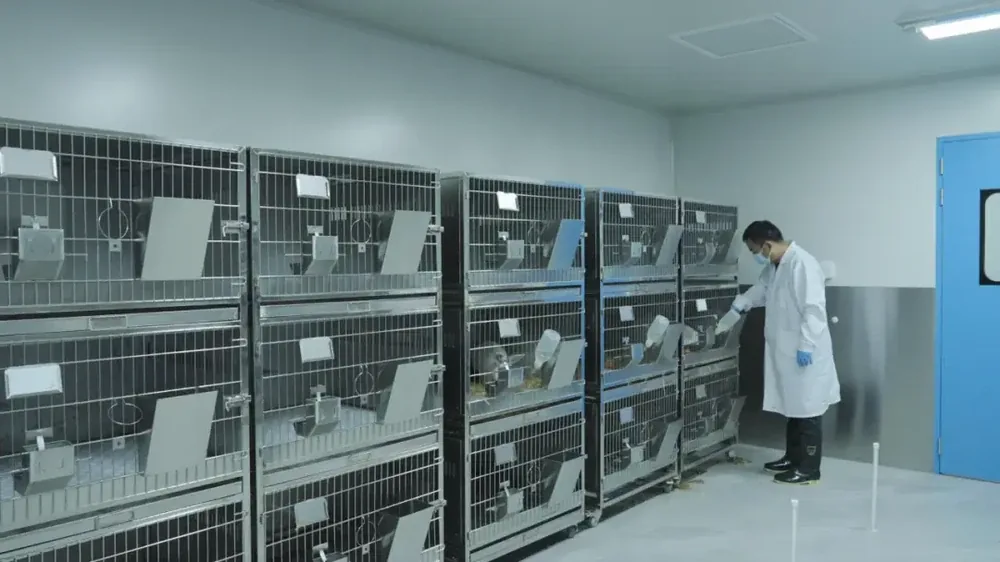
Laboratory animal facilities. Rack-level capture, an acid scrubber for ammonia, then UV or carbon as a polisher. The arrangement is set out under animal room waste gas treatment, and the case studies include a university SPF facility and a vaccine manufacturing site.
In each case the industrial odor abatement train follows the odour chemistry rather than the building. That is why two plants on the same estate can end up with completely different equipment.
An elimination funnel that settles most jobs in five questions
Full evaluations are rare, so most projects go through a shorter funnel. In practice industrial odor abatement decisions come down to five questions. The first one usually removes the most expensive option from the table.
Before the questions, confirm capture. A room hooded at 60% efficiency sends 40% of the mass straight past the train. That share decides whether the fence smells. Spend the first day of any survey on the hoods, not the equipment room.
Q1. Is the stream continuous and above 10,000 m³/h?
Then the shortlist narrows to scrubbing or biological treatment, because carbon and UV become consumable-heavy at that scale. Below 5,000 m³/h on an intermittent duty, carbon and UV return to contention.
Q2. Is sulfur the dominant odour?
Oxidation is the only route that keeps working, so specify an oxidizing scrubber. Carbon will hold sulfur for a while, then release it in a burst when the bed is disturbed or the humidity changes.
Q3. Is the gas within 5 °C of saturation?
Where the gas is saturated, condensation dilutes scrubbing liquor and blinds carbon pores. A knock-out drum and a reheater come first, and on most retrofits they change the total cost more than the choice of stage does.
Q4. Is any oil, dust or aerosol present?
Then nothing downstream survives without a prefilter. We have opened carbon vessels where the first 100 mm of media had caked into a solid layer, and the bed behind it had been doing nothing for months.
Q5. How close is the nearest neighbour?
Because distance sets stack height and exit velocity, both belong in the same budget as the treatment stage. A 98% removal rate still smells if the plume lands in a car park 60 m away.
Where capture is impossible, at open lagoons or tipping halls for instance, a spray deodorization system neutralises odour at the source boundary. It reduces complaints and buys time, yet it does not replace a treatment stage on a concentrated stream.
Sizing numbers you will be asked for
Once two options remain, the talk moves to numbers. These are the parameters we ask a customer for and the ranges we design to, so you can check any proposal against them.
| Parameter | Typical range | What it controls |
|---|---|---|
| Empty bed residence time, biofilter | 15 to 45 s | Media volume and footprint |
| Empty bed residence time, biotrickling | 5 to 15 s | Tower volume and irrigation load |
| Packed scrubber contact time | 1.5 to 3 s | Packing height at a given face velocity |
| Liquid to gas ratio | 1.5 to 3 L/m³ | Pump size and blowdown rate |
| Carbon contact time | 0.5 to 2 s | Media mass and replacement interval |
| Carbon space velocity | 500 to 2,000 per hour | Vessel diameter and bed depth together |
| Duct velocity, main run | 8 to 12 m/s | Duct size against noise and pressure drop |
| Stack exit velocity | 10 to 15 m/s | Plume rise against downwash |
| Fan static pressure allowance | 1,500 to 3,000 Pa | Fan selection and motor margin |
Resist the urge to design at the top of every range. Doubling contact time does not double removal, because the last part of the curve is flat. The fan pays for the difference every hour of the year.
What each option costs to own
Capital cost ranks the six options one way, while five-year cost often ranks them the other. So we model both before recommending anything. The table below shows where the money goes rather than a price, because prices move with the site.
| Option | Capital driver | Main operating cost | Five-year position |
|---|---|---|---|
| Oxidizing scrubber | Tower size, materials, chemical store | Chemicals, water, blowdown treatment | Low to medium |
| Biofilter | Media volume and land take | Media replacement every 5 to 10 years | Lowest where land exists |
| Activated carbon | Vessel and first fill | Media replacement every 6 to 18 months | Highest of the six |
| UV photolysis | Lamp count and power supply | Lamp sets, sleeve cleaning, electricity | Medium to high |
| Non-thermal plasma | Reactor and power supply | Electrodes, electricity | Medium |
| Thermal oxidiser | Refractory, heat exchanger, controls | Fuel, electricity, maintenance | High capital, low operating |
The pattern holds across projects, and it usually inverts the purchase order. Carbon looks cheap on a purchase order and expensive across five years, while a biofilter looks expensive on day one and cheap afterwards. Where land is available and the stream is biodegradable, the biofilter usually wins on total cost.
The stack is part of the system
Dilution is not a treatment technology, yet in industrial odor abatement the stack decides whether the plant gets complained about. Exit velocity, stack height and the building geometry set how the plume behaves in the first 200 m, so all three belong in the design.
A stack below 10 m/s exit velocity is easily pushed down by wind over a roof edge. Once the plume attaches to the building, it enters the recirculation zone and lands in the yard. We have measured 40 ppm at a loading bay from a stack removing 95% of its inlet load. The exit velocity was 6 m/s.
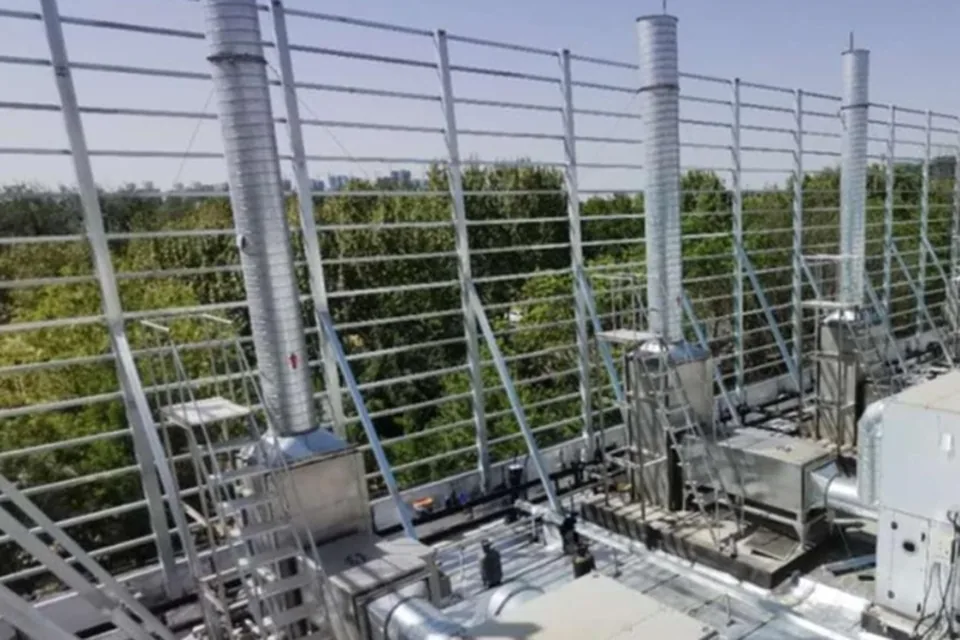
So treat the stack as equipment. Ask for the dispersion calculation, then check the exit velocity against the design wind. Finally, confirm the stack clears the roof by more than the building’s own height at the downwind corner.
Six failures we find on operating plants
Most industrial odor abatement problems we are called to are not sizing errors, although they look like them on the datasheet. They are operating errors that a weekly check would have caught.
- Scrubber pH drifting to neutral. The dosing pump runs, the tank reads 7, and hydrogen sulfide leaves unreacted. A pH controller with an alarm costs less than a month of complaints.
- Carbon bed blinded by condensate. Saturated gas meets cold media, water fills the pores, and the bed stops adsorbing while still looking intact from the outside.
- Biofilter dried out or channelled. Irrigation nozzles block, the bed cracks, gas takes the crack and the rest of the media goes dormant.
- UV lamps past their hours. Output falls long before a lamp fails. Without an hour meter, replacement happens when someone complains.
- Capture left at 60%. Open tanks, missing lids and unsealed hatches let the mass bypass the train entirely.
- Stack too short or too slow. The treatment works, and the plume still lands on the neighbour’s car park.
How to prove it works before you pay the balance
Commissioning is where most disputes start, so agree the test before the order. Four items cover it, and all four belong in the contract.
- Baseline and acceptance samples from the same points, preferably by the same laboratory, using EN 13725 olfactometry for odour concentration and a sulphur analyser for speciation.
- A 72-hour run at design flow, not a one-hour snapshot taken on a good day.
- Logged operating data for pH, differential pressure, irrigation flow and lamp hours, delivered with the report rather than on request.
- A fence-line sniff test by two people who were not on the project, at the hour your neighbours actually complain.
Expect 80 to 95% removal from a single stage on a mixed stream. Claims above 98% usually describe a staged train, because the second stage is where the last few percent come from.
Odour units are worth decoding before a limit is signed. One European odour unit per cubic metre is the concentration at which half a trained panel just detects the odour, so a fence-line limit of 5 ou/m³ allows five dilutions of the raw sample. That is why two plants with the same removal percentage can pass and fail the same limit. The inlet concentration sets the target, rather than the efficiency.
What we need to quote
Every industrial odor abatement quote starts with the same nine items. Send them and the first reply can be a recommendation instead of a catalogue page.
- Flow rate at normal and peak, in m³/h
- Temperature and relative humidity at the inlet
- Odour description, plus any gas analysis you already hold
- Source type: point, area or diffuse
- Operating hours and batch pattern
- Duct or stack dimensions, height and exit direction
- Distance and direction to the nearest sensitive receptor
- Available footprint, power and water
- The discharge limit or standard you must meet
If you are comparing proposals first, the industrial waste gas treatment buyer’s guide and our note on off-gas treatment standards and sizing explain how to read two offers side by side.
Frequently asked questions
These are the industrial odor abatement questions that come up on almost every call, split by whether they affect selection or operation.
Selection questions
Which technology removes hydrogen sulfide best?
An oxidizing scrubber. Sodium hydroxide raises the pH so H2S dissolves, and hypochlorite or hydrogen peroxide converts the sulfide to sulfate. Iron-impregnated carbon works on small flows, but the media is spent quickly once the sulfur load rises.
Can one stage handle ammonia and sulfur odours together?
Rarely. Ammonia needs acid conditions and sulfur needs alkaline or oxidizing conditions, so the two stages sit in series with separate liquor loops. Since a single tower is held at one pH, it will pass one of the two families straight through.
Is a biofilter or a scrubber better for a wastewater plant?
Both appear, and the split follows the source. Covered channels and wet wells produce high-sulfur gas that suits an oxidizing scrubber, while general area ventilation suits a biofilter. Many plants end up with a scrubber on the concentrated stream and a biofilter on the dilute one.
Operation and compliance questions
How long does activated carbon last on an odour stream?
Carbon lasts between six and eighteen months on a light load, and only weeks on a heavy one. Because the interval depends on the mass of odorant per hour, the humidity and the pre-treatment, ask for the design loading in grams per kilogram of media rather than a replacement interval.
What removal efficiency is realistic?
80 to 95% for a single stage on a mixed stream, depending on the compound and the contact time. Above 98% normally means two stages, and the second one is sized for the last few percent rather than the bulk load.
How is odour measured for a permit?
Dynamic olfactometry to EN 13725, reported in European odour units per cubic metre. A panel of trained assessors dilutes the sample until the odour is just detectable. Sulphur compounds are usually speciated by gas chromatography at the same time.
Next step
If you are weighing two options and want a third opinion, send the nine items above. We will say which stage we would test first in your industrial odor abatement project. We will also say which ones we would drop, before any drawing is made.