Environmental protection equipment supplier

Sludge Dewatering Room Odor: High-Load H2S Contro
Sludge dewatering room odor is the highest-strength point on most plants. Cake discharge can push hydrogen sulfide past 50 ppm at the release point. The room itself sits near 5 ppm, with people working in it all shift. Four layers fix it in order: enclose the release, capture it locally, ventilate the room, then treat what you captured. Skip the first two and the last two become expensive.

Why sludge dewatering room odor is the hardest point on site
Compare two sources on the same plant. The inlet works moves 4,600 m³/h of air carrying about 5 ppm of sulfide. A dewatering room might move 6,000 m³/h carrying five times that, with peaks far above it. Same fan size, ten times the sulfur.
The numbers from a 6,400 m³/d plant in Illinois show the shape of it. Above the sludge conveyor, hydrogen sulfide measured 57 ppm. In the press room it sat at 5 ppm, and near the press itself it reached 9.8 ppm. Without ventilation, that room would have drifted past the 10 ppm working limit during a dewatering shift.
Three things make this room different from every other one. Mechanical shear breaks open the sludge floc and releases sulfide held dissolved or bound. The cake then presents a huge wet surface for hours after the machine stops. And the centrate carries dissolved sulfide back through the drain, where it keeps gassing off in a warm, enclosed space.

The concentration map of one room
Sludge dewatering room odor does not come from one place. Treat the room as one volume and you will oversize the fan and undersize the capture. The load sits in four or five spots, and each one behaves differently.
Centrifuge / press20–80 ppminside the housing
Cake discharge50–200 ppmconveyor and chute
Cake hopper30–100 ppmopen top, filling peak
Filtrate channel and floor drain10–50 ppmcontinuous, warm, wet
Operator zone2–10 ppmbreathing height
Room air2–10 ppmwhat the extract sees
door
Plan view of a dewatering room. The mass sits in the middle of the room, not in the air. Three points carry most of the sulfur, and the room air is what is left over after capture.
| Point | Typical H2S | Why it peaks there | First move |
|---|---|---|---|
| Cake discharge | 50–200 ppm | Fresh surface, shear, fall through air | Enclose the chute, not the machine |
| Cake hopper | 30–100 ppm | Open top, big surface, filling surge | Lid plus local extract |
| Centrifuge or press | 20–80 ppm | Mechanical shear inside the bowl | Close the inspection openings |
| Filtrate channel | 10–50 ppm | Dissolved sulfide degassing in a warm room | Cover the channel, extract the headspace |
| Operator zone | 2–10 ppm | Dilution from room air above | Ventilate, monitor, do not rely on smell |
Four layers, in the only order that works
Sludge dewatering room odor control works in one order only. Each layer removes a different share of the load. The first two remove mass, the last two handle what escapes. Most failed projects skipped straight to the third layer and paid for it twice.
1MASS
Enclose the release, not the machine
Seal the chute, the conveyor transfer and the hopper lid. Leave the machine serviceable.
Removes 50–70% of the load2CAPTURE
Extract at the hood, at the right velocity
0.5 m/s into an enclosing hood, 1.0 m/s for an open one. Measure it at the hood, not at the fan.
Removes another 20–30%3ROOM
Ventilate the room as an occupied space
12 to 16 air changes per hour, 100% outside air, supply high and extract low.
Protects people, not the neighbours4TREAT
Treat the captured stream
Two-stage washing for high sulfide and high humidity. Size on mass, not on airflow.
Cleans what layers 1–3 collectedLayer 1: enclose the release point
The instinct is to seal the whole centrifuge. That fails on the first maintenance day, because the bowl has to open. What works is sealing the places where sludge meets air. A flexible curtain around the cake chute does more than a cabinet around the machine. So does a closed screw conveyor in place of an open belt, and a lid on the hopper.
Watch the inspection openings. A centrifuge has several, and each one leaks a little when closed and a lot when someone forgets the latch. The same applies to the polymer mixing point. A small open tank there can release more than the machine it feeds.
Layer 2: capture at the hood
Capture velocity is the number that decides whether this works. An enclosing hood needs about 0.5 m/s at the opening. An external hood needs around 1.0 m/s, and it needs to be close, because velocity falls off sharply with distance.
Place the extract so it pulls air across the release point and away from the operator. Do not put the grille directly over a falling cake stream, because it will swallow wet solids and block within weeks. A side slot along the conveyor cover works better than a ceiling grille above it.
Then measure. A hood that reads 0.2 m/s on a hot wire anemometer is doing nothing. The main duct will still feel strong, and the fan will still sound busy. This single check catches more failed systems than any other.
Layer 3: ventilate the room
Twelve to 16 air changes per hour is the working range for a dewatering room. Twelve is the floor for an occupied space, and 16 suits a room with several machines and open hoppers. Supply 100% outside air, because recirculation concentrates exactly the gas you are trying to clear.
Supply high and extract low. Hydrogen sulfide is heavier than air, and a high-level extract leaves a layer at floor level that the operator walks through. Keep the room 5 to 25 Pa below the corridor or the adjacent spaces, so air moves in through the door rather than out.
What layer 3 cannot do
Diluting 50 ppm at the source into 6,000 m³/h of room air leaves about 5 ppm at the extract. That is a treatment problem you bought by ventilating. Room ventilation protects the operator. It does not solve the odour, and it makes the downstream unit bigger.
Layer 4: treat the captured stream
This stream is warm, saturated and carries far more sulfide than the air from a covered channel. That combination narrows the options. Carbon saturates within days at these concentrations, so it belongs at the end as a polish, not at the front as the main stage.
A two-stage washer handles it: an alkaline stage to absorb hydrogen sulfide, then an oxidising stage to finish the job and control the residual. The pH setpoint matters more than the packing here, because absorption stops once the liquor turns acidic.

A biological stage can work if the load is steady, but it dislikes the spikes that come with a batch dewatering schedule. If you choose one, put a buffer or a pre-scrubber in front and expect a recovery period after every start-up.
Putting it on the roof
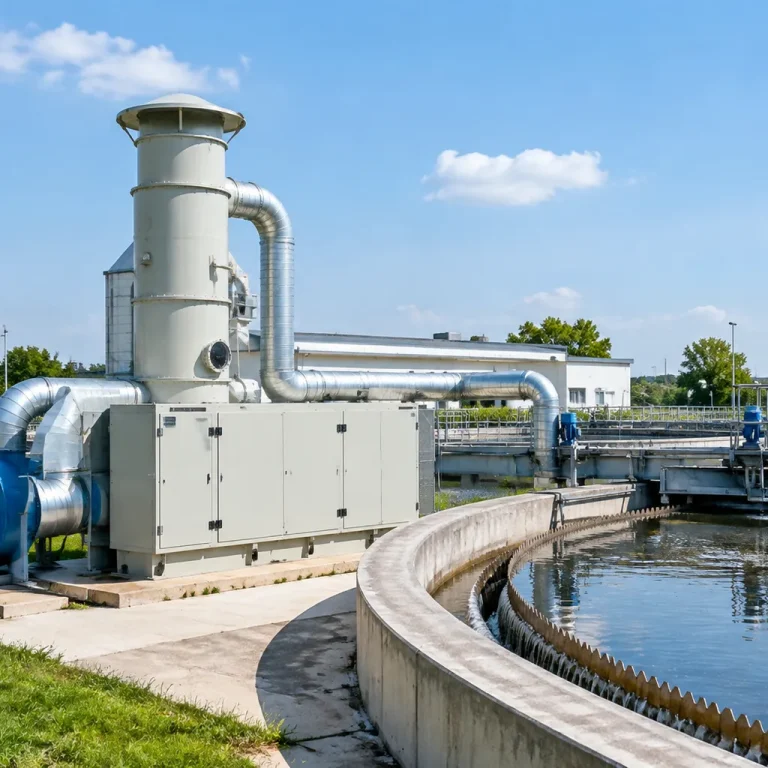
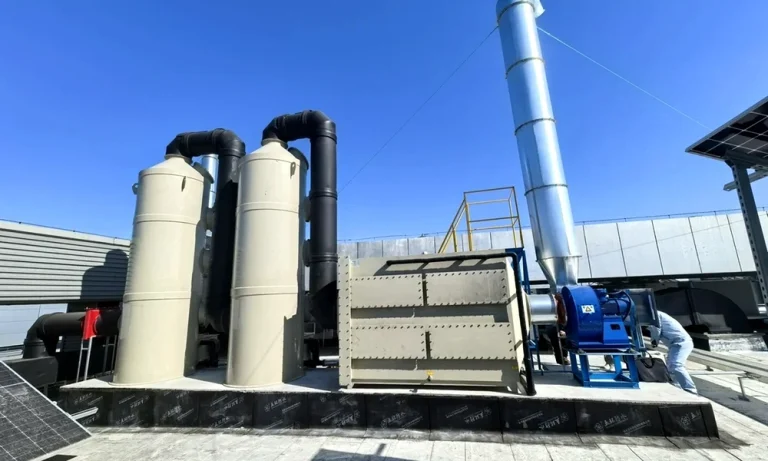
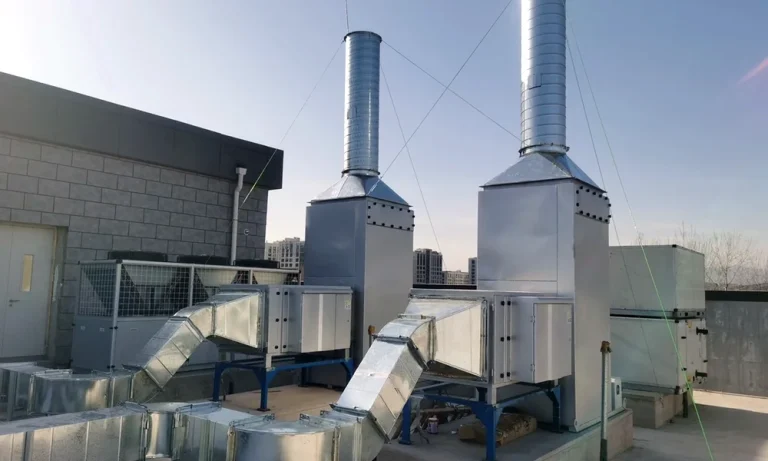
A packaged unit with washer, fan and dosing skid on one frame saves space, and it arrives tested. Two constraints decide whether it fits. The first is weight on an existing roof, because a wet washer is heavy and a slab that carried an old air handler may not carry it. The second is service access, since packing has to come out of the top or the side.
Keep the stack clear of the roof edge and of any intake within 10 m. On a tight site the discharge point often decides the layout, long before the equipment does.

Sizing sludge dewatering room odor control in one pass
Take a room 12 m by 8 m by 4 m. Volume is 384 m³. Local extraction serves three points: the cake chute, the conveyor cover and the hopper lid.
| Item | Basis | Result |
|---|---|---|
| Room ventilation | 14 ACH on 384 m³ | 5,376 m³/h |
| Local extraction | 0.5 m/s on 2.0 m² of hood opening | 3,600 m³/h |
| Total extract | Local plus the balance of room air | 6,000 m³/h |
| Sulfur load | 20 ppm average at 6,000 m³/h | about 170 g/h |
| Tower diameter | 1.5 m/s empty tower velocity | 1.2 m, specify DN1300 |
| Oxidant, 12% NaOCl | Four moles per mole of sulfide, with margin | 10–14 L/h |
Two numbers stand out. The local hoods carry 60% of the airflow but most of the sulfur, because they sit on the concentrated release points. And the oxidant draw runs into litres per hour, not millilitres. That is why dosing control and the chemical store matter as much as the tower.
Size for the peak, meter the average
Cake discharge is not steady. It spikes when the machine cycles, and again when someone empties a hopper. Size the fan and tower on the peak hour, then control the dosing on the measured outlet rather than on a fixed stroke.
What protects the people in the room
Ventilation reduces exposure. It does not make the room safe on its own, and the gas has a property that catches experienced operators. Above roughly 100 ppm, hydrogen sulfide deadens the sense of smell, so the warning disappears exactly when it matters most.
So put detectors where the release happens, not only at the door. Put a sensor at the cake chute and one in the operator zone. Set alarms at 10 ppm and an evacuation signal at 15 to 20 ppm. Link the alarm to the extract fan status, because a stopped fan during a shift is a real event and not a theoretical one.
Entry to a sludge pit or a covered channel still needs a permit, a test before entry and a standby person. Above 50 ppm, a filter mask is not enough and self-contained breathing apparatus is the only correct choice.
Do not trust the nose
Operators who work around sludge for years stop noticing low concentrations altogether. That is adaptation, not safety. The reading on the meter is the only number that counts. Take it where the person stands.
Four mistakes that repeat on every project
These four show up so often that they are worth checking before the drawings go out. Between them they sink more sludge dewatering room odor projects than any single equipment choice.
The first is ventilating the room and calling it odour control. It protects people, and it makes the treatment unit larger. The second is putting the extract grille in the ceiling. Hydrogen sulfide collects low, so a ceiling grille leaves the bottom metre untreated.
The third is choosing carbon for the main stage. At 50 ppm the bed is spent in days, and the replacement cost arrives monthly. The fourth is trusting the fan instead of the hood. A duct that roars proves the fan runs, not that air reaches the release point.
Frequently asked questions
These come up on most sludge dewatering room odor projects, usually after the layout is already fixed.
Design questions
How much air does a dewatering room need?
Twelve to 16 air changes per hour for the room, plus local extraction on the cake chute, conveyor and hopper. Size the fan on the larger of the two approaches. Keep the local hoods on a separate duct, because their load runs far above the room air.
Should local extraction and room ventilation share one duct?
Usually not. The local stream is far more concentrated and often warmer, so it deserves its own treatment stage or its own branch with a damper. Mixing them dilutes the concentrated stream and forces you to size the unit on total volume instead of mass.
Can I just dose the sludge instead of building extraction?
Sometimes, and it is worth pricing. Permanganate or iron salts reduce the sulfide before it leaves the liquid. In the Illinois case, dosing cut the conveyor reading from 57 ppm to 16 ppm and the room reading to below detection. It works well as a first step, though it does not remove the need for ventilation.
Operation questions
Why does the room smell worse on dewatering days only?
Because that is when the sludge is sheared and the cake surface is fresh. Between cycles the room is quiet and the load drops. Design and sample across a full cycle, including start-up, cake discharge and washdown, rather than on a quiet afternoon.
Is a biofilter suitable for this stream?
It can work on a steady load, but dewatering is batchy. High peaks can shock the bed, and recovery takes days. If you use one, put a scrubber or a buffer in front and plan for a period of reduced performance after each start-up.
How often should the hood velocity be checked?
Every quarter, and after any maintenance that opens a cover or moves a duct. A hood reading below 0.3 m/s is close to useless, even when the main duct still feels strong. The check takes minutes with a hot wire meter and catches most failures early.
Send the room layout and we will size the four layers
Share the room dimensions and the number and type of dewatering machines. Add the cake handling arrangement and the measured or expected H2S at the chute. We will come back with hood airflow, room air changes, tower size and the yearly chemical cost.
Request a quotation