Environmental protection equipment supplier

Wastewater Treatment Plant Odor Control: System Design Guide
Wastewater treatment plant odor control is a containment problem before it is a treatment problem. Sewage releases hydrogen sulfide wherever it is agitated with little oxygen present. So the smell comes from a handful of specific points, not the whole site. Cover those points, then draw air from them at a controlled rate. The treatment stage then has a small, steady load to work on. Skip the covering and even a large scrubber is treating dilution.
Why wastewater treatment plant odor control starts in the sewer
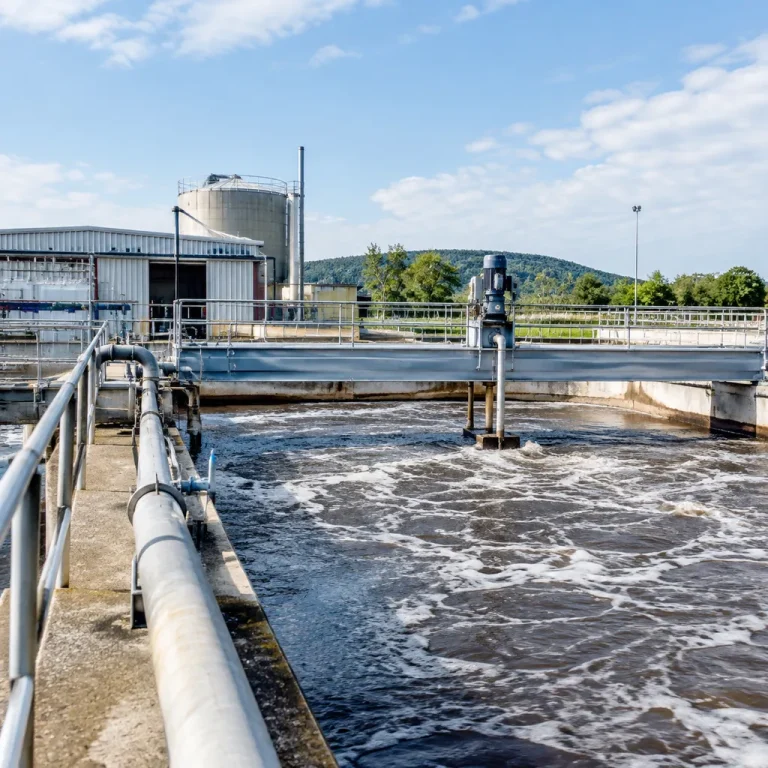
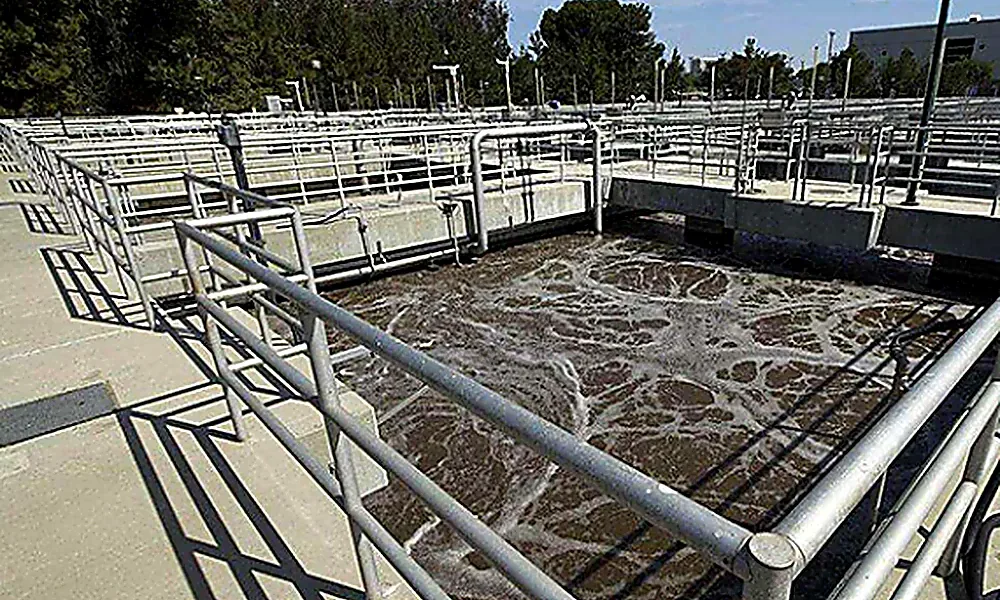
Sulfide forms because sulfate-reducing bacteria work without oxygen. That happens in a long rising main and in a wet well that turns over slowly. It also happens in any channel where solids settle. Once the flow reaches the plant, the same bacteria keep working until the water is aerated.
So two conditions drive the rate. When dissolved oxygen falls below about 0.5 mg/L, the bacteria switch to sulfate. An oxidation-reduction potential below minus 100 mV then confirms it. Temperature matters too, because a widely quoted rule of thumb says sulfide production roughly doubles for every 7 °C of wastewater temperature.
That is why a plant smells worse in August than in February. It is also why the inlet end carries most of the load. It also explains why a plant that adds a scrubber without covering its channels sees little change. The mass still leaves the water surface.
Where the odour actually comes from
So the table below ranks the points we find emitting most often. Concentrations vary widely between plants, so treat the ranges as an indication rather than a specification.
| Zone | Dominant odorant | Typical H2S in air | Why it emits |
|---|---|---|---|
| Inlet works and screens | Hydrogen sulfide, mercaptans | 1 to 50 ppm, higher after a long rising main | First turbulence releases gas held in the flow |
| Grit and grease removal | Hydrogen sulfide, fatty acids | 2 to 30 ppm | Agitation plus a large free surface |
| Primary sedimentation | Hydrogen sulfide, organic acids | 1 to 10 ppm at the weirs | Quiet surface, but sludge blanket turns septic |
| Aeration tanks | Ammonia, amines, some sulfide | 0.1 to 2 ppm, spiking with septic influent | Air stripping carries odour out of the water |
| Secondary clarifiers | Hydrogen sulfide at the weir | 0.5 to 5 ppm | Weir turbulence and returning septic sludge |
| Sludge thickening and dewatering | Hydrogen sulfide, ammonia, mercaptans | 5 to 50 ppm | Thickened sludge is anaerobic by nature |
| Cake storage and loading | Mercaptans, dimethyl sulfide | 2 to 20 ppm | Large exposed area, warm, biologically active |
Odour concentration is a different measure from H2S, so the two do not track each other closely. Raw sewage air often sits between 200 and 2,000 odour units. Sludge handling air, by contrast, can exceed 10,000. That gap appears because the sulfur species with the lowest thresholds are not the most abundant ones.
Walking the plant in process order
In wastewater treatment plant odor control, the zones that smell are the ones where sewage is agitated without oxygen. So walk the process from inlet to cake store, because the fix at each stop is different.
- 1Inlet workshighest loadCover the channel, extract at 6 to 12 air changes per hour, and expect the peak load of the whole plant here.
- 2Screens and screenings handlingThe conveyor and skip are often worse than the channel, because wet screenings sit in the open.
- 3Grit and grease tankslarge surfaceAerated grit chambers strip sulfide into the air, so extract from the covered headspace, not from the room.
- 4Primary clarifiersCover the weirs and launder, and control the sludge blanket, because a septic blanket emits for hours.
- 5Aeration tanksdiluteLarge air volume and low concentration, so treat the mixed liquor, not the air, wherever possible.
- 6Secondary clarifiersWatch the weir and the return sludge, since septic return flow carries sulfide back into the works.
- 7Sludge thickening and dewateringhigh loadEnclose the equipment, extract hard, and keep the room under negative pressure.
- 8Cake store and load-outSeal the bay, extract at the loading face, and schedule loads away from sensitive hours.
The three stops that decide the result
Inlet works and wet wells
The inlet is where the load is highest and where covering pays back fastest. A covered channel captures most of the release when the openings hold 0.3 to 0.5 m/s. It also keeps the surrounding yard clean. Without a cover, extraction pulls yard air instead.
Sludge handling
Thickened sludge is anaerobic, warm and concentrated, so this zone produces the strongest air on site. Enclose the centrifuge or press, then extract from inside the enclosure. Then hold the room at 20 to 50 Pa below the corridor. Our notes on wastewater plant odor control equipment and processes cover the enclosure details.
Aeration tanks
Better to leave this zone untreated, since treating the air is usually the wrong answer. The volume is enormous, and the concentration is low. So better to control the cause. Keep dissolved oxygen above 1.5 mg/L, avoid septic return streams, and manage foam before it carries odour across the site.
Covering and extraction decide more than the scrubber
In practice wastewater treatment plant odor control is settled by the covers, not by the treatment stage. In practice three numbers carry most of the design.
The first is air change rate, which sets the fan size. Enclosed rooms want 6 to 12 changes per hour. A covered channel instead needs enough extraction to hold the opening velocity. The second is negative pressure, usually 20 to 50 Pa below the surroundings, so air moves inward at every gap. The third is duct velocity: 8 to 12 m/s on the main run, so condensation and solids keep moving.
Common mistake
Sizing the scrubber from the channel area rather than from the extracted airflow. A cover that leaks draws yard air, and the treatment stage then works on a bigger, weaker stream for the same mass of sulfide.
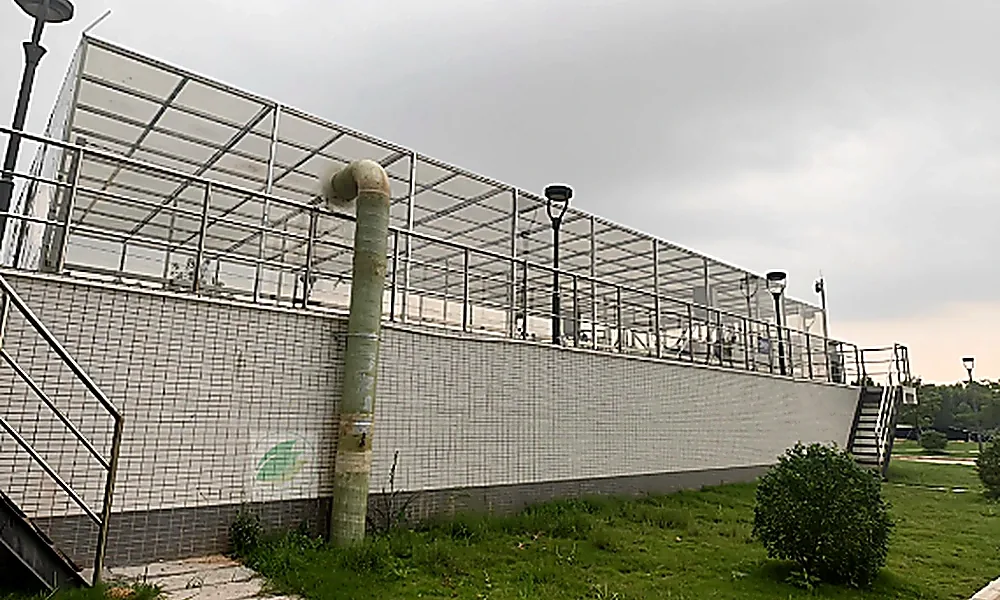
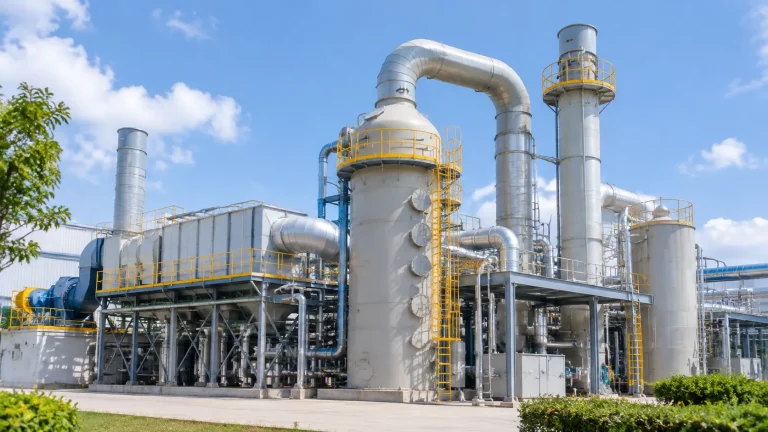
Materials deserve a line of their own, because odorous air is wet and acidic. Concrete covers spall unless they are coated, and 304 stainless pits at the welds within a few years. GRP, coated concrete and 316L are the usual choices here, because 304 pits at the welds. The scrubber tower page covers what we build for these duties.
Dosing the water is often cheaper than treating the air
Not every odour problem needs a bigger scrubber. Sulfide forms in the water, so controlling it there removes the load before it ever reaches the air. Three approaches are common, although each suits a different plant.
Nitrate dosing keeps the bacteria on nitrate instead of sulfate, so sulfide never forms. It works well in long rising mains and in wet wells with a long retention time. The dose follows the flow and the sulfide profile, so the cost is usually lower than treating the equivalent air.
Iron salts instead precipitate sulfide as iron sulfide, which stays in the sludge. That suits plants that already dose coagulant, because the chemical feed is in place. It also reduces the corrosion load inside the pipe, which is where much of the saving appears.
Oxygen injection raises the redox potential in a force main, which keeps sulfide from forming. It is used where a long sewer feeds a plant with a tight boundary. It is capital light and chemically simple, but the operating cost follows the pipe length closely.
Once the air-phase load falls, the treatment stage can be smaller. In practice the cheapest wastewater treatment plant odor control programme combines water dosing with covers. The scrubber is then reserved for peaks.
Choosing the treatment stage for the air you extract
The air you extract sets the stage, and wastewater treatment plant odor control rarely uses one stage alone. So the comparison below is the one we run on a first pass.
| Stage | Best at | Weak at | Typical duty |
|---|---|---|---|
| Caustic or oxidizing scrubber | Hydrogen sulfide, mercaptans, peaks | Ammonia, solvents, energy cost | Inlet works and sludge rooms, 1 to 3 s contact |
| Biofilter | Large dilute volumes, mixed odour | Peaks, cold weather, high sulfur | Aeration and general ventilation, 20 to 45 s |
| Biotrickling filter | Higher sulfur loads in a small footprint | Nutrient control, winter start-up | Covered channels, 5 to 15 s |
| Activated carbon | Polishing, low concentration, solvents | Cost at high load, humidity | Behind a scrubber or a biofilter |
| Spray deodorization | Area sources, open tanks, temporary relief | Concentrated streams, measurable removal | Yard and tank surfaces, boundary control |
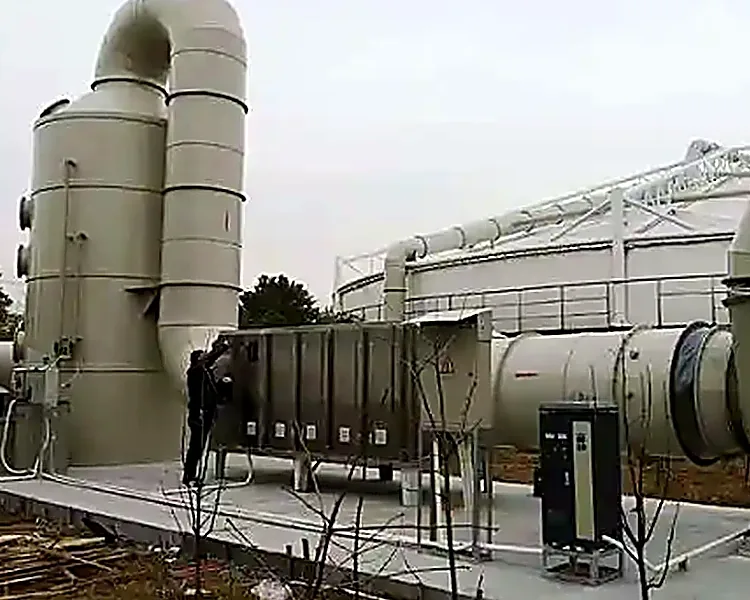
In practice two combinations cover most plants. On a mixed site, a scrubber on the inlet and sludge streams with a biofilter on general ventilation works well. When land is short, a biotrickling filter replaces the biofilter. It saves footprint at the cost of tighter nutrient control.
Where capture is impossible, a spray deodorization system reduces the boundary concentration. It is a supplement rather than a substitute for extraction. Our comparison of common deodorization methods for environmental facilities also sets out where each option stops working.
Retrofit or new build: two different problems
Most wastewater treatment plant odor control work is retrofit work, and that changes the design. A new plant can plan covers, duct routes and a stage room from the start, because nothing is built yet. A retrofit has to work around what is already built, so that constraint shapes the whole design.
So space is the first limit. A biofilter needs land the plant may not have. So a biotrickling filter or a scrubber on a steel frame often replaces it. The second is duct routing, which is where retrofits lose room. A 1,200 mm main has to cross the site without blocking access roads or services.
The third is shutdown windows, and they are shorter than the drawings assume. Tying a new duct into a live channel means a night shift and a temporary cover. It also means a plan for the gas that escapes while the work happens. That plan belongs in the programme, not in the site diary.
The fourth is fan capacity, and it is the one most often missed. Covers add pressure drop, so an existing fan may run short of duty once the extraction is connected. Check the fan curve against the new system resistance before ordering the ductwork.
Retrofit work also tends to arrive in phases, because budgets rarely cover a whole site. That is why the sequence in the last section matters. It lets each phase stand on its own while fitting the next.
The stack, the plume and the neighbour
For wastewater treatment plant odor control the stack is where the design gets judged. A compliant outlet can still land on somebody’s garden. So exit velocity, stack height and the buildings around it decide the first 200 m.
Aim for 10 to 15 m/s at the stack exit, because below that the plume stalls. Below that figure, wind over a roof edge pushes the plume down into the yard. The plant then smells worse than its outlet reading suggests. Then keep the stack clear of the roof by more than the building height at the downwind corner.
When housing sits within 200 m, add a dispersion calculation to the design package. It costs little at design stage, yet it is the document that settles a complaint six months later.
What the neighbours actually measure
A plant can meet its hydrogen sulfide limit and still receive complaints. Yet the two measures are not the same thing. Odour is a mixture effect, so the compounds with the lowest thresholds are often present in trace amounts.
Olfactometry to EN 13725 reports odour concentration in European odour units per cubic metre. One unit is the point at which half a trained panel just detects the smell. So a boundary limit of 5 ou/m³ allows five dilutions of the raw sample.
That is why two plants with the same removal percentage can pass and fail the same limit. So the inlet concentration sets the target. The biofilter design guide shows how residence time and media choice move that number.
For practical purposes, sample at the hours when complaints arrive rather than at the quietest part of the day. A single afternoon sample from a well-run week tells you very little, because Monday is a different plant.
Monitoring that stops complaints before they arrive
Wastewater treatment plant odor control fails quietly, so monitoring has to be deliberate. Four measurements cover a typical site, and all four are inexpensive.
- Hydrogen sulfide at the inlet of each treatment stage, logged continuously rather than sampled weekly.
- Cover opening velocity or space pressure, checked quarterly with a smoke test at the joints.
- Outlet odour by olfactometry to EN 13725 once or twice a year, plus a fence-line sniff at complaint hours.
- Chemical or media consumption per unit of sulfide removed, which is the earliest signal of a drifting stage.
The last one is the most useful, yet the least used. When caustic consumption per kilogram of sulfide rises, the scrubber is losing efficiency before any outlet reading moves.
Winter, foam and the seasonal failures
Most odour programmes are designed in summer, then fail in winter, or the other way round. Four seasonal effects are worth designing for.
Cold slows a biofilter, because the culture works between roughly 10 and 35 °C. Insulate the bed, and pre-heat the inlet where waste heat is available. Accept a lower removal rate in January rather than promising a summer figure all year.
When flows drop over a holiday weekend, sewers turn septic. So the Monday peak arrives with the highest sulfide load of the week. Size for that peak, and let the dosing respond to it rather than to the average.
Foam in aeration is a separate problem, although it produces the same symptom. Foam carries odour across the site and coats walkways, so treat it as an operational issue before adding extraction. The spray deodorization system is sometimes used at the boundary while the foam is brought under control. That is not a fix on its own.
Warm weather does the opposite, and it arrives faster than a bed can adapt. Higher water temperature raises sulfide production, so July is the test month. A bed that was adequate in March may be short of capacity in July.
What the system costs to run
Running costs in wastewater treatment plant odor control sit in three places, and their balance changes with the stage you choose. Fan power is the common item. It runs at roughly 1 to 3 kW per 1,000 m³/h against 1,500 Pa of system pressure.
A scrubber spends on caustic and oxidant, and the bill follows the sulfide load rather than the airflow. A biofilter instead spends on irrigation, nutrients and media replacement every five to ten years. Carbon spends on media and disposal, so the interval shortens quickly as load rises.
Cover maintenance is the item nobody budgets for, yet it decides the fan bill. Coated concrete, gaskets and access hatches need attention every few years. A leaking cover also raises the airflow the fan has to move.
A design sequence you can follow
Eight steps take a plant from complaint to specification, and each depends on the one before. Each one depends on the step before it, which is why skipping the survey produces an oversized scrubber.
- Walk the plant at the hour complaints arrive, and note which zones smell at that hour rather than at noon.
- Measure hydrogen sulfide at each zone, and log the peak rather than the average.
- Decide the capture method per zone: cover, enclosure, local hood or area spray.
- Calculate the extracted airflow from opening velocity and air change rate, not from the building volume alone.
- Size the duct at 8 to 12 m/s, then check the fan against the real pressure drop including the treatment stage.
- Select the stage from the load and the airflow, and expect two stages on a mixed site.
- Check the stack against the nearest housing before the layout is frozen.
- Write the acceptance test into the contract: outlet sulfide, odour units, and logged operating data.
What a specification should contain
A specification that lists equipment invites a price on equipment, so list performance instead. One that lists performance invites a design, so include the items below.
- Extracted airflow per zone, with the opening velocity or air change rate it is based on
- Design and peak hydrogen sulfide at the inlet of each stage, not just the average
- Outlet limits in both ppm and odour units, with the test method named
- Cover type per zone, with the material and the access arrangement
- Space pressure target for each enclosure, and how it will be verified
- Duct velocity, material and the condensate drainage points
- Chemical or media consumption per kilogram of sulfide removed, as a performance figure
- Stack height and exit velocity, with the dispersion basis
- Operating data to be logged, and the format it will be delivered in
That list fits on one page. It settles most of the arguments that otherwise appear at handover.
Commissioning and the first wet week
A new cover and a new stage behave differently once real sewage arrives. Commission on sewage, not on clean water, because the load on clean water tells you almost nothing.
Run for a week at design flow, then record the peak. Then check that every opening pulls inward. Check that no duct has a low point holding condensate, and that the dosing holds its setpoint through a load swing. The note on what scrubber towers can treat is worth reading before you accept a performance figure. The municipal industry page lists the configurations we build most often.
Frequently asked questions
These are the questions we hear most often about wastewater treatment plant odor control. They are split by whether they concern the design or the operation. More answers sit on our site FAQ.
Design questions
Where should we start if the budget only covers one zone?
Start at the inlet works. It carries the highest load, it is the easiest to cover, and it usually produces the largest reduction in boundary odour per unit spent. Sludge handling comes second.
How much air should we extract from a covered channel?
Enough to hold 0.3 to 0.5 m/s at the openings, which usually lands between 6 and 12 air changes per hour for the covered volume. The opening velocity matters more than the air change figure, because it is what stops gas escaping.
Is a biofilter or a scrubber better for a plant like ours?
A scrubber suits the concentrated streams at the inlet and in sludge handling, where sulfur peaks would upset a bed. A biofilter suits the large dilute volume from general ventilation. Most plants end up with both.
Operation questions
Why does the plant still smell after the scrubber was installed?
Because the covers leak or the capture is incomplete, so mass bypasses the stage. Check opening velocity and space pressure first, then check that the scrubber is holding pH and oxidant at the design points.
How often should covers and ducts be inspected?
Covers quarterly, with a smoke test at the joints, and ducts annually for condensate and corrosion. A leaking gasket raises the airflow the fan must move, so the symptom often appears as a fan that runs louder each year.
Can spray deodorization replace a treatment stage?
No. It reduces boundary concentration on area sources and buys time on a hot afternoon, but it does not remove a measurable mass of sulfide. Use it behind capture and treatment, not instead of them.
Next step
Then send us a plan of the plant with the zones marked. Also add the airflow you can extract from each, and any hydrogen sulfide readings you hold. We will tell you which zones to cover first in your wastewater treatment plant odor control programme. We will also say what the stage behind them has to handle.