Environmental protection equipment supplier

Industrial Emissions Compliance Checklist Export Projects
Understanding Industrial Emission Compliance for Export Projects
Navigating the complexities of international trade requires a rigorous approach to environmental standards. Industrial projects must align with destination-specific mandates to ensure successful commissioning and long-term operational viability.
Key Regulatory Frameworks in Global Markets
Compliance is dictated by the regional standards of the target market. Key frameworks include:
- European Union: Adherence to the Industrial Emissions Directive (IED) and Best Available Techniques (BAT) reference documents is mandatory to obtain CE marking.
- North America: Facilities must align with US EPA MACT (Maximum Achievable Control Technology) standards and comply with local NFPA guidelines for fire and explosion prevention.
- Global Standards: Projects often require adherence to ISO 14001 environmental management systems alongside localized national environmental thresholds for air and water quality.
Main Types of Industrial Emissions to Address
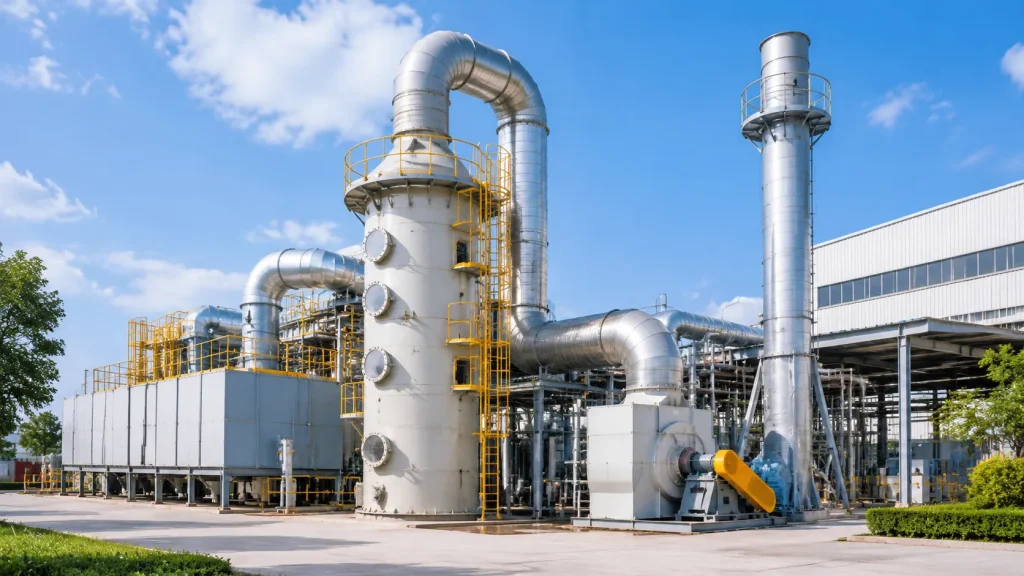
Engineering teams must design treatment systems capable of managing diverse output streams to meet normalized mg/Nm³ limits:
- Particulate Matter (PM): Capturing dust and fine particles through high-efficiency baghouses and filtration media.
- Volatile Organic Compounds (VOCs): Utilizing thermal oxidation or activated carbon adsorption to meet stringent destruction and removal efficiency (DRE) targets.
- Acid Gases and Oxides: Managing SO2 and NOx through specialized scrubbing technology and chemical neutralization processes.
Impact of Non-Compliance on Export Operations
Failure to meet emission requirements poses significant risks to project timelines and financial health:
- Legal & Regulatory Sanctions: Non-compliant equipment may be barred from site operation, resulting in daily fines or revocation of permits.
- Operational Stoppages: Systems failing to pass commissioning tests require costly retrofitting, leading to unplanned downtime and loss of output.
- Reputational Damage: B2B contracts often include stringent performance bonds; failing to achieve certified emission benchmarks can trigger breach-of-contract penalties and loss of future project eligibility.
Pre-Project Environmental Assessments and Approvals
Securing environmental clearances before dispatching equipment saves months of costly downtime. As an engineering team delivering turnkey installations worldwide, we integrate local regulatory approvals directly into our industrial emissions treatment compliance checklist for export projects. Getting upfront validation ensures your treatment systems clear customs, satisfy local environmental protection agencies, and match the destination site’s precise operating envelope.
Environmental Impact Assessment (EIA) Verification
Every export destination enforces specific EIA conditions that define maximum ground-level concentration limits and stack discharge parameters. We verify the local environmental impact assessment documentation early to align equipment design with local legal standards:
- Airshed Capacity Analysis: Confirming whether the target plant operates in an attainment or non-attainment zone for particulate matter, sulfur oxides, and nitrogen oxides.
- Dispersion Modeling Validation: Calibrating exhaust velocities, discharge temperatures, and stack heights using AERMOD or CALPUFF models accepted by destination regulators.
- Secondary Waste Streams: Identifying destination-specific handling rules for spent media, collected fly ash, and concentrated scrubber sludge.
Consent to Establish (CTE) and Consent to Operate (CTO)
Cross-border industrial projects require a two-stage permitting workflow to guarantee compliance from blueprint to commissioning:
| Approval Stage | Focus Area | Required Engineering Submittals |
|---|---|---|
| Consent to Establish (CTE) | Pre-construction validation | P&IDs, equipment footprint, emission destruction/removal efficiency (DRE) guarantees, and acoustic impact sheets. |
| Consent to Operate (CTO) | Post-installation validation | Factory acceptance test (FAT) records, emission testing ports layout, CEMS specs, and spill prevention control plans. |
We design equipment modules to meet both stages seamlessly, preventing redesigns during on-site civil and mechanical integration.
Baseline Air and Water Quality Monitoring
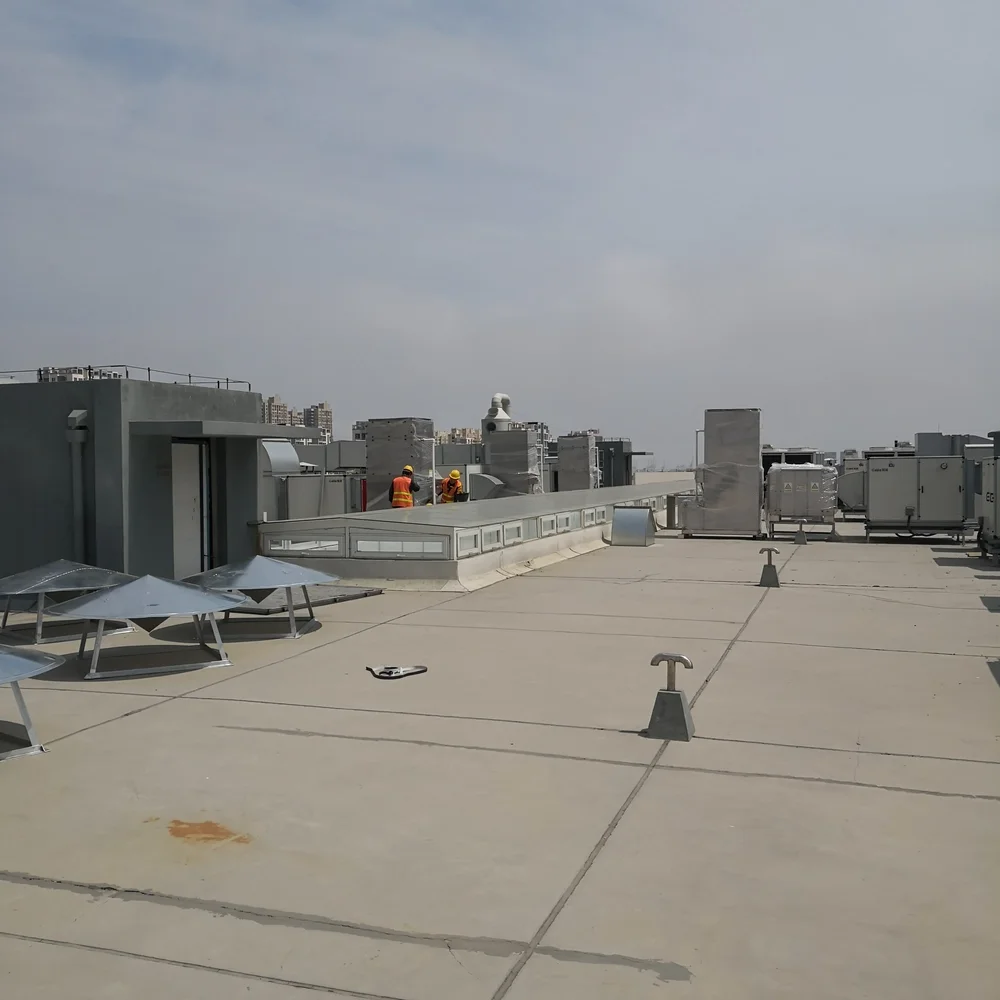
Before installing treatment hardware, establishing an accurate baseline prevents pre-existing background contamination from skewing your plant’s performance audits. Our field protocols focus on three core areas:
- Ambient Background Profiling: Measuring ambient concentrations of volatile organic compounds, acid gases, and particulate matter at plant boundary lines over consecutive 24-hour cycles.
- Effluent and Runoff Chemistry: Benchmarking incoming water streams, total dissolved solids (TDS), and pH levels. For heavy industrial installations, integrating targeted systems like our process for treatment and reuse of heavy metal-laden wastewater ensures the site handles contaminated discharge within local discharge limits.
- Meteorological Data Alignment: Recording local wind profiles, humidity, and barometric trends to ensure air pollution control and continuous emission monitoring systems deliver precise, normalized readouts from day one.
Core Industrial Emissions Treatment Systems
Meeting export compliance requires proven abatement hardware configured to pass strict destination-market emission audits. We engineer and deliver complete treatment packages designed to remove airborne toxins, neutralize liquid waste streams, and eliminate hazardous process byproducts at the source.
Air Pollution Control and Exhaust Gas Scrubbing
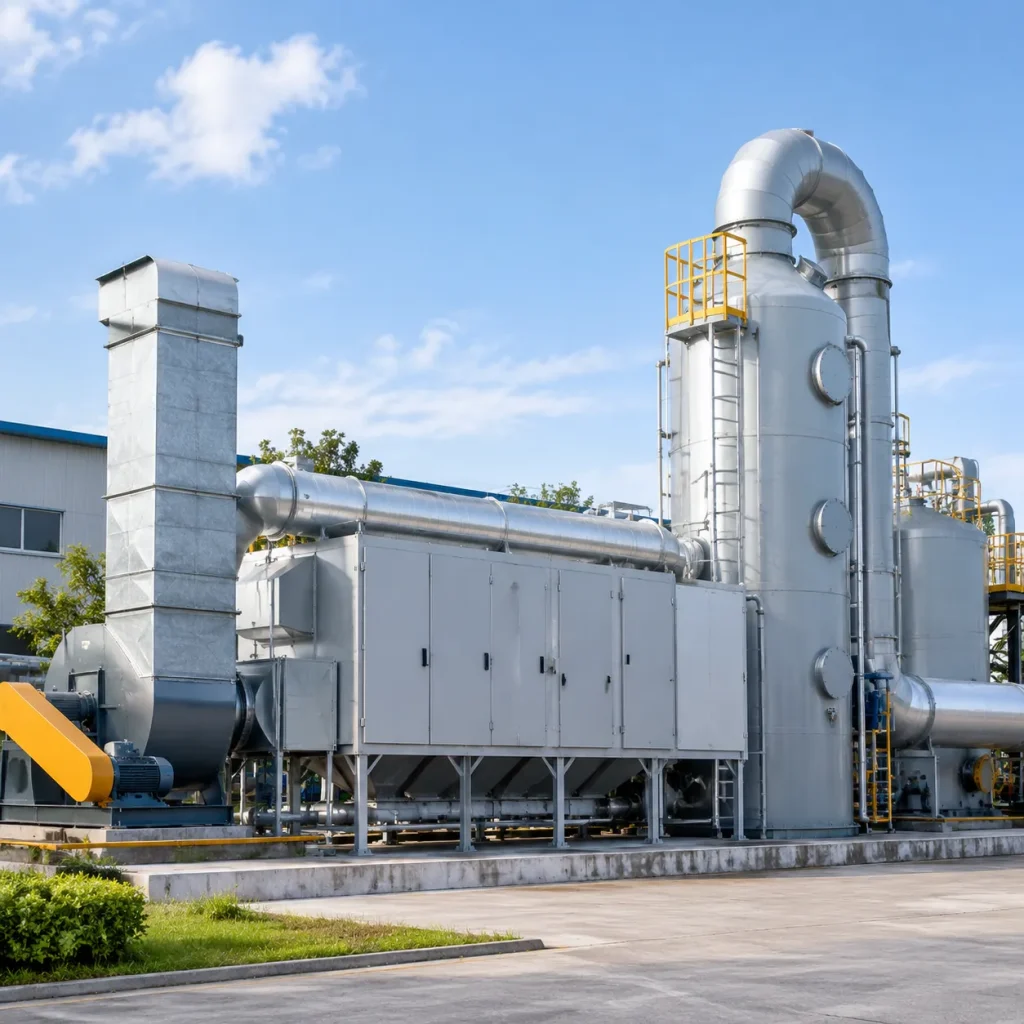
Controlling gaseous releases demands multi-stage capture matched to process chemistry and temperature. We build high-efficiency air pollution control systems that strip acid gases, capture heavy particulates, and destroy volatile organic compounds before exhaust reaches the stack.
- Particulate Filtration: Pulse-jet baghouses and cartridge collectors operating with high-efficiency membrane media to achieve sub-5 mg/Nm³ dust emissions.
- Acid Gas Scrubbers: Packed-bed wet scrubbers and dry sorbent injection setups utilizing chemical neutralization for sulfur dioxide, hydrogen chloride, and ammonia.
- VOC Abatement: Thermal and catalytic oxidizers delivering destruction efficiencies up to 99% for solvent-heavy industrial off-gases.
To align with international plant requirements, our engineering follows the practical guidelines detailed in our waste gas treatment industrial air pollution control guide, ensuring proper sizing, chemical compatibility, and reliable stack monitoring.
Industrial Wastewater and Zero Liquid Discharge (ZLD) Systems
Cross-border facility standards frequently penalize or ban raw liquid discharge. We implement closed-loop industrial wastewater treatment and ZLD systems that convert complex process effluents into reusable permeate and dry solid cake.
- Chemical Precipitation and Coagulation: Automated dosing skids that break emulsions, balance pH, and precipitate heavy metals. For specialized operations, our electroplating wastewater treatment solutions remove toxic metallic ions directly from continuous plating lines.
- Membrane Separation: Multi-pass reverse osmosis (RO) and ultrafiltration (UF) assemblies that recover up to 90% of process water for plant reuse.
- Thermal Evaporation and Crystallization: Mechanical vapor recompression (MVR) evaporators that isolate dissolved salts, preventing liquid runoff into municipal or natural water bodies.
Greenhouse Gas Reduction and Carbon Capture Solutions
Overseas buyers and environmental authorities increasingly require tangible carbon mitigation measures on heavy industrial installations. We deploy targeted decarbonization technologies to reduce direct emissions across thermal and chemical processes:
- Waste Heat Recovery (WHR): Capturing high-temperature flue gas thermal energy to preheat combustion air or generate plant steam, lowering fuel burn.
- Point-Source Carbon Capture: Modular absorption columns utilizing amine-based solvents to capture high-concentration CO2 streams for utilization or sequestration.
- Methane and Syngas Abatement: Enclosed flares and biogas upgrading scrubbers designed to convert fugitive fugitive greenhouse gases into stabilized, low-impact byproducts.
Industrial Emissions Compliance Checklist for Exporters
Executing an export project requires a structured framework to ensure treatment machinery satisfies both local site needs and destination-market import regulations. We use this four-phase checklist to eliminate compliance risks before equipment ships across borders.
Phase 1: Regulatory Mapping and Permitting
Before engineering begins, we align system parameters with the target jurisdiction’s legal thresholds:
- Identify Local Emission Caps: Document specific destination limits for total suspended particulates, volatile organic compounds (VOCs), sulfur dioxide, and nitrogen oxides.
- Baseline Permit Verification: Confirm cross-border environmental impact assessment approvals and verify plant operating consents against local air pollution control mandates.
- Standard Harmonization: Match destination codes (such as EU BAT/IED standards, US EPA standards, or regional clean air directives) with the facility’s design basis.
Phase 2: Treatment System Installation and Integration
Proper integration prevents mechanical mismatch and regulatory refusal during customs inspection and commissioning:
| Verification Focus | Key Engineering Criteria | Compliance Target |
|---|---|---|
| Electrical & Control | Voltage matching (e.g., 380V/50Hz vs. 480V/60Hz), PLC protocols, control panel enclosures | CE, UL 508A, or regional electrical codes |
| Explosion Safety | Flameless venting, antistatic filter media, spark detection, explosion isolation valves | ATEX Directive 2014/34/EU / NFPA 68, 69 |
| Effluent Balancing | Interfacing wet scrubbers with industrial drainage; adopting common treatment processes for pickling and phosphating wastewater where surface preparation exhaust generates acidic runoff | Local sewer discharge and environmental standards |
Phase 3: Operational Testing and Continuous Monitoring
Field verification proves whether operational equipment consistently delivers required capture and destruction efficiencies:
- Factory Acceptance Testing (FAT): Run dry tests, check weld integrity via non-destructive testing, and inspect structural paint thickness for marine transit protection.
- Site Acceptance Testing (SAT): Measure airflow velocities, pressure drops across filter media, and thermal oxidation recovery rates on-site.
- Stack Emission Monitoring: Calibrate continuous emission monitoring systems (CEMS) to verify that real-time particulate and gas concentrations remain below project guarantees.
Phase 4: Auditing and Certification
The final gate closes all documentation loops required by import authorities, border agencies, and plant environmental managers:
- Material Traceability: Assemble mill test reports for all pressure vessels, filter cages, and corrosion-resistant alloys.
- Third-Party EHS Auditing: Validate baseline safety records, emergency relief systems, and certified protocols for hazardous waste disposal and spent filter handling.
- Declaration of Conformity: Finalize technical construction files, bilingual operation and maintenance manuals, and official conformity certificates to secure final customs and plant handover sign-offs.
Carbon Footprint and ESG Compliance in Export Markets
Global trade regulations now demand complete accountability across environmental, social, and governance (ESG) criteria. Beyond checking stack discharge limits at the plant gate, cross-border buyers and regional regulators evaluate the total lifecycle carbon intensity of your production footprint. We integrate emissions management directly into broader decarbonization strategies, ensuring your operations remain compliant with cross-border trade mandates.
Quantifying Scope 1, 2, and 3 GHG Emissions
Accurate greenhouse gas accounting is the foundation of any defensible export compliance file. We map emissions directly across your operational boundaries:
- Scope 1 (Direct Emissions): Flue gas releases from boilers, furnaces, thermal oxidizers, and process vents. This also includes fugitive losses from chemical baths and secondary treatment stages, where installing targeted wastewater plant odor control equipment and processes prevents unmonitored atmospheric venting of volatile compounds.
- Scope 2 (Indirect Energy Emissions): The power consumed to run high-load air pollution control systems, heavy induction draft fans, pumps, and continuous heating systems. Selecting energy-efficient variable frequency drives (VFDs) and optimized duct layouts directly lowers this tier.
- Scope 3 (Supply Chain and Lifecycle Emissions): Upstream extraction of raw fabrication metals, consumable media usage (like lime, ammonia, or activated carbon), and downstream distribution channels.
| Emission Tier | Primary Plant Sources | Key Abatement and Control Focus |
|---|---|---|
| Scope 1 | Boilers, kilns, chemical exhaust vents | Burner tuning, thermal recovery, closed-loop scrubbers |
| Scope 2 | ID fans, blowers, compressor stations | High-efficiency IE4 motors, differential pressure automation |
| Scope 3 | Sorbent sourcing, sludge transport, logistics | Reagent dosing optimization, localized consumable supply chains |
Product Carbon Footprint (PCF) Reporting
Major trading hubs require cradle-to-gate transparency for industrial goods. The European Union’s Carbon Border Adjustment Mechanism (CBAM) and comparable global border tariffs penalize carbon-intensive imports that lack auditable lifecycle data.
To clear customs without delays or penalty surcharges, your Product Carbon Footprint (PCF) documentation must verify:
- Specific Embedded Emissions: Exact kilograms of CO2 equivalent per metric ton of finished output, supported by verified fuel and mass-balance logs.
- Process Verification: Validated uptime and destruction rates of air pollution control systems tied to production batches.
- Direct Stack Correlation: Continuous emission records matching the billing periods of manufactured export lots.
Meeting Import and Export ESG Standards
Securing long-term supply agreements with international EPCs and global conglomerates requires documented alignment with international reporting frameworks, including GRI, CDP, and ISO 14064 standards.
- Continuous Data Traceability: Maintain tamper-proof data acquisition systems that link stack monitors, scrubbers, and energy meters directly to the corporate ESG register.
- Third-Party Assurance: Ensure baseline emissions data undergo regular external technical audits to maintain verified compliance ratings for overseas stakeholders.
- Secondary Waste Controls: Document the proper neutralisation and zero-landfill diversion rates of collected dusts, spent reagents, and filter media to verify total environmental stewardship.
Monitoring, Auditing, and Documentation Management
Securing international regulatory approval demands verifiable proof that your treatment systems perform under daily operational conditions. An effective Industrial Emissions Treatment Compliance Checklist for Export Projects treats data logging and transparent reporting as critical engineering safeguards rather than administrative afterthoughts.
Real-Time Emission Tracking and Data Logging
Destination markets require continuous operational validation rather than occasional batch sampling. We design our monitoring infrastructure to deliver automated, tamper-proof logs directly to facility management systems.
- Stack Emission Monitoring: Integrated CEMS setups measure exhaust gas velocity, opacity, and temperature while tracking volatile organic compounds and acid gases in real time.
- Process Interlocks: Automated feedback loops trigger alerts or adjust abatement equipment operating parameters instantly if emission levels approach regulatory caps, similar to the precision controls implemented in our printing plant VOCs treatment solutions for emission control.
- Calibration Audits: Automated zero and span drift tests verify sensor reliability, maintaining defensible data records for regulatory review.
Third-Party Environmental Audits and Risk Assessment
Independent validation eliminates blind spots and provides the legal assurance required by foreign environmental agencies and project financiers.
- Standardized EHS Auditing: Third-party environmental inspectors evaluate equipment operating health, filtration integrity, and overall facility risk profiles.
- Secondary Waste Protocols: Auditing teams verify that secondary by-products—such as spent carbon media, filter cakes, and scrubber blowdown—meet hazardous waste disposal standards without creating secondary liabilities.
- Containment Verification: Assessors inspect secondary containment basins and emergency shutoff valves to ensure spill prevention control mechanisms comply with destination-port environmental directives.
Digital Record-Keeping for Export Clearances
Border clearance authorities, international EPC partners, and municipal regulators expect immediate access to historical operating data. We maintain centralized, digital documentation architectures that protect cross-border supply chains from costly regulatory hold-ups.
| Document Type | Verification Scope | Retention & Export Function |
|---|---|---|
| Emissions Run Logs | Continuous hourly concentrations of PM, VOCs, and flue gases | Verifies ongoing adherence to localized emission limit values (ELVs). |
| FAT & SAT Certificates | Factory dry-run testing and on-site commissioning sign-offs | Confirms equipment build quality and mechanical integrity at delivery. |
| Calibration Certificates | Third-party sensor validations and analyzer test reports | Substantiates the precision of reported environmental data during audits. |
| Maintenance Archives | Media replacement schedules, filter delta-P logs, and repairs | Demonstrates continuous upkeep to ensure operational longevity and safety. |
Selecting an Environmental Engineering and EPCM Partner
Choosing the right engineering, procurement, and construction management (EPCM) partner determines whether your facility passes border reviews or faces costly project delays. When executing an industrial emissions treatment compliance checklist for export projects, we look beyond standard manufacturing capabilities to verify cross-border engineering execution, jurisdictional know-how, and lifecycle accountability.
Evaluating Technical Expertise and Compliance History
We evaluate potential engineering partners against proven delivery records in heavily regulated target jurisdictions. A capable partner must demonstrate familiarity with destination-specific codes, ranging from regional air pollution control thresholds to international safety standards like ATEX and IECEx.
| Evaluation Metric | Key Verification Criteria | Risk Mitigation Impact |
|---|---|---|
| Regulatory Track Record | Prior approvals under EU IED, US EPA, or national standards | Prevents redesign delays at port of entry |
| Engineering Validation | Finite element analysis (FEA), CFD airflow modeling, P&ID sign-offs | Eliminates on-site mechanical and airflow failures |
| Fabrication Standards | ASME, PED, ISO 9001, and EN 1090 structural certifications | Assures structural integrity during transit and operation |
| Electrical Compatibility | Dual-frequency (50/60 Hz) motors, UL 508A, or CE control panels | Prevents site commissioning downtime |
When reviewing past performance, we focus on several vital criteria:
Audit Trail Integrity: Transparent testing documents, mill test reports, and non-destructive testing (NDT) logs.
Integrated Safety Systems: Built-in explosion venting, isolation valves, and grounding to handle combustible particulate loads.
Emissions Guarantees: Contractually binding outlet concentration limits, supported by factory acceptance testing (FAT) before shipment.
Industry-Specific Solutions for Energy, Chemical, and Manufacturing
Generic treatment equipment rarely satisfies strict export mandates. Different industrial sectors require purpose-built hardware tailored to their specific chemical footprints, moisture levels, and particulate loads:
- Energy & Power Generation: Heavy reliance on high-efficiency flue gas desulfurization modules, electrostatic precipitators, and continuous stack emission monitoring interfaces to control sulfur oxides, nitrogen oxides, and fly ash.
- Chemical Processing: Scrubbers designed for acid mist removal, integrated condensers for volatile organic compounds (VOCs), and emergency containment systems adhering to regional spill prevention control requirements. Specialized operations also deploy targeted methods for odor control in laboratory animal facilities and biomanufacturing spaces to handle localized, fugitive gaseous streams.
- Heavy Manufacturing: High-volume pulse-jet baghouses fitted with antistatic filter media, secondary HEPA polishers, and spark detection systems to satisfy cross-border combustible dust regulations.
Matching process chemistry with the appropriate metallurgy, filter fabrics, and digital controls ensures that every system performs reliably under local environmental and regulatory scrutiny.