Environmental protection equipment supplier

Laboratory Animal Facility Odor Control: Engineering Design Guide
Laboratory animal facility odor control is an exhaust engineering problem, not a deodorizer purchase. You keep a room acceptably fresh by capturing air where the smell is produced, moving enough of it, and treating that exhaust before it leaves the stack. Most rooms need 15 to 20 air changes per hour. Because ammonia drives most complaints, the scrubbing stage usually carries the load. Get capture and air change rate right, and a three-stage train will hold the room. Get them wrong, and no amount of carbon will save it.
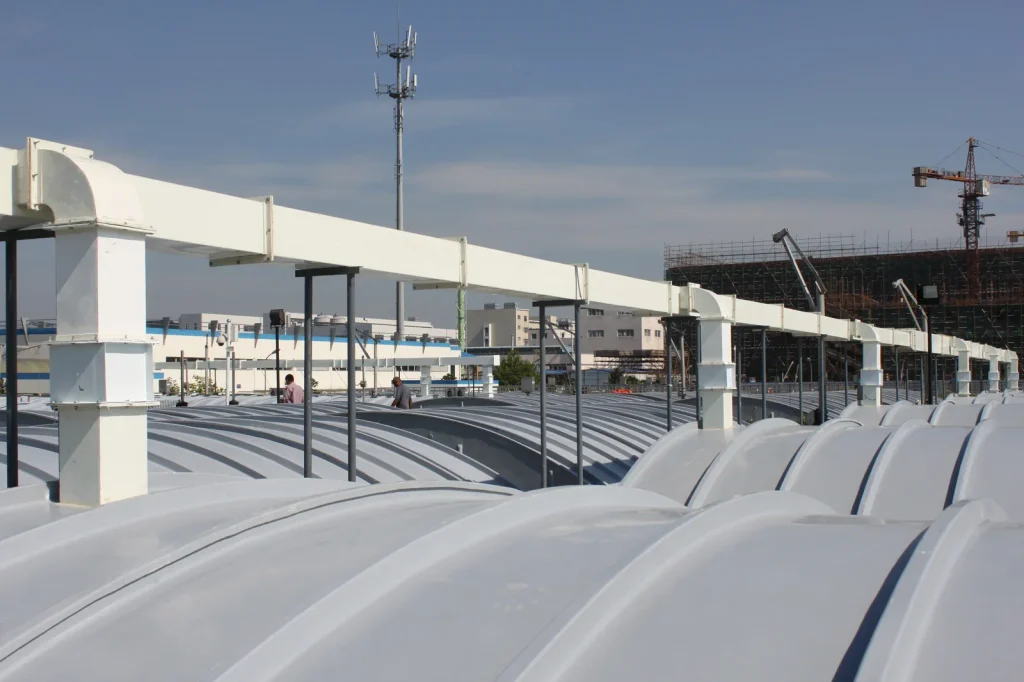
Most complaints we get called in for do not start with a missing treatment unit. They start with a room designed for animal holding and later filled with twice the cage density. Sometimes the carbon bed sits behind a spray scrubber that never ran. Occasionally the stack discharges two metres below an office window. In every case, the equipment is the last thing to fix.
This guide follows the order the decisions actually constrain each other. First, what is in the air. Then how much air you move, where you capture it, and what you do with it. The numbers come from published monitoring ranges and from our own projects. Treat them as starting points, then measure your own rooms before you buy equipment.
What is actually in animal room exhaust
Animal room air carries four classes of contaminant, and they behave differently enough that one technology rarely covers all of them. Ammonia drives most design decisions. Urine hydrolysis produces it continuously, so concentration climbs between cage changes. It is also the first thing staff and inspectors notice.
| Contaminant | Main source | Typical room concentration | What it does |
|---|---|---|---|
| Ammonia (NH3) | Urease hydrolysis of urine in soiled bedding | 5 to 50 ppm, depending on cage change interval and bedding type | Pungent and irritant to respiratory epithelium. It also corrodes copper and aluminium, and it poisons carbon capacity. |
| Hydrogen sulfide (H2S) and mercaptans | Fecal and bedding decomposition | Sub-ppm to low single digits | Detectable at very low concentration, so it contributes strong odor even when total load is small. |
| Volatile organics | Skatole, indole, volatile fatty acids, pheromones, cage sanitizer residue | Trace, highly variable | Persistent animal smell that lingers after ammonia has been controlled. |
| Bioaerosols and dander | Fur, skin flakes, bedding dust, aerosolized allergens | Varies with species and cage type | Occupational allergen risk. Dust also fouls UV lamps and blinds carbon beds. |
Ammonia values get quoted without context, so two caveats matter here. A 25 ppm ceiling is the figure most often written into facility SOPs, although many institutions target 10 to 15 ppm at cage level instead. Whatever ceiling your SOP states, size from the concentration at the cage exhaust rather than at the room return. That is the air you have to capture.
Three numbers that set the whole design
Three parameters fix the size, cost and pressure drop of every downstream stage. In laboratory animal facility odor control, choose them before you choose a technology.
Air changes per hour
Most rodent and rabbit rooms run 12 to 20 air changes per hour, while high density and infectious work push toward the top of that range. The figure is not a comfort setting. At 10 ACH, a densely caged room accumulates ammonia faster than staff can change bedding. At 25 ACH, you pay to heat, cool and dehumidify a large air volume for a small gain in odor.
| Room situation | Usual ACH | What it implies for the exhaust train |
|---|---|---|
| Low density holding, ventilated cages with individual exhaust | 10 to 15 | Smaller air volume, so carbon or UV polishing is often enough |
| Standard SPF barrier rodent rooms | 15 to 20 | Needs a full train: particulate pre-filter, ammonia scrubbing, polishing |
| High density breeding or infectious (ABSL-2) rooms | 18 to 25 | HEPA before odor treatment, larger ductwork, redundant fans |
| Large animal or primate rooms | 12 to 15, higher when heat load demands | Higher odor load per cubic metre, so scrubbing does most of the work |
Pick the rate from your SOP and your cage density, then check it against the room cooling load. When the two disagree, the load usually wins. The odor design then has to work with whatever air change rate you can afford.
Capture point
Air captured at the cage or rack leaves the room already concentrated, so you move and treat far less of it. Air captured at the room return is dilute, which means a bigger duct and a bigger carbon bed for the same mass of ammonia. We size most new systems at 30 to 40 percent rack-level exhaust and take the balance from the ceiling. That split is a compromise between capture efficiency and the cost of running ductwork to every rack. It is also the biggest cost lever in laboratory animal facility odor control.
Required removal efficiency
Work backwards from the stack. Suppose the room holds 20 ppm and the neighbours sit 15 m away. An 80 percent reduction still leaves 4 ppm at the stack, which is enough to be noticed on a still morning. That is why animal facilities usually state a target as stack concentration rather than percentage removal. It is also why the scrubbing stage carries the ammonia duty, while carbon polishes behind it.
A treatment train that works in sequence
Order matters more than the individual components. Carbon placed in front of a scrubber wastes capacity on ammonia it holds poorly. A UV lamp placed behind a dust-loaded pre-filter loses intensity within a month. So the train runs from dirtiest to cleanest.
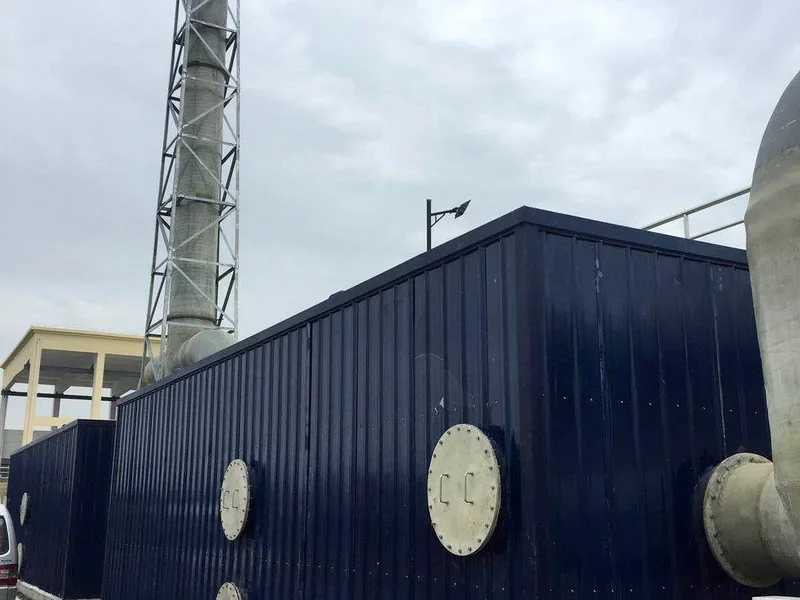
| Stage | Purpose | Typical equipment | Sizing note |
|---|---|---|---|
| 1. Particulate pre-filter | Remove dander, bedding dust and hair before they coat downstream media | Bag filter, or a baghouse dust collector for heavy dust loads | 150 to 250 Pa clean pressure drop. Change on differential pressure, not on a calendar. |
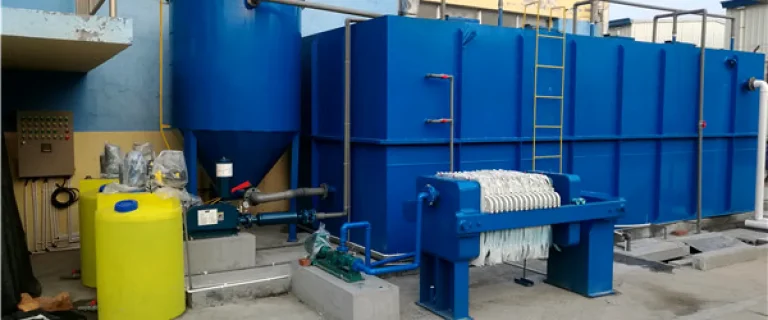
| 2. Ammonia scrubbing | Transfer ammonia into an acid solution | Packed wet scrubber with dilute sulfuric acid, pH held at 2 to 4 | Liquid-to-gas ratio 1.5 to 2.5 L/m³. pH control is the whole system. |
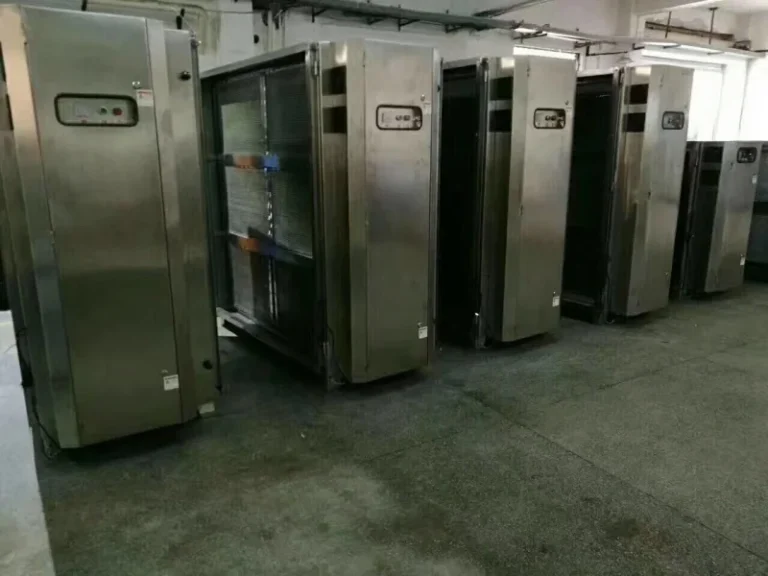
| 3. Oxidation | Break remaining odorants and reduce viable load | UV photolysis unit at 185 nm plus 254 nm | Needs clean, low-humidity air. Lamp output decays long before the lamp fails. |
| 4. Polishing | Catch what the first three stages miss | Activated carbon adsorber, impregnated grade when sulfur dominates | Empty bed contact time 0.5 to 2 s. Guard against ammonia slip from stage 2. |
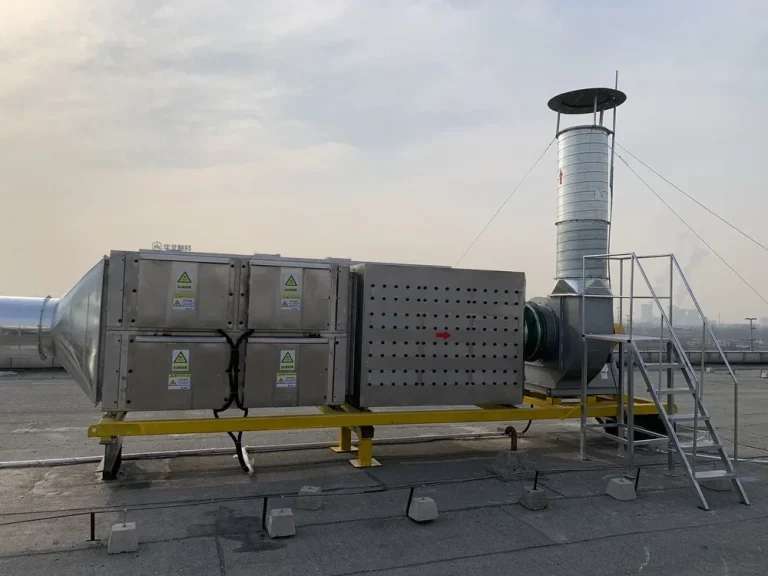
Not every facility needs all four stages. A small ventilated-cage room with low ammonia can run a pre-filter and a carbon polisher. A dense SPF room next to a residential block usually needs the full sequence, and the scrubber is the stage that decides whether complaints stop.
Worked example: sizing a 400 m² SPF rodent room
Given
The room measures 400 m² with a 2.6 m finished ceiling. It runs at 15 air changes per hour, and 40 percent of the exhaust is taken at rack level. The stack sits 12 m from a staff break room window.
Step 1: exhaust volume
400 × 2.6 gives 1,040 m³ of room volume. At 15 ACH that is 15,600 m³/h, or 4.33 m³/s. Add 10 percent for leakage and balancing, then round the fan duty to 17,000 m³/h.
Step 2: scrubber
At a liquid-to-gas ratio of 2 L per m³, recirculation comes to about 34 m³/h. A single-stage packed tower at 0.8 to 1.2 m/s lands at roughly 4.0 m² of cross-section, which is a 2.2 m diameter vessel. Acid consumption tracks ammonia mass load, so size the dosing pump from measured ppm rather than from airflow.
Step 3: carbon polisher
At 0.3 m/s face velocity the bed needs 14.4 m². With 0.6 m bed depth that is 8.6 m³ of carbon, or about 3.9 t at 450 kg/m³. Empty bed contact time works out at 2.0 s, which is generous but appropriate when the scrubber is the primary barrier.
What this example does not cover
Heat recovery, fan redundancy and the duct route fall outside this calculation. In retrofit projects those three items usually cost more than the treatment equipment itself, and none of them can be sized from a floor plan. Send us the layout and we will run the numbers against your actual cage count.
Materials and the ammonia corrosion trap
Ammonia plus condensate is aggressive, and it drives most of the materials decisions in laboratory animal facility odor control. We regularly find 304 stainless ductwork perforated at the first elbow within two years, in rooms running above 25 ppm. The fix is not a thicker gauge. It is a different alloy, or a different material class.
| Component | Common mistake | What we specify instead |
|---|---|---|
| Ductwork after the scrubber | Galvanised steel, which fails at seams and low points | 316L stainless, or FRP for larger rectangular runs |
| Scrubber shell and packing | Carbon steel with a thin coating | FRP shell with PP or PVDF packing, because pH 2 service punishes coatings |
| Fans and impellers | Aluminium impeller, attacked by ammonia | PP or FRP impeller, or 316L with a condensate drain |
| Carbon vessel | Mild steel with an internal lining that blisters | FRP vessel, or lined steel with a monitored lining |
| Instrumentation | Copper signal cable routed through the airstream | Shielded cable outside the duct, sensors on quick-release fittings |
Two details prevent most of the corrosion we see. Slope the duct back toward the scrubber, so condensate drains into the sump instead of pooling at a low point. Then fit a demister after the packing, so droplets do not carry downstream into the carbon bed.
Controls, monitoring and acceptance testing
A laboratory animal facility odor control train that cannot be verified will drift out of specification within a year. Three measurements are worth instrumenting from day one.
- Ammonia at the cage exhaust and at the stack. Continuous electrochemical sensors are inexpensive now. One stack sensor catches a failed scrubber before staff smell it.
- Differential pressure across the pre-filter and the carbon bed. Filter loading and bed channelling both show up here first.
- Scrubber pH and recirculation flow. A pH probe that has not been calibrated reads happy while the tower strips nothing.
Run acceptance testing with animals in the room, not in an empty building. Airflow balance in a vacant room says almost nothing about capture at a loaded rack. We test at design cage density. Ammonia gets measured at three rack positions and at the stack. Then we confirm the room holds under 5 Pa negative to the corridor while the door opens and closes.
If your facility is still at design stage, the guide to laboratory animal room waste gas treatment covers the wider layout. The laboratory animal industry page lists the configurations we build most often.
What actually drives operating cost
Fan power is the largest single line item in laboratory animal facility odor control, and it scales with the square of airflow. Every unnecessary air change is expensive. Behind the fan sit four consumables.
| Cost item | Typical replacement interval | What shortens it |
|---|---|---|
| Pre-filter bags | 3 to 6 months | High dander load, infrequent cage changes, dusty bedding |
| UV lamps | 8,000 to 10,000 hours, replaced on output not on failure | Dust on the sleeve, high humidity, lamps running below design temperature |
| Carbon media | 12 to 24 months | Ammonia slip from the scrubber, sulfur load, wet carryover from a failed demister |
| Scrubber acid and caustic | Continuous, tracks ammonia load | Poor pH control, over-dosing, sump purge frequency |
One pattern is worth flagging. Some facilities skip the scrubber and rely on carbon alone. They report changeouts every four to six months, because ammonia occupies acid sites long before the bed’s VOC capacity is used. Adding a scrubber usually pays back inside two years on media cost alone.
Laboratory animal facility odor control: seven failures we see on site
- Carbon bed bypassed at the vessel flange. Gaskets compress and flow takes the path of least resistance. Smoke-test the vessel after every media change.
- UV lamps counted, not measured. A lamp at 40 percent of its original output still looks lit. Check it annually with a UV-C radiometer.
- Scrubber pH drifting above 5. Ammonia absorption collapses, yet nothing else about the plant changes. This is the most common cause of a sudden complaint after months of quiet.
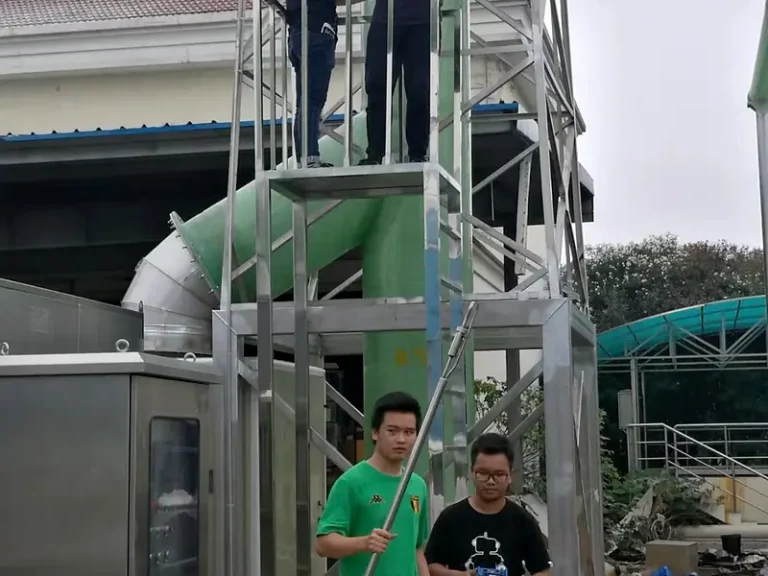
- Stack discharging into a recirculation zone. No treatment fixes a plume that comes back down the facade. Check stack height against the building wake before blaming the equipment.
- Rack exhaust dampers closed to save energy. Capture falls and room concentration rises, so the scrubber sees a weaker but larger air volume. Both effects hurt.
- Condensate trapped at a duct low point. Corrosion starts there, and the pinhole appears six months later above a clean corridor ceiling.
- Acceptance test run empty. The room passes at 3 ppm with no cages, then fails at 22 ppm in the first full week of operation.
Our notes on biotech animal facility odor control cover the routines that keep a train in specification. They show how these failures play out in a research setting. The equipment function breakdown explains what each stage does to the air.
When the room already exists
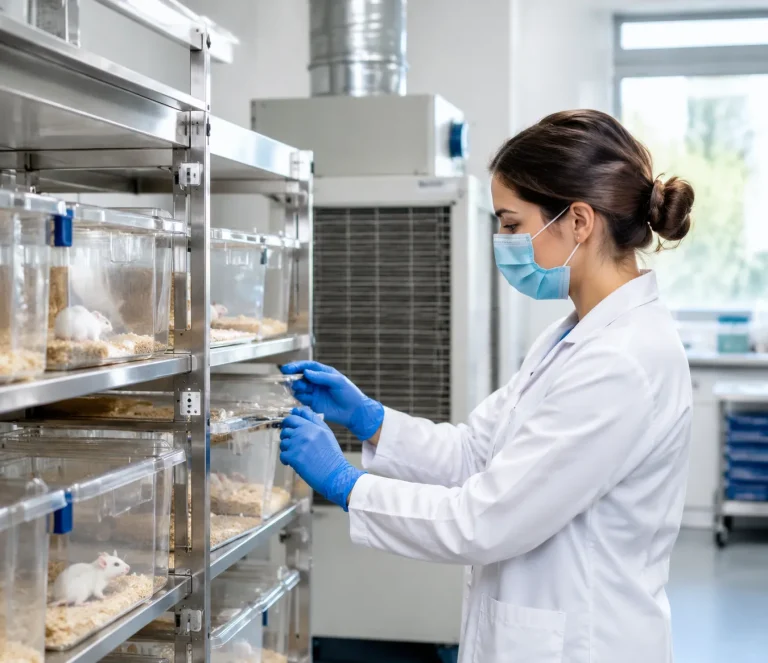
In laboratory animal facility odor control, retrofit work follows different logic. The ceiling void is fixed, the shaft is fixed, and the fan room usually has 200 mm of spare width. So we measure for two weeks first, then tighten capture at the racks before adding treatment capacity. Capture improvements cost less per ppm removed than any equipment bolted onto the roof.
Two recent projects show the range. A university SPF animal laboratory needed stack concentration down without extra plant room area, so the design went vertical, with a scrubber stacked above a compact carbon vessel. A vaccine manufacturer’s animal laboratory had the opposite constraint: roof space to spare but a strict validation protocol, so instrumented proof took priority over footprint.
Frequently asked questions
These are the questions that come up in most laboratory animal facility odor control sizing calls, grouped by what they affect.
Sizing and design questions
How many air changes per hour does an animal room need?
Most rodent and rabbit rooms run 12 to 20 air changes per hour. Standard SPF barrier rooms usually sit at 15 to 20, while high density breeding or ABSL-2 rooms go to 18 to 25. Below about 12 ACH, ammonia accumulates faster than bedding changes can remove it. Above 20, the extra heating and cooling cost rarely buys much odor improvement, unless infectious work or heat load forces it.
Can activated carbon alone handle ammonia in animal room exhaust?
It can, but it is an expensive way to do it. Ammonia occupies acid sites on the carbon, so the bed saturates long before its capacity for volatile organics is used. Changeouts then land at four to six months instead of twelve to twenty-four. A packed scrubber running dilute sulfuric acid at pH 2 to 4 removes the bulk of the ammonia, and the carbon behind it behaves as a polisher.
Is UV photolysis enough on its own?
Rarely on its own for high density rooms. UV at 185 nm and 254 nm breaks down many odorants and reduces viable counts, yet it handles ammonia poorly. Output also falls as dust coats the sleeve. In our projects UV sits third in the train, after particulate removal and scrubbing, so it polishes rather than carries the load.
What stack concentration should we design for?
Design to stack concentration, not to a removal percentage. For a facility with nearby occupied space, a workable target is under 1 ppm ammonia at the stack, with no perceptible odor at the boundary under still conditions. If the stack sits inside a building wake or near an air intake, raise or relocate it before you add treatment capacity.
Operation and maintenance questions
Can we recover heat from animal room exhaust?
Yes, with a caveat. Cross-contamination risk rules out most rotary wheels in animal facilities. Run-around coils and plate exchangers with a purge section are the usual choice, because they recover 40 to 60 percent of sensible heat without transferring air between streams. Put the recovery coil downstream of particulate filtration, so the fins stay clean.
How often should the carbon media be replaced?
Every 12 to 24 months when a scrubber handles the ammonia duty, and every 4 to 6 months when carbon is the only barrier. Replace on measurement rather than on a calendar. Sample the bed at the outlet face quarterly, then change it when breakthrough exceeds your stack target.
What to send us for a sizing proposal
For a laboratory animal facility odor control project, we can size the train from four inputs. Room dimensions and cage count come first. Then species and cage change interval, plus the air change rate your SOP requires. Finally, a site plan showing stack location against windows and air intakes. Add two weeks of ammonia readings if the room is already running. That is enough for a stage-by-stage design, a pressure budget and an operating cost estimate.
Planning an animal facility exhaust upgrade?
Send the room data and we will return a stage-by-stage sizing sheet, including scrubber duty, carbon bed volume and expected changeout interval for your ammonia load.
Request a sizing review See the animal room system